What Is Cap Rate? Definition & Meaning Explained
By Hami Tahm · Last reviewed September 2026 · 5 min read
Key Takeaways
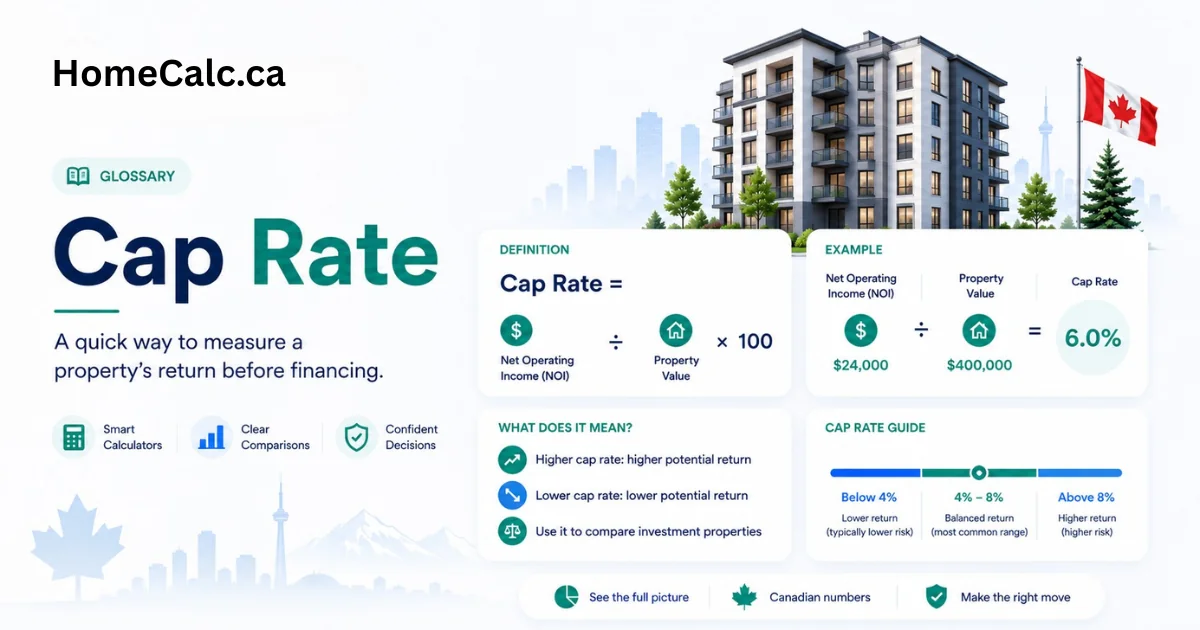
- Cap rate (capitalization rate) = NOI ÷ Property Value × 100 — the standard measure of a rental property's income return.
- A higher cap rate means higher income relative to price, but usually signals higher risk or a less competitive market.
- A lower cap rate (3–4%) is normal in Toronto and Vancouver — these are appreciation-driven markets, not yield-driven.
- Cap rate is set by the market through comparable sales — no authority or government body fixes it.
- Cap rate is pre-debt — it ignores mortgage costs and measures the property itself, not your financing.
What is cap rate in real estate?
Cap rate (capitalization rate) is the ratio of a rental property's annual Net Operating Income to its market value, expressed as a percentage. Formula: Cap Rate = NOI ÷ Property Value × 100. A 5% cap rate means the property generates 5 cents of net income for every dollar of value.
The Definition of Cap Rate
Cap rate (capitalization rate) is the ratio of a property's Net Operating Income (NOI) to its current market value, expressed as a percentage. Formula: Cap Rate = NOI ÷ Property Value × 100. It measures how much net income a property generates relative to its price, assuming no financing. A 5% cap rate means $5 of annual NOI per $100 of property value.
Cap Rate Formula
Cap Rate = NOI ÷ Property Value × 100
NOI (net operating income) is gross rental income minus vacancy and operating expenses — before mortgage payments. Net cap rate and cap rate mean the same thing — both use NOI, which is already net of operating expenses. A 5% cap rate means the property generates 5 cents of net income annually for every dollar of its value.
Cap rate is the ratio of a property's Net Operating Income to its current market value, expressed as a percentage.
What Does a High Cap Rate Mean?
A high cap rate means a property generates more income relative to its price. In Canada, cap rates above 6–7% typically indicate secondary markets, value-add assets, or higher-risk properties with elevated vacancy or deferred maintenance. High cap rates in major cities like Toronto or Vancouver are uncommon and often signal distress.
Calgary and Edmonton typically see 4.5–6.5% residential cap rates — strong income yields that reflect energy-sector market dynamics and lower asset prices relative to income, not distress. Above 7% in those markets, investigate quality of tenancy and vacancy. A very high cap rate (10%+) in any major Canadian city is a red flag — verify that the NOI is sustainable and investigate vacancy, deferred maintenance, or seller motivation before proceeding.
What Does a Low Cap Rate Mean?
A low cap rate means a property generates less income relative to its price. In Canada, residential cap rates of 3–4% are common in Toronto and Vancouver — markets where investors accept lower yields in exchange for high appreciation potential, strong liquidity, and demand-driven rent growth. Low cap rate does not mean bad investment.
A lower cap rate means you are paying more per dollar of income. In return, you typically get a more liquid market, higher-quality tenants, and stronger long-term appreciation. In Vancouver, some properties trade at 2–3% cap rates — investors accept minimal income yield in exchange for land value appreciation.
What Does a Specific Cap Rate Mean?
A 10% cap rate means a property generates 10% of its purchase price annually through net operating income. In Canada's major real estate markets, a 10% cap rate is extremely uncommon and is typically a distress signal — indicating high vacancy, significant deferred maintenance, an unsustainable rent roll, or a motivated seller. Always verify the NOI before acting.
| Cap Rate | What It Signals | Typical Canadian Markets |
|---|---|---|
| 2–3% | Trophy asset, minimal cash flow, land/appreciation play | Downtown Vancouver, Toronto core |
| 3–4% | Standard urban residential, low yield, strong demand | Toronto/GTA, Ottawa, Victoria |
| 4–5% | Balanced income and growth, healthy fundamentals | Montreal, Halifax, Gatineau |
| 5–7% | Strong yield, secondary city or value-add | Calgary, Edmonton, Winnipeg |
| 7–9% | High yield — investigate asset quality and vacancy | Smaller cities, rural, some distress |
| 10%+ | Distress signal in major markets — verify NOI before proceeding | Rare in urban Canada; red flag in Toronto/Vancouver |
Cap rate benchmarks shift with interest rate cycles. In a high-rate environment, investors demand higher cap rates — compressing property prices.
Calculate Cap Rate on Any Canadian Property
Use our free cap rate calculator — enter your property's income and value and get cap rate, reverse valuation, and cash-on-cash return instantly.
Who Determines Cap Rate?
Cap rates are determined by the market, not by any government body, regulator, or lender. When investors pay more per dollar of income for similar properties, cap rates compress. When demand falls or risk rises, cap rates expand. Comparable sales data is the primary input.
Cap rates are determined by the market through comparable sales — no authority sets them. As more investors pay higher prices for similar income, cap rates compress. When buyers retreat, cap rates expand.
Net Cap Rate & Cap Rate for REITs
Net cap rate and cap rate are the same metric — the "net" refers to the use of Net Operating Income in the calculation. Both figures are pre-debt and pre-tax.
REITs report a blended portfolio cap rate across all holdings. This figure is used to compare REIT valuations against bond yields — when bond yields rise, REIT cap rates typically rise in parallel, compressing REIT unit prices.
What Is a Good Cap Rate in Canada?
A good cap rate in Canada depends on the city and strategy. For income-focused investors, 5–6%+ in Calgary or Edmonton is strong. For appreciation-focused investors in Toronto or Vancouver, 3–4% is typical and acceptable. As a general rule, a cap rate above your mortgage rate indicates positive leverage — the property's income covers its debt cost. Below that rate, you are relying on appreciation.
A cap rate above your mortgage rate indicates positive leverage in Canadian real estate. Toronto and Vancouver residential cap rates typically range 3–4%. Use the cap rate calculator to compare your property's yield against these benchmarks with your own numbers.
Ready to Go Deeper?
Learn how to calculate cap rate step by step — with a full NOI breakdown, a complete Ontario worked example, and the reverse valuation formula.
▶ Related tools and guides
- Cap Rate Calculator— Calculate cap rate and reverse valuation for any Canadian rental property.
- How to Calculate Cap Rate— Step-by-step formula guide with a full Ontario worked example.
- Rental Property Mortgage Calculator— See monthly payment and total interest at any down payment and rate.