Is Your Mortgage or Rent Payment Actually Costing You More?
Is a mortgage payment more expensive than rent in Canada?
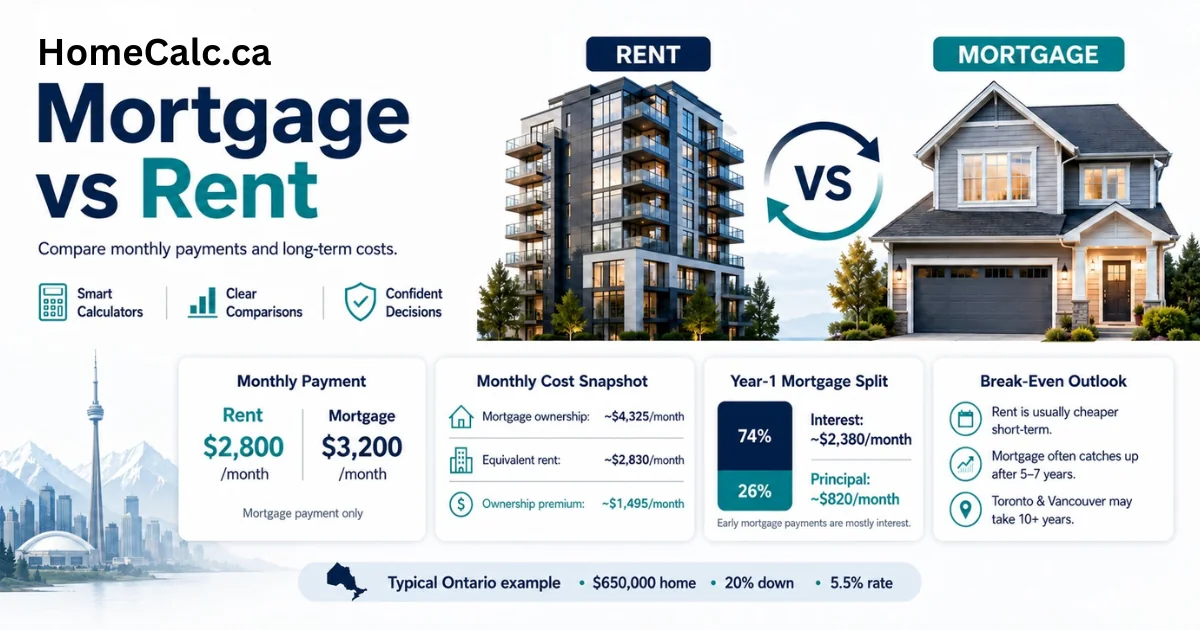
In Canada, a mortgage payment on a $650,000 home with 20% down at 5.5% over 25 years runs approximately $3,200/month — compared to roughly $2,800/month to rent an equivalent unit in Ontario. The mortgage costs more month-to-month, but about $820 of each early payment builds equity through principal paydown. Whether the mortgage is the better financial choice depends on how long you plan to stay (Bank of Canada, April 2026).
Key Takeaways
- A $650K mortgage at 5.5% typically costs about $400/month more than equivalent Ontario rent.
- In year 1, only about $820 of your monthly payment reduces the mortgage balance.
- Renting and investing the monthly savings can match buying over timelines under 5 years.
- Toronto and Vancouver price-to-rent ratios above 30 make the ownership premium especially steep.
- The mortgage becomes the stronger financial choice after 5-7 years at 3% appreciation.
Rent vs. Mortgage: A Direct Monthly Cost Comparison
A $650,000 home with 20% down at 5.5% over 25 years carries a monthly mortgage of approximately $3,200 — versus roughly $2,800/month to rent an equivalent unit in Ontario. Add property taxes (~$433), insurance (~$150), and maintenance (~$542), and total monthly ownership reaches ~$4,325. The mortgage alone costs $400/month more than renting, but ~$820 of each early payment builds equity rather than paying interest (Bank of Canada, April 2026).
These numbers answer the month-to-month question — but the month-to-month comparison misses the full picture. For a fuller breakdown of which path wins over time, see our complete renting vs. buying guide for Canada.
| Cost item | Mortgage (20% down, 5.5%) | Renting (equivalent unit) |
|---|---|---|
| Mortgage payment (P+I, 25yr) | ~$3,200/month | - |
| Property tax | ~$433/month (Ontario avg) | - |
| Home insurance | ~$150/month | ~$30/month (tenant insurance) |
| Maintenance (1% of value/yr) | ~$542/month | - |
| Rent payment | - | ~$2,800/month |
| TOTAL monthly cost | ~$4,325/month | ~$2,830/month |
| Monthly ownership premium | ~$1,495/month more than renting | - |
| Year-1 equity built (principal) | ~$820/month | - |
| Year-1 interest (sunk cost) | ~$2,380/month | - |
Source: Bank of Canada (bankofcanada.ca, April 2026); CMHC (cmhc-schl.gc.ca). Rate is illustrative - verify at bankofcanada.ca. CMHC insurance not applicable at 20% down.
A $650,000 home in Ontario with 20% down at 5.5% over 25 years carries a monthly mortgage payment of approximately $3,200 — roughly $400/month more than equivalent rent, before adding property taxes, insurance, or maintenance (Bank of Canada, April 2026). The gap is real, but it is not the same as $400/month thrown away — part of every mortgage payment is working for you. Use the rent vs. buy calculator to run these numbers against your actual home price and local rent.
The 5.5% rate in these examples is illustrative — verify before you act
Mortgage rates change. The 5.5% rate used throughout this article is an illustrative example for 2026 — your actual rate will depend on your lender, term length, insured vs. uninsured status, and market conditions at the time you apply. For the current Bank of Canada benchmark rate, check bankofcanada.ca. A 1% difference in your rate changes the monthly mortgage payment by approximately $300/month on a $520,000 mortgage over 25 years.
What You Build With a Mortgage vs. What Renting Builds
In year one of a $520,000 mortgage at 5.5%, roughly $2,380 of each monthly payment goes to interest — only $820 reduces the loan balance. Both interest and rent are gone once paid. The difference is that the $820/month in principal is forced savings you own, plus any appreciation gain. A renter who invests $820/month at 7% annual return builds approximately $57,700 over 5 years — a comparable wealth path.
In year one of a $520,000 mortgage at 5.5%, approximately $2,380 of each monthly payment goes to interest and only $820 reduces the mortgage balance through principal paydown. This split is not fixed — it improves every year as the balance shrinks.
Here is how the interest/principal split changes over a 25-year amortization on this mortgage:
- Year 1: ~$2,380 interest · ~$820 principal
- Year 10: ~$2,050 interest · ~$1,150 principal
- Year 20: ~$1,450 interest · ~$1,750 principal
Renters are not without a wealth-building path — they simply need to replicate it manually. A renter who invests the $130,000 down payment at 7% annual return holds approximately $182,000 after 5 years, without any debt or maintenance obligation. The honest framing is that the mortgage provides forced savings; renting requires deliberate savings. Neither path is inherently wasteful — both require a plan.
Most of your early mortgage payments go to your lender, not your equity
In the first few years of a mortgage, the interest-to-principal split is heavily weighted toward interest. On a $520,000 mortgage at 5.5%, you pay roughly $28,560 in interest in year one — and only $9,840 reduces the balance. Homeowners who feel they are "building wealth" with every payment are right, but only for ~$820/month of a $3,200 payment in year one. The proportion improves every year as the balance shrinks.
When a Mortgage Payment Beats Renting in Canada
A mortgage beats renting financially once you cross the break-even year — typically year 5–7 in most Canadian markets. At 3% annual appreciation, a $650,000 home gains roughly $97,500 in value over 5 years. Add approximately $52,000 in principal paydown, and total equity built reaches ~$149,500. A renter investing the $1,500/month ownership premium at 7% builds ~$107,000 over 5 years — so the buyer catches up around year 6 (Statistics Canada).
Long tenure (6+ years): At 3% annual appreciation, total equity from appreciation alone ($97,500 over 5 years) plus principal paydown ($52,000) reaches approximately $149,500. A renter investing the $1,500/month premium at 7% reaches roughly $107,000 in the same window. The buyer catches up around year 6, then pulls ahead.
Inflation hedge: A fixed mortgage payment of $3,200/month stays constant while Canadian rents increase 3-5% annually. Over 10 years, a renter's $2,800/month payment becomes approximately $3,800-$4,500/month, while the owner's principal payment stays locked. The monthly premium shrinks in real terms every year the buyer holds.
Leverage: With 20% down ($130,000), you control a $650,000 asset. At 3% appreciation, the home gains $19,500 in year one — a 15% return on the $130,000 invested. No investment account replicates this leverage profile without equivalent risk. For a precise monthly payment projection, use the mortgage payment calculator.
When the mortgage wins: a practical checklist
The mortgage beats renting when: (1) you plan to stay 6 or more years, (2) you pass the OSFI stress test at your contract rate plus 2% (OSFI B-20, 2024), (3) you have your down payment plus 2-4% for closing costs saved, and (4) your local market has a price-to-rent ratio under 25. If all four conditions are met, the math typically favours buying over a 6-plus-year horizon. If any are missing, run the rent vs. buy calculator first.
When Renting Is Cheaper Than Carrying a Mortgage
Renting is cheaper than carrying a mortgage when the ownership premium cannot be recovered within your planned timeline. A $650,000 Ontario home costs roughly $1,500/month more than renting an equivalent unit — $90,000 over 5 years before equity gains. When break-even falls outside your horizon, renting and investing the difference is the stronger financial choice. Toronto and Vancouver buyers face price-to-rent ratios above 30, pushing break-even past a decade.
Short timeline (under 4 years): Closing costs of $9,750-$26,000 on a $650,000 home need time to amortize. Sell before year 4 and transaction costs alone — real estate commissions, legal fees, land transfer tax — can erase any equity from appreciation.
High price-to-rent markets: Toronto and Vancouver buyers face mortgage carrying costs $1,000-$2,000/month higher than equivalent rent, pushing the financial break-even year beyond a decade in most scenarios. At a price-to-rent ratio above 30, renting is a rational long-term choice, not a failure to commit.
The "rent is waste" myth: On a $520,000 mortgage at 5.5%, year-one interest is approximately $28,560 — $2,380/month that builds no equity. Rent buys housing. So does mortgage interest. The difference is the forced savings component ($820/month), not the total payment. Framing the entire mortgage as wealth-building while calling rent "throwing money away" ignores $2,380 in monthly sunk costs on the buyer's side.
▶ See how your monthly payment compares over time
- Open rent vs. buy calculatorRun the full break-even math for your home price, mortgage rate, and local rent.
Frequently asked questions
Is it cheaper to rent or pay a mortgage in Canada in 2026?
Renting is cheaper month-to-month for most Canadians. A $650,000 home with 20% down at 5.5% carries a monthly mortgage of ~$3,200 — plus ~$1,125 for taxes, insurance, and maintenance — versus ~$2,800/month to rent an equivalent unit. That is roughly $1,500/month more to own. Over 6 or more years, equity and appreciation typically close and reverse that gap (Bank of Canada, April 2026).
What portion of a mortgage payment actually builds equity?
In the early years, most of each mortgage payment goes to interest, not equity. On a $520,000 mortgage at 5.5%, year-one monthly interest is approximately $2,380 and principal paydown is only ~$820. By year 10, the split improves to roughly $2,050 interest and $1,150 principal. Equity also builds through appreciation — at 3% annually, a $650,000 home gains ~$19,500 in value per year.
At what point does a mortgage become cheaper than renting in Canada?
A mortgage becomes cheaper than renting — in cumulative cost terms — once you cross the break-even year, which typically falls between year 5 and year 7 in most Canadian markets. Before that point, renting and investing the monthly cost difference is financially competitive. The exact break-even year depends on your home price, mortgage rate, local appreciation rate, and what equivalent rent costs in your market.
Is it better to rent and invest the difference than to buy a home?
For timelines under 5 years, renting and investing the ownership premium — roughly $1,500/month on a $650,000 Ontario home — often produces equal or greater net worth than buying. At 7% annual investment return, $1,500/month invested over 5 years grows to approximately $107,000. Over 10 or more years, homeowners typically pull ahead through equity, appreciation, and the leverage effect of a fixed mortgage against rising rent.
How do mortgage payments compare to rent in high-cost cities like Toronto or Vancouver?
In Toronto and Vancouver, the gap between mortgage carrying costs and rent is much larger than in mid-size Canadian cities. A $900,000 Toronto condo with 20% down at 5.5% carries a mortgage of ~$4,400/month — versus ~$3,200/month to rent a comparable unit. That $1,200/month premium, combined with a price-to-rent ratio above 30, means break-even often takes 10 or more years in these markets.
Sources
- Bank of Canada. Canadian Interest Rates and Monetary Policy Variables. bankofcanada.ca — Accessed April 2026.
- Canada Mortgage and Housing Corporation (CMHC). Mortgage Loan Insurance. cmhc-schl.gc.ca — Accessed April 2026.
- Office of the Superintendent of Financial Institutions (OSFI). Residential Mortgage Underwriting Practices and Procedures (B-20). osfi-bsif.gc.ca — Accessed April 2026.