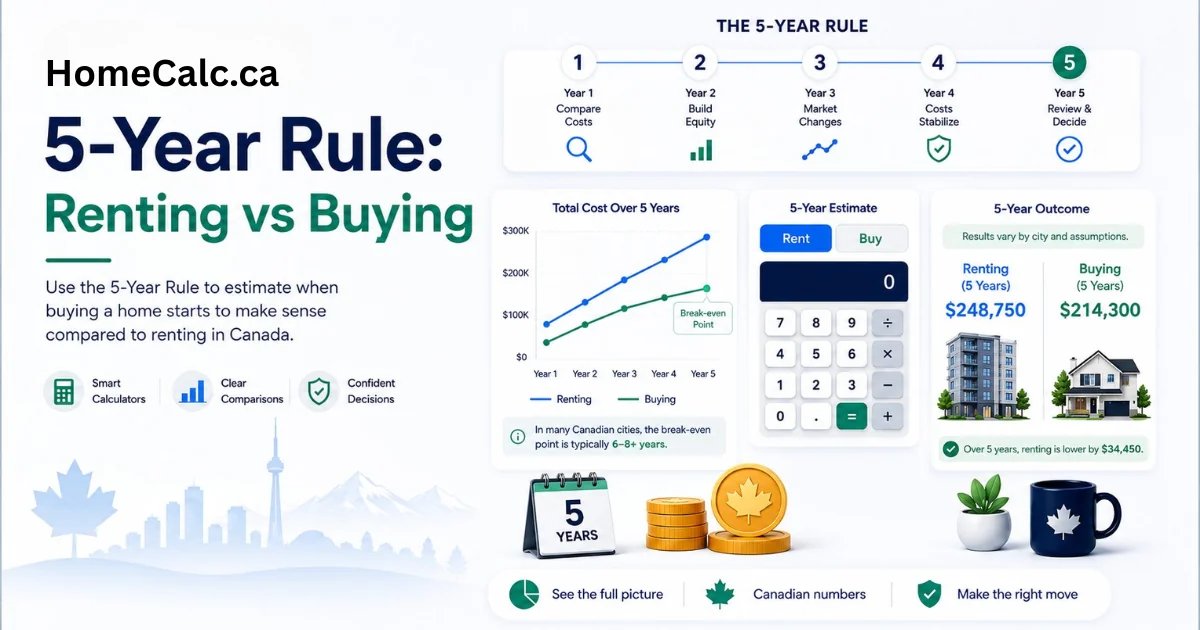
The 5-Year Rule: How Long You Must Stay in a Home Before Buying Beats Renting (Canada 2026)
By Hami Tahm · Last reviewed September 2026 · 6 min read
Two different rules — make sure you're reading the right one
This post is about the 5-YEAR rule — the minimum number of years you should plan to stay in a home before buying beats renting financially.
Looking for Ben Felix's 5% rule (annual unrecoverable-cost test for rent-vs-buy)? See our dedicated 5% rule explainer — or jump to the quick overview below.
★ The Short Answer
The "5-year rule" says buying a home only makes financial sense if you plan to stay for at least five years. In most Canadian cities in 2026, the real break-even is longer — 6–8 years nationally, and 10–14 years in Toronto and Vancouver.
But the 5-year rule is only a starting point. Your city, your down payment, current mortgage rates, and what you'd do with the money if you rented instead all change the math significantly.
Part of our complete rent vs. buy guide for Canada.
You've probably heard some version of the 5-year rule: 'Don't buy a home unless you plan to stay for at least five years.' It's one of the most widely repeated pieces of real estate advice in Canada — cited by mortgage brokers, financial planners, and personal finance writers alike.
But where does the 5-year rule come from? Is it still accurate in 2026 with Canada's current mortgage rates and home prices? And does it apply equally in Calgary and Toronto?
This post explains the math behind the 5-year rule, city-by-city break-even data for 2026, and the factors that can push your personal break-even point earlier or later than five years.
Jump to:
• What is the 5-year rule for renting vs. buying?
• Why transaction costs create the 5-year minimum
• City-by-city break-even: does the 5-year rule apply in Canada?
• What the 5% rule says (Ben Felix's framework)
• When does buying beat renting earlier than 5 years?
• When does buying take longer than 5 years to beat renting?
What Is the 5-Year Rule for Renting vs. Buying?
The 5-year rule is a simplified guideline that says: don't buy a home unless you plan to stay for at least five years, because it takes approximately five years for the financial benefits of homeownership (equity building, appreciation) to overcome the large upfront and exit costs of buying and selling.
The rule exists because buying and selling a home is extremely expensive on a per-transaction basis:
- • Buying costs: down payment, land transfer tax (0.5–2.0% of purchase price, doubled in Toronto), legal fees, home inspection, title insurance — typically 2–5% of the purchase price.
- • Selling costs: realtor commission (3–5% of sale price), legal fees, potential capital gains tax on investment properties. Typically another 4–6% of the purchase price.
Combined: on a $660,000 home, you might spend $40,000–$65,000 in pure transaction costs just to buy and then sell the property. You need enough appreciation and equity growth to exceed this before selling — and that typically takes 5–8 years in most Canadian markets.
Why Transaction Costs Create the 5-Year Minimum
Here's the math. On a $660,000 home in an average Canadian market (not Toronto):
| Transaction Cost | When Paid | Estimated Amount |
|---|---|---|
| Land transfer tax (Ontario, non-Toronto) | On purchase | $8,475 |
| Legal fees (purchase) | On purchase | $1,500–$2,000 |
| Home inspection | On purchase | $500–$700 |
| Title insurance | On purchase | $200–$400 |
| Total buying costs | — | ~$11,000–$12,000 |
| Realtor commission (4.5% of $660K) | On sale | $29,700 |
| Legal fees (sale) | On sale | $1,000–$1,500 |
| Total selling costs | — | ~$31,000–$32,000 |
| TOTAL transaction costs (buy + sell) | — | ~$42,000–$44,000 |
Key point: That $42,000–$44,000 in transaction costs is money you need to recover through equity building and home appreciation before selling. At 3% annual home appreciation on a $660,000 home, you gain $19,800 in value in year 1. It takes roughly 2–3 years just for appreciation to match buying costs — before you account for selling costs.
Add selling costs ($30,000+) and you're looking at $72,000+ in total transaction costs to break even. At 3% appreciation on a $660,000 home, that takes approximately 5–6 years. This is where the 5-year rule comes from.
City-by-City Break-Even: Does the 5-Year Rule Apply in Canada in 2026?
The 5-year rule is not universal. In high-cost cities with extreme price-to-rent ratios, the break-even point is much longer. In affordable cities, it can be shorter. For a full ranking of where buying wins soonest, see our guide to the best Canadian cities to buy vs. rent. Here's the 2026 picture across major Canadian markets:
| City | Avg. Price | P/R Ratio | Trans. Costs | Break-Even | Applies? | Assessment |
|---|---|---|---|---|---|---|
| Toronto | $1,120,000 | 35+ | $40,000+ | 11–14 years | ✗ Extended | 🔴 Very long horizon |
| Vancouver | $1,100,000 | 30+ | $38,000+ | 10–13 years | ✗ Extended | 🔴 Very long horizon |
| Ottawa | $640,000 | 22–25 | $22,000 | 8–10 years | ✗ Extended | 🟡 Long — stay committed |
| Calgary | $600,000 | 17–19 | $18,000 | 6–8 years | ✗ Extended | 🟡 Reasonable — plan to stay |
| Halifax | $500,000 | 15–17 | $15,000 | 5–7 years | ✓ Yes | 🟢 5-year rule applies |
| Edmonton | $420,000 | 15–18 | $13,000 | 4–6 years | ✓ Yes | 🟢 Under 5 years possible |
| Regina | $340,000 | 12–15 | $10,000 | 3–5 years | ✓ Yes | 🟢 Beats renting quickly |
Assumptions: 3.94% mortgage rate (March 19, 2026), 20% down, 25-year amortization, 3% annual appreciation, 2.5% annual rent increase, 4.5% selling costs. (Sources: CREA, Ratehub.ca, HouseIndex.ca, March 2026)
★ The Critical Insight: The 5-Year Rule Is a Floor, Not a Target
In Toronto and Vancouver, the traditional "5-year rule" is dangerously misleading. The actual break-even in these markets is 10–14 years — meaning buying for a 5-year stay in Toronto almost certainly results in a financial loss compared to renting and investing.
The 5-year rule was developed in US and lower-cost Canadian markets where price-to-rent ratios are 15–20. It does not translate to markets where ratios exceed 30–35.
Quick Primer: Ben Felix's 5% Rule (Different Concept)
The "5% rule" is a separate framework from the 5-year rule — it tests annual ownership costs as a percentage of home value, not how long you should stay. For a full explainer with Canadian examples, see our dedicated 5% rule section. Below is a quick overview.
Ben Felix, portfolio manager at PWL Capital and co-host of The Rational Reminder podcast, has popularized a more precise framework for the rent vs. buy decision: the 5% rule.
★ How the 5% Rule Works (Ben Felix / PWL Capital)
The 5% rule says: the annual unrecoverable cost of owning a home is approximately 5% of the home's value per year.
The 5% breaks down as:
• ~1% property tax
• ~1% maintenance costs
• ~3% cost of capital (the opportunity cost of the down payment + mortgage interest, minus equity building) — this is the hardest to calculate
Formula: Home price × 5% ÷ 12 = Monthly unrecoverable cost of owning
Applied to a $660,000 home:
$660,000 × 5% ÷ 12 = $2,750/month in unrecoverable costs
If you can rent a comparable home for less than $2,750/month: renting is financially smarter. If rent exceeds $2,750/month: buying may make sense.
As Ben Felix notes: "The 5% rule is an oversimplification" — but it's a useful quick test before running deeper numbers. (Source: Ben Le Fort / PWL Capital; nomoredebts.org, December 2025)
Applying the 5% rule to the Canadian markets above:
| City | Home Price | 5% Annual Cost | Monthly Threshold | Avg. Rent vs. Threshold |
|---|---|---|---|---|
| Toronto | $1,120,000 | $56,000/yr | $4,667/mo | Avg. rent $2,500 — renting wins clearly |
| Vancouver | $1,100,000 | $55,000/yr | $4,583/mo | Avg. rent $2,400 — renting wins clearly |
| Ottawa | $640,000 | $32,000/yr | $2,667/mo | Avg. rent $2,000 — borderline / close |
| Calgary | $600,000 | $30,000/yr | $2,500/mo | Avg. rent $1,900 — renting slightly favoured |
| Halifax | $500,000 | $25,000/yr | $2,083/mo | Avg. rent $1,700 — buying competitive |
| Edmonton | $420,000 | $21,000/yr | $1,750/mo | Avg. rent $1,600 — buying makes sense |
| Regina | $340,000 | $17,000/yr | $1,417/mo | Avg. rent $1,600 — buying wins monthly |
When Does Buying Beat Renting Earlier Than 5 Years?
In some circumstances, buying can make financial sense even for a stay shorter than 5 years. These are rare but real:
✓ Buying beats renting in under 5 years when:
• You're in Regina, Winnipeg, or a very low-cost market where the mortgage P+I is already lower than rent. In these markets, buying wins from month one on cash flow — though you still need 3–4 years to recover buying/selling costs.
• Home prices are appreciating significantly above 3%/year in your market. In a rising market (e.g., 6–8% appreciation), the break-even compresses. However: past appreciation is not guaranteed future appreciation.
• You negotiated a substantially below-market purchase price. An undervalued purchase reduces the time needed to recover transaction costs.
• You have a large down payment (30%+) that dramatically reduces monthly costs. Lower monthly payments shrink the gap between ownership costs and rent, accelerating the break-even.
When Does Buying Take Longer Than 5 Years to Beat Renting?
Most buyers in major Canadian cities will find the 5-year rule is optimistic rather than conservative. Buying takes significantly longer than 5 years to beat renting when:
✗ Buying takes 8–14+ years to beat renting when:
• You're in Toronto or Vancouver — price-to-rent ratios of 30–38 mean the monthly premium of ownership over renting is $1,500–$2,500. That cash flow disadvantage compounds against you for years before equity catches up.
• Your down payment is under 20% — CMHC insurance (2.8–4.0% of mortgage) adds to your balance immediately and delays the point when selling proceeds exceed total costs.
• Mortgage rates rise after you buy — if you're on a variable rate or renewing in 2026, a 1% rate increase on a $660K mortgage adds $6,600/year in extra interest that delays your break-even.
• Home appreciation is flat or negative — in markets where prices stagnate or fall (e.g., Toronto condos in 2025–2026), transaction costs may never be fully recovered.
calculate your personal break-even
is renting really wasting money
► Find Your Personal Break-Even Point
calculate your personal break-even — Enter your city, home price, and rent — see your break-even year in 60 seconds
full rent vs. buy guide — Read the full rent vs. buy guide for Canada 2026
is renting really wasting money — Is renting really wasting money? The math
full financial analysis — Full financial analysis: 20-year wealth comparison
Should I buy a house in Canada right now? — Where the 2026 market stands, city by city
rent-to-own vs. buying — If your timeline is under 5 years but you still want to lock in a price
Frequently Asked Questions
Disclaimer: This article is for informational and educational purposes only. Break-even calculations are estimates based on March 2026 market data and stated assumptions. Individual results will vary based on home price, mortgage rate, appreciation, and local costs. Always consult a licensed financial advisor before making real estate decisions.
Sources: Ratehub.ca (March 19, 2026) · HouseIndex.ca (January 2026) · WOWA.ca (March 2026) · CREA (January 2026) · BestRates.ca (March 2026) · PWL Capital / Ben Felix (2025) · Ben Le Fort / nomoredebts.org (December 2025) · Bank of Canada (March 18, 2026) · Ontario Ministry of Finance (2026)