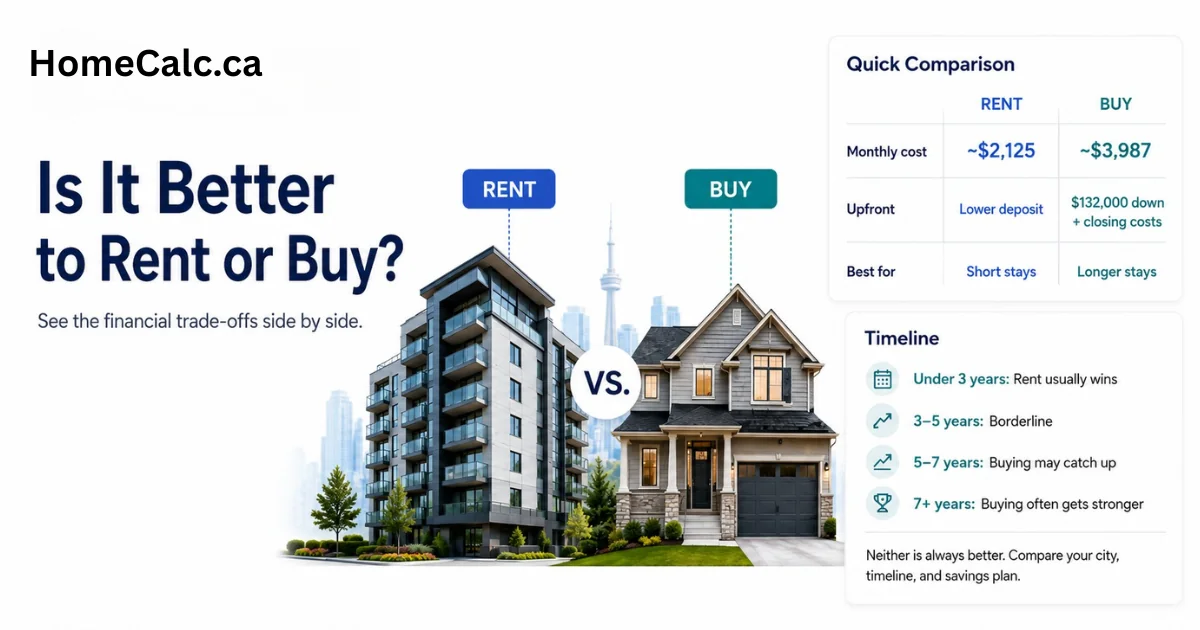
Is It Better to Rent or Buy? What Nobody Tells You
By Hami Tahm · Last reviewed September 2026 · 10 min read
★ The Short Answer
Neither is universally better. Renting is better for flexibility, low upfront cost, and short time horizons. Buying is better for long-term stability, equity building, and markets where the price-to-rent ratio is under 20.
The answer changes completely depending on: your city, how long you stay, your down payment, and one number most people never calculate — the opportunity cost of the money you lock up in a down payment.
Read on for the full picture — including the hidden costs both sides conveniently ignore.
📖 This page is a decision tool — not a market overview
This framework tells you whether renting or buying is right for your situation, based on three inputs: time horizon, down payment, and your city's price-to-rent ratio. For the national market analysis and comprehensive rent vs. buy math, see the complete rent vs. buy guide for Canada.
Should I Rent or Buy? The 3-Factor Decision Matrix
Your answer isn't a national average — it's the intersection of three personal variables. Find your row:
| Plan to stay | Down payment | City type (P/R ratio) | Verdict |
|---|---|---|---|
| Under 3 years | Any | Any | Rent — transaction costs alone destroy any buying advantage |
| 3–7 years | Under 10% | Over 25 (e.g. Ottawa, Calgary) | Rent — CMHC + high P/R: break-even rarely arrives |
| 3–7 years | 20%+ | 15–25 (e.g. Halifax, Edmonton) | Borderline — run the calculator for your numbers |
| 7+ years | 20%+ | Under 25 | Buy — equity + locked payment beats rising rent |
| 7+ years | Any | Over 30 (Toronto, Vancouver) | Rent — unless you'll invest the monthly gap consistently |
P/R = price-to-rent ratio (home price ÷ annual rent). Under 15: buying clearly wins. 15–20: competitive. Over 20: renting favoured. Over 30: renting strongly favoured. Use the rent vs. buy calculator for your specific city and numbers.
Jump to:
• Should I rent or buy? The 3-factor decision matrix
• The real math: rent vs. buy side by side
• The hidden costs of buying (that nobody talks about)
• The hidden costs of renting (that nobody talks about)
• The 3 things that determine which is better for you
• The "is renting throwing money away?" myth — debunked
The Real Math: Renting vs. Buying Side by Side
The most important thing to understand: a mortgage payment and rent are not the only costs. The real comparison is total cost of shelter — and on this measure, the gap between renting and buying is much smaller than most people think.
Here's a direct comparison using a typical Canadian scenario in March 2026:
| Buying a $660,000 Home | |
|---|---|
| Down payment (20%) | $132,000 out of pocket |
| Monthly mortgage (3.74%, 25yr) | $2,720/month |
| Property tax (1% avg.) | $550/month |
| Home insurance | $167/month |
| Maintenance (1% rule) | $550/month |
| TOTAL monthly cost (buying) | ~$3,987/month |
| Monthly rent (national avg.) | $2,100/month |
| Renters insurance | $25/month |
| TOTAL monthly cost (renting) | ~$2,125/month |
| Monthly gap (buying costs more) | ~$1,862/month |
At first glance, renting wins by nearly $1,900 a month. But this ignores two critical factors that buyers have and renters don't: equity building and home appreciation. That monthly "cost" of ownership includes a portion that becomes a financial asset — your equity. The real comparison is more nuanced.
★ The Equity Adjustment — What Makes Buying Competitive
On a $660,000 home with 20% down at 3.74% (25yr), in year 1:
• Monthly mortgage payment: $2,720
• Portion going to interest: ~$1,572
• Portion going to principal (equity): ~$1,148
So the true "cost" of the mortgage in year 1 is $1,572/month (interest only), not $2,720 — the rest builds equity. Add home appreciation of 3%/year ($1,650/month on a $660K home) and the owner is building ~$2,800/month in equity + appreciation — money a renter never accumulates.
The question is: does this offset the $1,862/month gap? The answer depends entirely on how long you stay and what you do with the money you save by renting.
What You Build With a Mortgage vs. What Renting Builds
In year one of a $520,000 mortgage at 5.5%, roughly $2,380 of each monthly payment goes to interest — only $820 reduces the loan balance. Both interest and rent are "gone" once paid. The difference is that the $820/month in principal is forced savings you own, plus any appreciation gain. A renter who invests $820/month at 7% annual return builds approximately $57,700 over 5 years — a comparable wealth path.
The interest-to-principal split is not fixed — it improves every year as the balance shrinks. Over a 25-year amortization on a $520K/5.5% mortgage:
- Year 1: ~$2,380 interest · ~$820 principal
- Year 10: ~$2,050 interest · ~$1,150 principal
- Year 20: ~$1,450 interest · ~$1,750 principal
Renters are not without a wealth-building path — they simply need to replicate it manually. A renter who invests the $130,000 down payment at 7% annual return holds approximately $182,000 after 5 years, without any debt or maintenance obligation. The honest framing is that the mortgage provides forced savings; renting requires deliberate savings. Neither path is inherently wasteful — both require a plan.
Most of your early mortgage payments go to your lender, not your equity
In the first few years of a mortgage, the interest-to-principal split is heavily weighted toward interest. On a $520,000 mortgage at 5.5%, you pay roughly $28,560 in interest in year one — and only $9,840 reduces the balance. Homeowners who feel they are "building wealth" with every payment are right, but only for ~$820/month of a $3,200 payment in year one. The proportion improves every year as the balance shrinks.
The Hidden Costs of Buying (That Nobody Talks About)
Homeownership advocates focus on the mortgage payment and equity. They rarely mention these:
1. Transaction Costs: The Money That Disappears Immediately
Buying and selling a home is expensive. These costs are paid in full upfront and never recovered:
- Land Transfer Tax: 0.5–2.0% of purchase price. In Toronto: double (provincial + municipal LTT). On a $660,000 Toronto purchase: up to $19,950 in LTT alone.
- Closing costs: Legal fees ($1,500–$2,500), home inspection ($400–$600), title insurance ($200–$400), mortgage appraisal ($300–$500). Total: $2,500–$4,000.
- Realtor commission when you sell: 3–5% of sale price. On a $660,000 home: $19,800–$33,000. This is often the biggest financial cost of homeownership that buyers never think about when buying.
Total transaction cost to buy and sell a $660,000 home: $42,000–$57,000 in Toronto. This money is gone — it earns no equity and builds no wealth. You need appreciation and equity to exceed this amount just to break even.
2. The Maintenance Reality Check
The 1% rule says homeowners should budget 1–2% of home value per year for maintenance. On a $660,000 home:
- Year 1–3: Minor expenses (paint, fixtures, appliance repairs): $3,000–$6,000/year
- Year 5–10: Major systems begin to need attention: HVAC ($5,000–$12,000), roof ($8,000–$20,000), windows ($5,000–$15,000), plumbing repairs
- Year 10–20: Kitchen/bathroom renovations if you want to maintain resale value: $20,000–$60,000
Over 10 years: $66,000–$132,000 in maintenance on a $660,000 home. This money is a pure cost — not an investment, not equity.
3. The Opportunity Cost of the Down Payment
This is the most important hidden cost — and the one that homeownership advocates never mention. Your $132,000 down payment isn't free. It's capital that could be invested.
$132,000 invested in a diversified index fund at the S&P/TSX 30-year average of 7% per year becomes $259,813 in 10 years. That's $127,813 in growth that renters can capture — and homeowners cannot, because their capital is locked in brick and mortar.
This doesn't mean renting automatically wins — it means the question is not "mortgage vs. rent" but "home appreciation vs. market returns." In cities where homes appreciate at 5%+/year, buying wins. In cities where appreciation is 2–3%, the market often wins.
The Hidden Costs of Renting (That Nobody Talks About)
Renting advocates focus on flexibility and avoiding maintenance. They rarely mention these:
1. Rent Increases Are Compounding and Relentless
Your mortgage payment (if fixed-rate) is locked in for the term. Your rent is not. In provinces without strong rent control — Alberta, Saskatchewan, Nova Scotia — landlords can increase rent to market rates between tenancies. Even in Ontario and BC, which have annual caps (2.5% in Ontario 2026, 2.3% in BC 2026), long-term renters face a compounding problem. Use our rent-increase guideline calculator to model your local rules — or the BC rent-increase calculator for British Columbia's RTB limit specifically:
- At 2.5% annual increase, $2,100/month becomes $2,686/month in 10 years
- At 3% annual increase, $2,100/month becomes $2,822/month in 10 years
- If you move to a new unit in a rent-decontrolled market, you face full market price resets
A fixed-rate mortgage, by contrast, has the same P+I payment from year 1 to year 25. This predictability has enormous long-term value that renters underestimate.
2. You're Building Someone Else's Equity
Yes, your rent is not 'thrown away' — you're paying for housing, a real service. But your landlord is using your rent payments to pay down their mortgage. Every $2,100 you pay in rent is $2,100 that doesn't build your net worth.
Over 10 years at $2,100/month (with 2.5% annual increases), you'll pay approximately $283,000 in rent. That money is gone. A homeowner, over that same period, will have paid roughly $330,000 in mortgage payments — but a meaningful portion of that returned as equity.
3. Renters Rarely Invest the Difference
The 'rent and invest the difference' strategy only works if you actually invest the difference. Most renters don't.
A 2023 Morningstar Canada study found that while renting is mathematically superior in many high-cost markets, renters who pocket the savings from renting over buying rarely invest the difference consistently. A mortgage acts as forced savings — it builds equity whether you're disciplined or not. Renters who lack investment discipline often end up with less wealth than homeowners over 20+ year periods, even in markets where the pure math favoured renting.
4. Security and Stability Risk
In Canada, landlords can end a tenancy for owner's own use, renovations ('renovictions'), or sale of the property. Even with provincial protections, renters face genuine displacement risk — especially in Ontario and BC where these notices are common. Being forced to move disrupts your life, exposes you to full market-rate rents in a new unit, and can make it harder to maintain school districts, community ties, and routines.
is renting really wasting money
The 3 Things That Actually Determine Which Is Better for You
Stop reading national averages. These three variables determine your personal answer.
🔑 Variable 1: How Long You Plan to Stay
Under 3 years: Renting almost always wins. Transaction costs alone destroy any financial advantage from buying.
3–5 years: Borderline. Depends on your market's appreciation rate.
5–7 years: Most markets start favouring buying. Equity catches up to rent savings.
7+ years: Buying is financially competitive or superior in most Canadian markets.
10+ years: Buying wins in virtually every Canadian market except extreme P/R ratios.
Source: BestRates.ca rent vs. buy analysis, 2026; HomeCalc calculator data
See the 5-year rule for the full breakdown of why this timeline threshold matters more than almost any other input.
🔑 Variable 2: Your City's Price-to-Rent Ratio
Formula: Home price ÷ (monthly rent × 12)
Toronto: $1,120,000 ÷ ($2,500 × 12) = 37.3 → Renting strongly favoured
Vancouver: $1,100,000 ÷ ($2,400 × 12) = 38.2 → Renting strongly favoured
Ottawa: $640,000 ÷ ($2,000 × 12) = 26.7 → Renting slightly favoured
Calgary: $600,000 ÷ ($1,900 × 12) = 26.3 → Borderline / balanced
Halifax: $500,000 ÷ ($1,700 × 12) = 24.5 → Borderline / balanced
Edmonton: $420,000 ÷ ($1,600 × 12) = 21.9 → Buying starts to make sense
Regina: $340,000 ÷ ($1,350 × 12) = 21.0 → Buying makes sense
Under 15: Buying clearly wins | 15–20: Competitive | Over 20: Renting favoured
Note: March 2026 prices and rents. Ratios shift with market conditions.
For the full city-by-city breakdown, see best cities to buy vs. rent in Canada.
🔑 Variable 3: What You Do With the Money You Don't Spend
This is the wildcard that changes everything.
If you rent and INVEST the difference (down payment + monthly savings):
→ Renting is financially competitive or superior in most markets
→ Especially true in Toronto and Vancouver where the monthly gap is $1,500–$2,000+
If you rent and SPEND the difference (lifestyle inflation, consumption):
→ Buying is almost always the better long-term wealth-building strategy
→ A mortgage is forced savings. Most renters don't replicate this discipline.
Honest assessment: Research consistently shows most renters do NOT systematically invest the difference. If that's you, buying may build more wealth over 20+ years — even in high-cost markets.
The "Is Renting Throwing Money Away?" Myth — Debunked
"Renting is throwing money away" is one of the most repeated — and most misleading — pieces of financial advice in Canada. Here's why it's wrong. And here's why it's not entirely wrong either.
Why "throwing money away" is wrong
Rent is not wasted — it's payment for housing, a service. A renter gets: a place to live, zero maintenance responsibility, flexibility to move, no exposure to market downturns, and preserved capital that can be invested.
Homeowners also 'throw away' money: mortgage interest (in year 1, roughly 58% of each payment is interest), property taxes (100% sunk cost), home insurance (100% sunk cost), maintenance (100% sunk cost), land transfer taxes (100% sunk cost), realtor commissions (100% sunk cost). On a $660,000 home, a homeowner 'throws away' approximately $42,000–$60,000 in pure costs in the first three years alone.
Why it's not entirely wrong
The grain of truth: a mortgage is forced savings. Every payment builds equity in an asset that has historically appreciated. Most renters, despite the mathematical advantage of renting in high-cost markets, end up with less wealth at retirement than homeowners — because they don't invest the difference.
The Morningstar Canada analysis is clear: in pure financial logic, renting often wins in Toronto and Vancouver. But 'behaviorally,' buying wins — because it imposes savings discipline that most people lack on their own.
is renting really wasting money
Who Renting Is Better For — Right Now in Canada
Renting is the financially smarter choice in March 2026 if you fit this profile:
✓ Renting is better for you if:
• You're in Toronto or Vancouver — price-to-rent ratios exceed 35, meaning you'd pay 35 years of rent to buy the property. The financial math strongly favours renting.
• You plan to move within 5 years — transaction costs alone (LTT + closing + realtor commission) will wipe out any equity or appreciation gains on a short timeline.
• Your income is variable or uncertain — a 25-year mortgage with no flexibility is dangerous if your income can fluctuate by 30%+ in a bad year.
• You don't have 20% down saved yet — CMHC insurance (2.8–4.0% added to your mortgage) and the lack of equity buffer make buying with less than 10% down a significant financial risk in a flat or declining market.
• You're in a career transition or expecting a major life change — new city, new relationship, growing family. Flexibility has real financial value that doesn't show up in any calculator.
• You will actually invest the difference — if you have the discipline to invest the down payment and monthly savings from renting, the math often favours you.
Who Buying Is Better For — Right Now in Canada
Buying is the better choice in March 2026 if you fit this profile:
✓ Buying is better for you if:
• You're in Calgary, Edmonton, Halifax, Regina, or a mid-sized Canadian city — price-to-rent ratios of 15–22 make buying financially competitive even at current rates. Break-even arrives in 5–7 years.
• You plan to stay 7+ years — the break-even point in most Canadian markets is 5–8 years. Long-term buyers capture the full compounding of equity and appreciation while their fixed-rate mortgage stays flat as rent keeps rising.
• You have 20% down and an emergency fund — you avoid CMHC insurance, you start with real equity, and you have a buffer for the maintenance costs that hit every homeowner eventually.
• Your income is stable — fixed mortgage payments are manageable when income is predictable. Two-income households with secure employment are the ideal profile for 2026 buying.
• You value stability and permanence — the ability to renovate, put down roots, and never worry about a landlord ending your tenancy has genuine value beyond the financial math. If this matters to you, it's a valid reason to buy.
• You won't invest the difference if you rent — if you're honest with yourself that the down payment would sit in a savings account earning 3%, a mortgage might be the better forced-savings vehicle over a 20-year horizon.
The Leverage Effect — Why Buying Compounds Faster Once You're In
With 20% down ($130,000), you control a $650,000 asset. At 3% appreciation, the home gains $19,500 in year one — a 15% return on the $130,000 invested. No investment account replicates this leverage profile without equivalent risk. A renter investing the same $130,000 at 7% would gain ~$9,100 in year one — meaningful, but not leveraged.
Inflation hedge: A fixed mortgage payment of $3,200/month stays constant while Canadian rents increase 3–5% annually. Over 10 years, a renter's $2,800/month payment becomes approximately $3,800–$4,500/month, while the owner's principal payment stays locked. The monthly premium shrinks in real terms every year the buyer holds.
For a precise monthly payment projection at your contract rate, use the mortgage payment calculator.
► See Which Is Better for Your Specific Numbers
use our free rent vs. buy calculator — enter your city, rent, and home price
is renting really wasting money
rent-to-own vs. buying — a middle path if neither renting nor buying outright fits your timeline
3 Real Scenarios: What Would You Do?
Three common profiles mapped to the decision matrix above. If one sounds like you, start there — then run your numbers in the calculator.
Scenario 1: Toronto couple, relocating in 2 years — RENT
Profile: Alex and Sam, both 29, combined income $145,000, renting a 2-bedroom in Leslieville at $2,650/month. Sam's employer may transfer them to Montreal in 18–24 months.
Matrix row: Under 3 years · Any down payment · Toronto P/R 37+
Why rent: LTT alone on a $900,000 condo would cost ~$14,000 upfront. Realtor commission on exit (~$27,000) plus closing costs means they need 3+ years of appreciation just to recover transaction friction — and they may not have 3 years. Their $55,000 savings stays liquid for the move and FHSA contributions.
Verdict: Rent. Stack savings in FHSA/RRSP; revisit buying when the timeline is 7+ years and the city is settled.
Scenario 2: Halifax dual-income family, 10-year stay — BUY
Profile: Priya (nurse) and James (teacher), ages 36 and 38, household income $128,000, $105,000 saved (20% on a $525,000 semi-detached). Kids in local schools; no planned relocation.
Matrix row: 7+ years · 20% down · Halifax P/R ~24.5
Why buy: No CMHC premium. Monthly ownership ~$3,100 vs. rent ~$1,850 — a $1,250 gap, but ~$900/month goes to principal in year one. Break-even estimated at 6–7 years; they plan 10+. Fixed mortgage payment beats rising rent over the decade.
Verdict: Buy. Run the rent vs. buy calculator with Halifax inputs to confirm break-even year.
Scenario 3: Ottawa contractor, 5% down, 5-year horizon — RENT (for now)
Profile: Jordan, 32, federal IT contractor ($92,000), $38,000 saved (5% on a $640,000 townhouse). Contract may renew or shift to hybrid in another city within 5 years.
Matrix row: 3–7 years · Under 10% down · Ottawa P/R ~26.7
Why rent (for now): CMHC adds ~$24,000 to the mortgage at 5% down. High P/R + uncertain timeline means break-even likely arrives after year 8 — past Jordan's planning window. Renting at $2,100/month preserves mobility and keeps the down payment invested until the timeline clears 7 years.
Verdict: Rent for now. Target 10%+ down and a 7-year stay before buying; use the down payment calculator to model CMHC tiers.
Frequently Asked Questions
Disclaimer: This article is for informational and educational purposes only. It does not constitute financial, mortgage, or legal advice. Market data is as of March 19, 2026. Always consult a licensed mortgage professional or financial advisor before making real estate decisions.
Sources: Morningstar Canada · CMHC Housing Market Outlook (2026) · CREA (January 2026) · BestRates.ca (March 2026) · WOWA.ca (March 2026) · Bank of Canada (March 18, 2026) · RE/MAX Canada · CPA Canada · HouseIndex.ca