Renting vs. Buying a Home in Canada: Which Is Right for You?
Is it better to rent or buy a home in Canada?
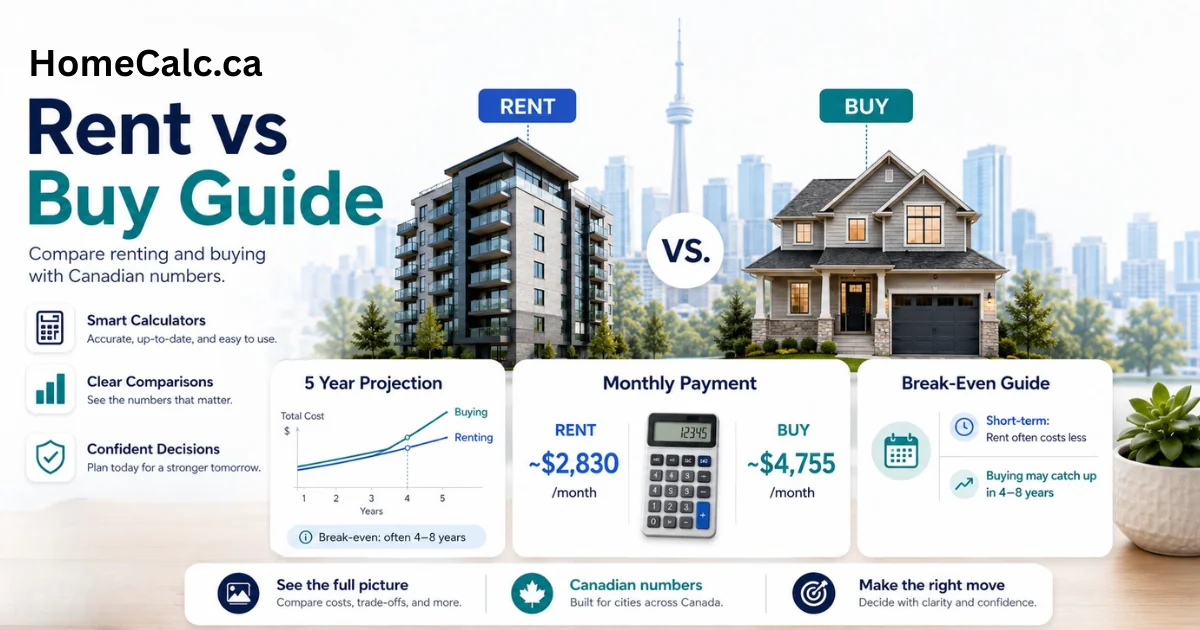
Renting versus buying a home in Canada comes down to your break-even year. For a typical $650,000 home, that often lands around year 6 depending on appreciation, rates, and rent growth.
Key Takeaways
- Your break-even year matters more than your headline mortgage rate.
- Most Canadian buyers need 4-8 years for buying to beat renting financially.
- CMHC and stress-test rules can materially change affordability outcomes.
- Closing costs and maintenance are commonly underestimated by first-time buyers.
- Use your own numbers with a calculator before committing to either path.
Want a faster decision before reading the full breakdown? See our quick rent-vs-buy decision framework — eight questions that get most Canadians to a clear answer in five minutes.
The True Cost of Renting vs. Buying a Home
The true cost depends on your monthly ownership premium, down payment opportunity cost, and local appreciation rate.
For a focused decision framework, see Is It Better to Rent or Buy?.
| Cost item | Renting (monthly) | Buying (monthly) |
|---|---|---|
| Mortgage payment (P+I) | - | ~$3,630 |
| Property tax | - | ~$433 |
| Home insurance | ~$0 | ~$150 |
| Maintenance (1%/yr) | - | ~$542 |
| Rent payment | ~$2,800 | - |
| Tenant insurance | ~$30 | - |
What is the break-even year?
It is the year when total ownership costs equal total renting costs plus forgone investment returns.
These numbers shift dramatically by city. In Regina and Winnipeg, monthly mortgage payments are already cheaper than rent, while in Toronto and Vancouver the ownership premium exceeds $2,400/month. See our ranking of 15 Canadian cities by price-to-rent ratio for city-specific break-even data.
You may have heard the argument that renting is "throwing money away." We unpack the math behind that claim — and why it's mostly a myth — in our deep dive on whether renting is really throwing money away.
What 2026 CMHC and OSFI Rules Mean for Your Decision
CMHC insurability and OSFI stress-test requirements can directly change your rent-vs-buy outcome.
First-time buyers have additional levers: FHSA contribution room, the Bill C-4 GST exemption (March 2026), and 30-year amortizations on insured mortgages since December 2024. We cover all of these in our first-time buyer rent vs. buy guide for 2026.
If you can't currently pass the stress test or aren't ready for a full purchase, a rent-to-own arrangement can bridge the gap — but the math is tricky and not every program is worth signing. We compare the trade-offs in our rent-to-own vs. buying breakdown.
Verify current rules before acting
Check official CMHC, OSFI, and Bank of Canada updates before final decisions.
When Buying a Home Wins Financially
Buying generally wins with longer timelines, stable cash flow, and realistic assumptions for maintenance and transaction costs. Whether 2026 specifically is the right year for you depends on current rates, your local market, and your timeline — see our honest answer to "should I buy a house in 2026?" for the year-specific analysis.
The classic test for "long enough to make buying worth it" is the 5-year rule — buying only makes financial sense if you stay at least five years to recover transaction costs. We explain the math, where the rule actually breaks down in 2026, and why some Canadian markets need 8–14 years instead of five in our deep dive on the 5-year rule.
Buying checklist
Target 6+ years, pass the stress test, and keep emergency reserves after closing.
▶ Calculate your own break-even year
- Open rent vs. buy calculatorEnter your home price, mortgage rate, and monthly rent to estimate break-even.
Frequently asked questions
Is it cheaper to rent or buy a home in Canada in 2026?
In most Canadian markets, renting is cheaper month-to-month in the short term. For a $650,000 Ontario home, buying costs roughly $1,955/month more than renting an equivalent property in year one. But over 6 or more years, equity buildup and appreciation typically close that gap.
What is the break-even point between renting and buying in Canada?
The break-even point is the year when cumulative ownership costs equal cumulative renting costs plus the investment returns you could have earned on your down payment. In Canadian cities, this typically falls between 4 and 8 years.
How long do you need to stay in a home before buying makes financial sense?
Plan to stay a minimum of 4 years before buying becomes competitive with renting, and ideally 6 or more years to recover closing costs and build meaningful equity.
What hidden costs should I factor in when deciding to rent or buy?
For buying: CMHC insurance premium, land transfer tax, legal fees, inspection, title insurance, and annual maintenance. For renting: tenant insurance and non-included utilities.
Does renting vs. buying make more sense in expensive cities like Toronto or Vancouver?
In Toronto and Vancouver, high price-to-rent ratios make renting competitive for longer. Buyers in these markets often need longer ownership timelines before buying clearly wins.