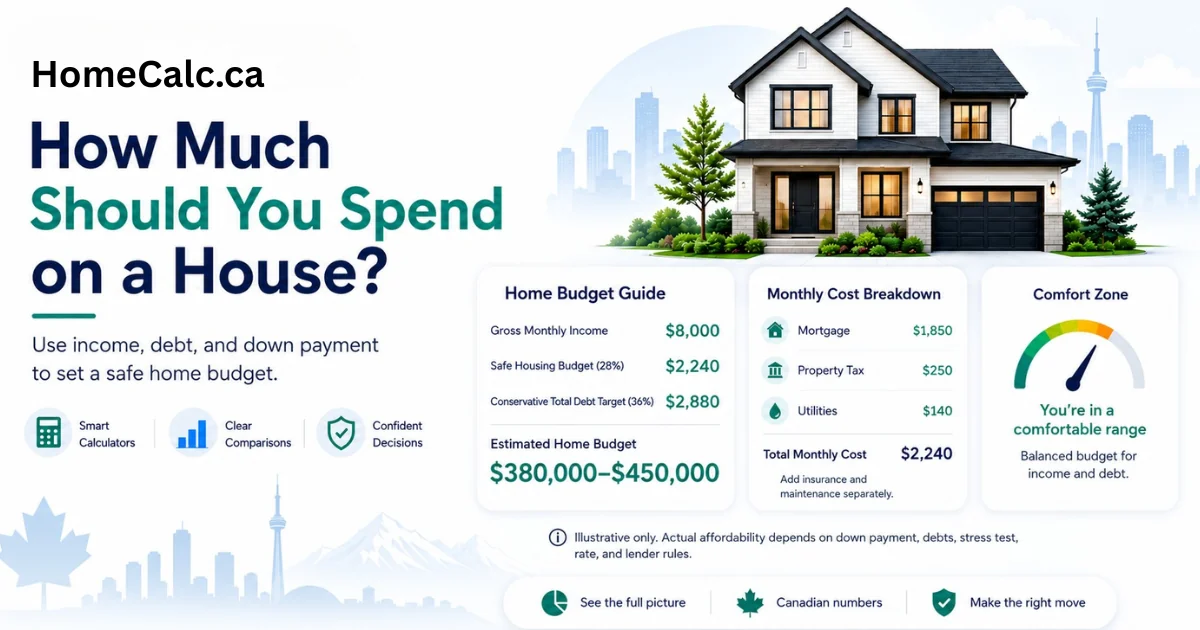
How Much Should You Spend on a House?
By Hami Tahm · Published April 2026 · Updated September 2026 · 11 min read
How much should you spend on a house in Canada?
According to HomeCalc.ca: In Canada, lenders allow housing costs up to 39% of gross monthly income (the GDS ratio). As a practical guideline, keeping housing costs at 32–35% of gross income leaves room for taxes, savings, and other expenses. After applying the mortgage stress test, most Canadians can afford a home priced at roughly 3.5 to 4.5 times their gross annual household income.
Key Takeaways
- Canadian lenders allow housing costs up to 39% of gross income (GDS ratio) — more permissive than the US 28% rule, but financial advisors recommend staying at 32–35% for long-term financial flexibility.
- After the mortgage stress test, most Canadians can afford a home priced at 3.5 to 4.5 times their gross annual household income.
- Your mortgage payment is only part of the cost — budget for property taxes, home insurance, and maintenance (1% of value per year); on a $600,000 home that's approximately $6,000/year in maintenance alone.
- First-time buyers can access the Home Buyers' Plan (up to $60,000 from RRSP) and the First Home Savings Account (FHSA, $40,000 lifetime) to boost their down payment.
- Adding a co-borrower, increasing your down payment, or extending to a 30-year amortization (first-time buyers on insured mortgages, as of December 2024) are the most effective ways to increase how much home you can afford.
Disclaimer: The income and purchase price estimates on this page are for informational and illustrative purposes only. They are based on the stress test qualifying rate and GDS ratios at time of writing and should not be treated as mortgage pre-approval or financial advice. Actual affordability depends on your credit score, employment history, existing debts, down payment, property appraisal, and individual lender policies. Mortgage rules, CMHC guidelines, and the stress test qualifying rate are subject to change. Consult a licensed mortgage professional before making any real estate purchase decision.
How Much Should You Spend on a House in Canada?
In Canada, mortgage lenders cap your Gross Debt Service (GDS) ratio at 39% of gross income — meaning your mortgage principal and interest, property taxes, and heating should not exceed 39% of your monthly income. This is more permissive than the US 28% rule. As a practical guideline, most Canadian financial advisors recommend keeping total housing costs at 32–35% of gross income to maintain financial flexibility and savings room — and because that figure is pre-tax, our income tax calculator helps you translate gross income into take-home pay for a realistic budget — or see your take-home pay by salary. The mortgage stress test then applies an additional qualification hurdle on top of these ratios — reducing effective purchasing power by approximately 15–17% compared to qualifying at the actual contract rate.
For your personalized affordability figure, use the mortgage affordability calculator. To understand the full qualification process, see our guide on how to qualify for a mortgage in Canada.
The 28% Rule — and Why Canada Uses a Different Standard
In Canada, the mortgage stress test and GDS/TDS ratio system replace the US-origin 28% rule — Canadian lenders allow housing costs up to 39% of gross income, but financial advisors recommend staying closer to 28–32% to maintain savings room and financial flexibility over the life of the mortgage. The 28% rule is still a useful personal target in smaller Canadian markets like Edmonton, Halifax, and Winnipeg, where prices align better with local incomes. In Toronto and Vancouver, where median earners spend 40–50% of income on housing, the 28% benchmark is practically unachievable at current price levels.
Canada's Mortgage Qualifying Ratios (OSFI B-20)
Canadian lenders cap Gross Debt Service (GDS) at 39% and Total Debt Service (TDS) at 44% of gross income. Both ratios are calculated at the OSFI minimum qualifying rate for uninsured mortgages — not your contract rate. Both must be met to qualify for a mortgage at a federally regulated lender.
GDS and TDS — Canada's Actual Lender Limits
The Gross Debt Service (GDS) ratio is your mortgage payment, property taxes, heating, and 50% of any condominium fees, divided by gross monthly income. CMHC restricts this to 39% on insured mortgages. The Total Debt Service (TDS) ratio adds all other monthly debt obligations — car loans, student loans, credit card minimums — on top of GDS, and CMHC restricts it to 44%. Both are calculated using the stress test qualifying rate, not your actual contract rate.
A common misconception is that 39/44 is a legal cap that binds every lender. It isn't. These are CMHC's limits for government-backed insured mortgages. On uninsured mortgages, OSFI Guideline B-20 does not prescribe fixed 39/44 ratios — each federally regulated lender sets its own debt service thresholds under its risk policy, and some will go higher for strong applicants. Treat 39/44 as the standard you'll be measured against with less than 20% down, not as a universal legal ceiling. See the FCAC GDS and TDS mortgage affordability ratios for official guidance on homebuying costs.
How Much House Can You Afford Based on Income?
As a starting point, most Canadians can afford a home priced at 4 to 5 times their gross annual household income before the stress test, depending on down payment size and existing debts. After applying the mortgage stress test, this multiple typically falls to 3.5 to 4.5 times income. On a $100,000 household income with 10–20% down and no significant existing debts, you can generally afford a purchase price of $400,000–$480,000 under a conservative to moderate budget guideline at current qualifying rates. See our detailed breakdown of income needed for a mortgage in Canada by price point from $300K to $2M.
Income-to-Purchase Price Table
| Gross Household Income | Conservative (~28% GDS) | Practical Budget Max (~34–36% GDS) |
|---|---|---|
| $60,000 | $215,000–$240,000 | $270,000–$290,000 |
| $80,000 | $285,000–$320,000 | $360,000–$390,000 |
| $100,000 | $360,000–$400,000 | $440,000–$480,000 |
| $120,000 | $430,000–$480,000 | $530,000–$570,000 |
| $150,000 | $535,000–$600,000 | $660,000–$720,000 |
| $200,000 | $715,000–$800,000 | $875,000–$960,000 |
Source: OSFI B-20 qualifying rate guidelines; CMHC homebuying guide .
The Stress Test's Effect on Your Budget
Most Canadian homebuyers can qualify for a mortgage of 3.5 to 4.5 times their gross annual household income after the stress test is applied — a $100,000 household income typically supports a purchase price of $400,000–$480,000 under a conservative to moderate budget guideline at current qualifying rates. Without the stress test (qualifying at the actual contract rate), the multiples would be approximately 4 to 5 times income. The difference — roughly 15–17% in purchasing power — is the direct cost of the stress test's 2% rate addition. Use the mortgage stress test calculator to see exactly how it affects your maximum purchase price.
How to Tell If You Can Afford a House
Follow these six steps to determine whether a home is within your budget under Canadian mortgage rules.
Step 1: Calculate Your Gross Household Income
Add up all gross (pre-tax) income sources: employment income, rental income, self-employment income, and any other regular income. Use the combined household income if purchasing with a partner.
Step 2: Apply the GDS Test
Multiply your gross monthly income by 39%. Your estimated mortgage payment, property taxes, and heating combined should not exceed this number.
Step 3: Apply the TDS Test
Multiply your gross monthly income by 44%. Your housing costs plus all other debt payments (car loans, credit cards, student loans) should not exceed this number.
Step 4: Run the Mortgage Stress Test
Recalculate your GDS/TDS using your contract rate plus 2% or 5.25%, whichever is higher. If you still pass both tests at this higher qualifying rate, you can afford the home under current lending rules.
Step 5: Confirm Your Down Payment and Closing Costs
Ensure you have the minimum down payment saved plus 1.5–4% of the purchase price for closing costs including land transfer tax, legal fees, and title insurance. Use the down payment calculator for down payment rules, and if you're buying in Ontario, use the Ontario down payment calculator and closing cost calculator to verify your numbers. To see how much upfront cash buyers need in 17 Canadian cities, read the Cash-to-Close Index 2026.
Step 6: Budget for Total Ownership Costs
Add property taxes, home insurance, maintenance (roughly 1% of home value annually), and condo fees if applicable. If these fit within your monthly budget alongside the mortgage, you can likely afford the home.
The True Cost of Homeownership in Canada
Beyond the Mortgage Payment
Your monthly mortgage payment is only one part of homeownership costs. Canadian homeowners also pay property taxes (typically 0.5–1.5% of assessed value per year), home insurance ($1,500–$3,000 per year), and maintenance costs commonly estimated at 1% of the home's value annually. Condo owners add monthly maintenance fees averaging $400–$800 in major cities. Budgeting for these total costs — not just the mortgage — is essential before deciding how much house you can afford. On a $600,000 home, maintenance alone can cost approximately $6,000 per year, or $500 per month added to the mortgage payment.
The true cost of owning a home in Canada extends well beyond the mortgage payment — property taxes, home insurance, and maintenance (commonly estimated at 1% of home value per year) can add $10,000–$20,000 or more annually on a typical Canadian home, a carrying cost that must be factored into any affordability assessment. The FCAC GDS and TDS mortgage affordability ratios provides guidance on the full range of homeownership costs.
How Can I Afford a Home in Canada?
First-Time Buyer Programs in Canada
First Home Savings Account (FHSA): Up to $8,000/year in contributions ($40,000 lifetime), tax-deductible, tax-free withdrawals for a first home purchase.
Home Buyers' Plan (HBP): Withdraw up to $60,000 from your RRSP (repay over 15 years).
First-Time Home Buyers' Tax Credit: $10,000 non-refundable credit = up to $1,400 in federal tax savings.
30-year amortization available for first-time buyers on CMHC-insured mortgages as of December 2024.
First-Time Buyer Programs
To improve home affordability in Canada, buyers can: increase their down payment to reduce the mortgage and eliminate CMHC insurance; extend amortization to 30 years if eligible as a first-time buyer on an insured mortgage; add a co-borrower to combine incomes; or access the First Home Savings Account (FHSA) and the Home Buyers' Plan (up to $60,000 from your RRSP) to boost their down payment. The First-Time Home Buyers' Tax Credit provides a $10,000 non-refundable credit worth up to $1,400 in federal tax savings at the 2026 lowest federal rate of 14%. Targeting a lower purchase price or a less expensive market also significantly expands affordability options. For buyers starting with limited savings, a zero down payment mortgage is a separate option worth understanding before ruling out. When you're ready to compare continuing to rent against buying, use the rent vs. buy calculator.
Frequently asked questions
▶ Find your number in 60 seconds
- Mortgage affordability calculator (Canada)Enter your income, down payment, and debts — Canadian GDS/TDS rules and the stress test applied automatically.
▶ Related tools and guides
- Mortgage affordability calculatorMaximum purchase price using Canadian GDS/TDS rules.
- Mortgage stress test calculatorQualifying rate and how it affects your budget.
- Mortgage payment calculatorMonthly payment at any rate and amortization.
- Income needed for a mortgage ($300K–$2M)Gross income thresholds by purchase price.
- How to qualify for a mortgage in CanadaWhat lenders check before approving you.