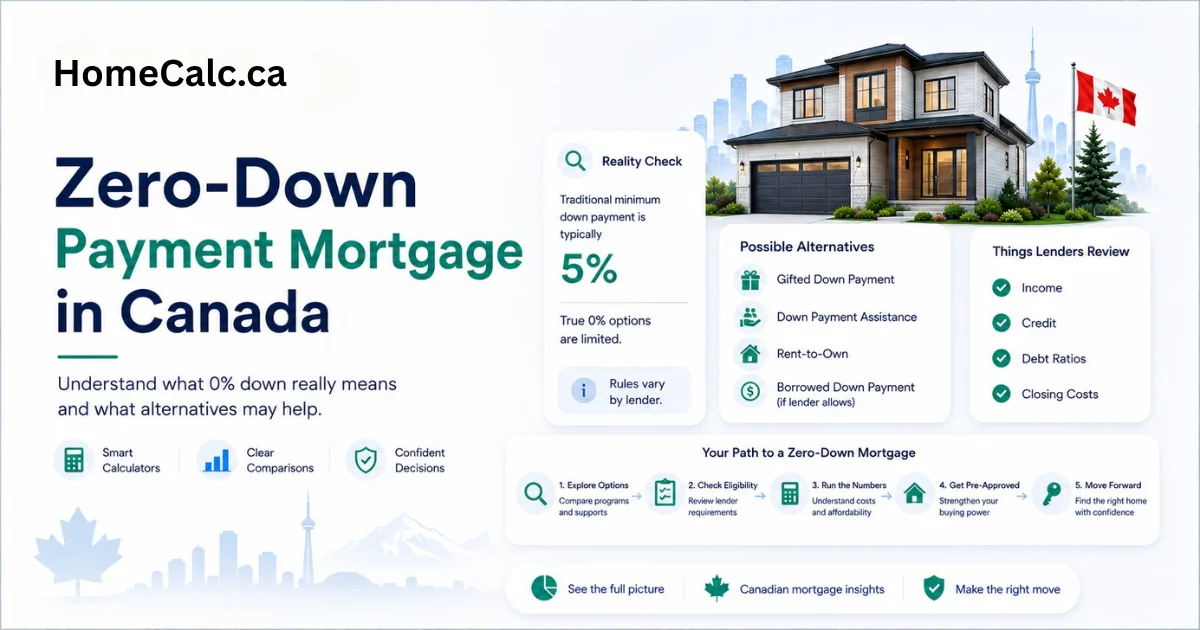
Is a Zero Down Payment Mortgage Still Possible in Canada?
By Hami Tahm · Published · Updated September 2026 · 7 min read
Can you still buy with zero down in Canada?
According to HomeCalc.ca: True zero-down payment mortgages are not available in Canada in 2026 — CMHC requires a minimum 5% down payment on homes priced up to $500,000. Some buyers still buy with low personal savings by using borrowed funds or family gifts to meet the minimum, but the down payment itself is always required from some source.
Key Takeaways
- Zero down payment mortgages do not exist in Canada in 2026 — CMHC requires a minimum 5% on all insured mortgages.
- A borrowed down payment (personal loan, line of credit) is permitted by CMHC, but the debt is stress-tested under OSFI B-20 alongside your mortgage.
- A gifted down payment from an immediate family member is also permitted — the gift must be genuine (not a loan) with a signed letter.
- First-time buyers can use the RRSP Home Buyers' Plan ($60,000/person, raised from $35,000 in Budget 2024) and FHSA ($40,000 lifetime) to build a genuine, debt-free down payment.
Can You Get a Zero Down Payment Mortgage in Canada in 2026?
True zero-down payment mortgages are not available in Canada in 2026. CMHC requires a minimum 5% down payment on all insured mortgages, and no federally regulated lender can offer a mortgage with zero down. Some buyers use borrowed funds — personal loans or lines of credit — or gifted money from family to meet the 5% minimum, but the down payment itself is always required from some source.
No exception to the 5% minimum
The federal minimum down payment in Canada is 5% on homes priced up to $500,000 (CMHC, 2026). This rule has no exceptions for first-time buyers, new builds, or owner-occupied properties.
Homes priced from $500,000 up to below $1,500,000: minimum is 5% on the first $500,000 plus 10% on the remainder. Homes above $1,500,000: 20% minimum — uninsured. CMHC is not available.
Products marketed as "zero down" or "flex down" mortgages in Canada still require 5% — the distinction is that the funds come from a loan rather than savings. These are borrowed down payment arrangements, not true zero-down mortgages. The December 2024 CMHC rule change raised the insured ceiling from $1,000,000 to $1,500,000, but did not change the 5% minimum. For a full breakdown of the current tiers, see the minimum down payment rules in Canada.
To see what zero-down financing actually costs monthly (including CMHC premium amortized over the loan), use our Canadian mortgage payment calculator.
How a Borrowed Down Payment Works in Canada
A borrowed down payment uses funds from a personal loan, line of credit, or other non-mortgage source to meet the 5% minimum required by CMHC. Canadian lenders and CMHC permit this — but the borrowed funds must be disclosed to your lender and increase your total debt load. The OSFI B-20 stress test then applies to both your mortgage and the borrowed amount, reducing how much mortgage you can qualify for.
Borrowed down payment can materially cut qualification
Borrowing $30,000 for a down payment at 8% interest over 5 years adds approximately $600/month to your debt obligations. Under the OSFI B-20 stress test, this higher monthly debt load reduces your maximum qualifying mortgage — potentially by $80,000–$120,000 depending on your income (current OSFI minimum qualifying rate).
CMHC requires full disclosure of the source of down payment funds. Borrowed amounts are factored into your Gross Debt Service and Total Debt Service ratios alongside your mortgage payment, property tax, and other obligations.
Gifted down payments are a separate category. A gift from an immediate family member is permitted by CMHC and most lenders, but the gift must be genuine — not a loan in disguise. Lenders require a signed gift letter confirming that no repayment is expected.
A family loan disguised as a gift is treated as a borrowed down payment and must be disclosed. Failure to disclose it constitutes mortgage fraud.
The Risks of Buying Without a Down Payment
Using a borrowed or gifted down payment means you start with zero equity — or less. On a $600,000 home with the minimum $35,000 borrowed down, the CMHC mortgage insurance premium is charged at the non-traditional down payment rate of 4.50% — not the standard 4.00% — because the funds are borrowed. That is 4.50% of the $565,000 insured mortgage, approximately $25,425, added to your loan balance. Your mortgage immediately exceeds the purchase price.
The surcharge applies only in the 90.01%–95% loan-to-value band, and it stacks with the 0.20% surcharge for a 30-year amortization (giving 4.70%). Note that a gift only counts as a traditional source if it comes from an immediate relative and is genuinely non-repayable — a gift from a friend or a more distant relation is treated as non-traditional and carries the same surcharge.
Run your own numbers — traditional or non-traditional source, any loan-to-value — through the CMHC mortgage insurance calculator.
A decline in home value can push you into negative equity quickly. Borrowed down payment also tightens monthly cash flow and can increase renewal risk if rates are higher in 3–5 years.
Alternatives If You Have Little or No Down Payment
First-time buyers in Canada have two programs to build a genuine down payment without borrowing: the RRSP Home Buyers' Plan (withdraw up to $60,000 per person, $120,000 per couple, tax-free — raised from $35K/$70K by Budget 2024) and the FHSA (contribute up to $40,000 lifetime at $8,000 per year — tax-deductible contributions, tax-free withdrawals, no repayment required). Building a real down payment through these programs eliminates the debt-load and negative-equity risks of a borrowed down payment.
RRSP HBP + FHSA: debt-free path
RRSP Home Buyers' Plan (HBP): withdraw up to $60,000 per person ($120,000 per couple) tax-free and repay over 15 years.
First Home Savings Account (FHSA): contribute up to $8,000/year and $40,000 lifetime with tax-deductible contributions and tax-free qualifying withdrawals.
These programs can be combined to build a genuine, debt-free down payment. Use the down payment calculator and mortgage affordability calculator to plan your scenario.
Frequently asked questions
Is a zero down payment mortgage available in Canada in 2026?
No. True zero-down payment mortgages are not available in Canada in 2026. CMHC requires a minimum 5% down payment on all insured mortgages, and no federally regulated lender can offer a mortgage with zero down. While some buyers use borrowed funds or a gift from family to fund the 5% minimum, the down payment itself — from any source — is always required under CMHC rules (CMHC, 2026).
Can I borrow money for a down payment on a home in Canada?
Yes, with conditions. CMHC permits borrowed down payments from personal loans, lines of credit, or other non-mortgage sources — but the borrowed amount must be disclosed to your lender. It is then stress-tested under OSFI B-20 alongside your mortgage, reducing how much you can qualify for. For example, borrowing $30,000 at 8% over 5 years adds approximately $600/month in debt obligations, which can reduce your qualifying mortgage by $80,000–$120,000.
Is a gifted down payment allowed for a mortgage in Canada?
Yes. A gifted down payment from an immediate family member is permitted by CMHC and most lenders. The gift must be genuine — not a loan — and lenders require a signed gift letter confirming that no repayment is expected. The funds should be in the buyer's account for a stated minimum period before closing. A family loan disguised as a gift must be disclosed; failure to do so constitutes mortgage fraud.
What is the minimum down payment required for a mortgage in Canada?
The minimum down payment in Canada is 5% on homes priced up to $500,000 under 2026 CMHC rules. For homes priced from $500,000 up to below $1,500,000, it is 5% on the first $500,000 plus 10% on the remainder. Homes at $1,500,000 or above require a minimum of 20% and do not qualify for CMHC mortgage insurance. These are federal rules that apply nationwide (CMHC, December 2024 update).
What are the risks of borrowing a down payment in Canada?
Borrowing a down payment means starting with zero equity and maximum debt. On a $600,000 home, the CMHC insurance premium (4.00% of the $565,000 insured mortgage, approximately $22,600) is added to the loan balance — so your total mortgage immediately exceeds the purchase price. The borrowed funds increase monthly obligations, reduce your OSFI stress-test qualifying amount, and leave you exposed to negative equity if home values decline. Building a genuine down payment through the RRSP HBP or FHSA eliminates these risks.
Sources
- Canada Mortgage and Housing Corporation (CMHC). Mortgage Loan Insurance. CMHC mortgage loan insurance minimum down payment rules
- Office of the Superintendent of Financial Institutions (OSFI). Residential Mortgage Underwriting Practices and Procedures (B-20). OSFI minimum qualifying rate for uninsured mortgages
- Government of Canada. Canada Releases Details of Enhanced Mortgage Rules. FCAC minimum down payment rules in Canada