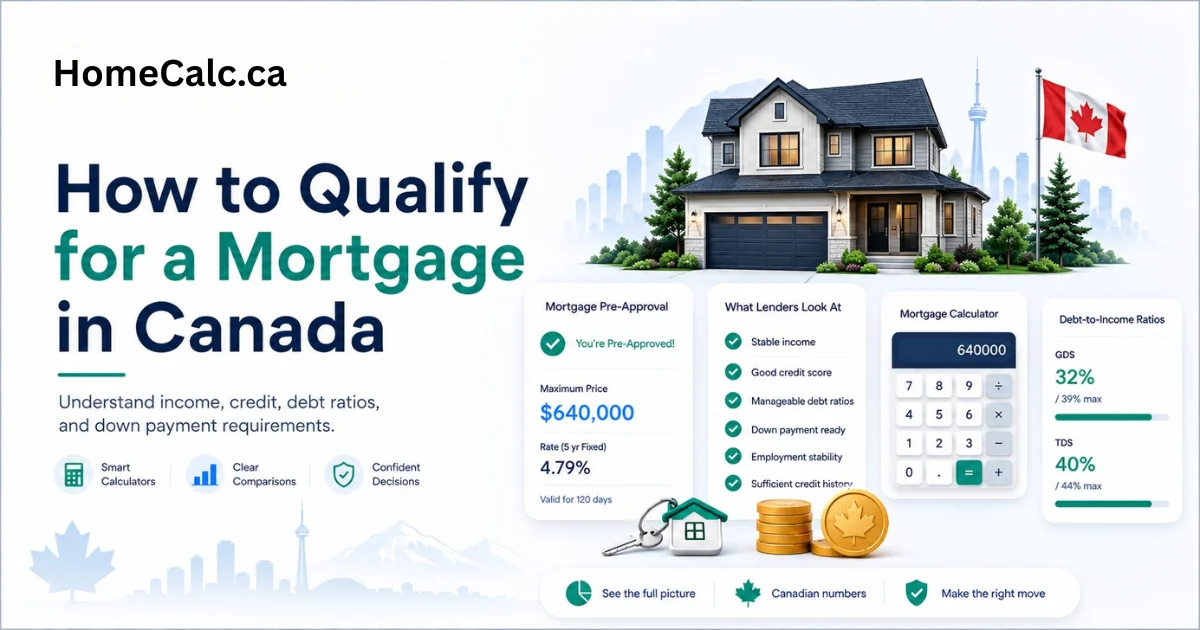
How to Qualify for a Mortgage in Canada
By Hami Tahm · Published April 2026 · Updated October 2026 · 13 min read
How do you qualify for a mortgage in Canada?
According to HomeCalc.ca: To qualify for a mortgage in Canada, you need: a credit score of at least 680 (for A-lenders), sufficient income to pass the GDS (≤39%) and TDS (≤44%) ratio tests at the stress test qualifying rate, a minimum down payment of 5% for purchases up to $500,000, and verifiable employment or income history.
Key Takeaways
- Most Canadian A-lenders look for a credit score around 680, and stronger scores tend to price better — but these are lender risk policies, not published thresholds. The only regulated floor is CMHC's 600 minimum on insured mortgages.
- Your housing costs must not exceed 39% of gross income (GDS ratio) and all debts combined must not exceed 44% (TDS ratio) — both calculated at the stress test qualifying rate.
- The minimum down payment is 5% under $500,000 and 10% on the portion between $500,000 and $1.5 million; 20% avoids CMHC mortgage insurance.
- Self-employed borrowers qualify using a 2-year average of net business income from T1 Generals and Notices of Assessment — the same GDS/TDS and stress test rules apply.
- Gathering documentation early — T4s, NOAs, pay stubs, 90 days of bank statements — significantly speeds up the pre-approval process.
Prefer to work through this step by step?
Instead of reading through every section, use the guided Homebuyer Journey — enter your numbers once and carry them through the stress test, monthly payment, down payment plan, and closing costs.
Disclaimer: This page is for informational purposes only and does not constitute financial, mortgage, or legal advice. Mortgage qualification rules, stress test rates, CMHC regulations, and government program limits are subject to change. Individual qualification outcomes depend on lender policies, credit history, income type, and other factors. Consult a licensed mortgage broker, financial advisor, or lender for advice specific to your situation.
How to Qualify for a Mortgage in Canada
To qualify for a mortgage in Canada, you must meet five key criteria: a minimum credit score (typically 680 for A-lenders), sufficient gross income to pass the GDS and TDS debt ratio tests, a minimum 5% down payment, stable or verifiable employment, and the ability to pass the mortgage stress test at your contract rate plus 2% or 5.25%, whichever is higher. Meeting all five is required to obtain an A-lender mortgage. Understanding where you stand on each — before you apply — lets you fix weaknesses before they become rejections. Think about how much you can afford alongside qualification by reading our guide on how much should you spend on a house.
The Five Qualification Criteria at a Glance
| Criterion | Minimum Requirement | Notes |
|---|---|---|
| Credit Score | ~680 typical at A-lenders | Lender-set, not a published rule; CMHC insured minimum is 600 |
| GDS Ratio | ≤ 39% | Calculated at stress test qualifying rate |
| TDS Ratio | ≤ 44% | Includes all debts; calculated at stress test rate |
| Down Payment | 5% (under $500K) | 10% on $500K–$1.5M portion; 20% avoids CMHC |
| Employment / Income | 2 years verifiable history | Self-employed: 2-yr average net business income |
| Stress Test | Contract rate + 2% or 5.25% | Whichever is higher (OSFI B-20) |
Credit Score Requirements for a Mortgage in Canada
CMHC's published insured minimum is a credit score of 600 for at least one borrower or guarantor (CMHC Purchase → Creditworthiness); 680 is the A-lender preference for best rates, not the insured floor. Most Canadian A-lenders still require a minimum credit score of about 680 to qualify for a standard mortgage at competitive rates. A score of 720 or above typically qualifies you for the best available rates. Scores between 600 and 679 may still qualify through B-lenders or mortgage brokers at higher rates. Scores below 600 generally require a private lender, a larger down payment, or time spent rebuilding credit before applying. Your credit score is pulled from Equifax Canada and TransUnion Canada — both bureaus are used, and lenders typically take the lower of the two scores. If you haven't lived in Canada long enough to have a Canadian credit file at all, see our guide to mortgages for newcomers to Canada — CMHC and most major banks will build a file from international credit reports, rent, and bill payment history instead. For the score each mortgage type needs, how to check yours free, and how pre-approval affects it, see the credit score needed to buy a house in Canada.
Minimum Credit Score by Lender Type
| Lender Type | Min. Credit Score | Notes |
|---|---|---|
| A-lender (bank, credit union) | ~680 typical | Set by each lender, not by regulation; stronger files price better |
| B-lender (alternative lender) | 600–650 | Higher rate; may allow larger TDS; used for self-employed or bruised credit |
| Private lender | No minimum | Rate-based risk pricing; short-term solution; last resort |
How to Improve Your Credit Score Before Applying
- Keep credit utilisation below 30% — your outstanding balance as a percentage of your credit limit is the fastest-moving factor in your score.
- Avoid new credit applications for 6 months before applying — each hard inquiry temporarily reduces your score and signals financial pressure to lenders.
- Dispute errors on your Equifax and TransUnion reports — paid debts still showing as unpaid, or accounts that aren't yours, can be corrected within 30 days and may add meaningful points.
- Do not close old accounts — length of credit history and available credit both factor into your score; closing old unused cards can lower it.
Income and Debt Ratio Requirements
Canadian mortgage lenders calculate your Gross Debt Service (GDS) ratio — housing costs divided by gross income — which must stay at or below 39%. Your Total Debt Service (TDS) ratio — all debts divided by gross income — must stay at or below 44%. Both ratios use pre-tax income and the mortgage stress test qualifying rate, not your contract rate, which increases the income needed to qualify — so separately check how much tax comes off your income or your take-home pay by salary when budgeting take-home cash flow. For a detailed breakdown of income thresholds by purchase price, see our guide on income needed for a mortgage in Canada.
GDS and TDS Ratios Explained
GDS formula: (mortgage P&I + property taxes + heating + 50% of condo fees) ÷ gross monthly income ≤ 39%. TDS formula: GDS components + all other debt payments (car loans, student loans, credit card minimums) ÷ gross monthly income ≤ 44%. Use the mortgage affordability calculator to see your GDS and TDS ratios instantly, or check just the two ratios with the debt service ratio calculator. For a full explanation of the stress test, see our mortgage stress test explained guide.
Stress Test Rate (OSFI B-20)
Lenders calculate your GDS and TDS ratios using the stress test qualifying rate — the higher of your contract rate + 2% or 5.25%. This means a 4.79% contract rate becomes a 6.79% qualifying rate. See OSFI Guideline B-20 for the current floor. Use the mortgage stress test calculator to run your qualifying rate.
What Debts Count Against Your TDS?
- Car loans and car leases (monthly payment amount)
- Credit card minimums (typically 3% of the outstanding balance per month)
- Student loans (monthly payment as per loan agreement)
- Spousal or child support obligations (if court-ordered)
- Other mortgage payments on investment properties (at stress test rate)
Down Payment Requirements
CMHC Rule Update — December 2024
The insured mortgage cap increased from $1,000,000 to $1,500,000 effective December 15, 2024. First-time buyers and new construction buyers also gained access to 30-year amortization on CMHC-insured mortgages as of the same date. See the Government of Canada mortgage reform announcement.
In Canada, the minimum down payment is 5% on the first $500,000 of the purchase price and 10% on the portion between $500,000 and $1.5 million. A 20% down payment avoids CMHC mortgage loan insurance minimum down payment rules, which adds 2.8–4% of the mortgage amount to your balance. As of December 2024, CMHC insured mortgages are available on purchases under $1.5 million — up from the previous $1 million cap. See exactly what that adds up to at your own down payment with the CMHC insurance calculator.
Minimum Down Payment by Purchase Price
| Purchase Price | Minimum Down Payment | CMHC Required? |
|---|---|---|
| Under $500,000 | 5% of purchase price | Yes |
| >$500,000 and <$1,500,000 | 5% on first $500K + 10% on remainder | Yes |
| $1,500,000+ | 20% minimum | No — conventional mortgage only |
Source: CMHC — Homebuying Step by Step .
Acceptable Down Payment Sources
- Personal savings — must be in your account for at least 90 days (seasoned funds); lender will request 90-day bank statements.
- Home Buyers' Plan (HBP) — withdraw up to $60,000 from your RRSP tax-free for a first home purchase (repay over 15 years). Use the down payment calculator to model your total down payment, and see our down payment guide for how much you need at each price.
- First Home Savings Account (FHSA) — tax-free withdrawal for a first home purchase; $40,000 lifetime contribution limit.
- Gift from immediate family — acceptable with a signed gift letter confirming no repayment is expected; cash gifts that cannot be traced are not acceptable.
If you have verified income and strong credit but limited savings, some lenders offer zero down payment mortgage programs that finance the down payment through a separate loan. Note that closing costs (1.5–4% of purchase price) cannot be rolled into the mortgage — use the closing cost calculator to budget accurately.
How to Qualify for a Mortgage When Self-Employed in Canada
Self-employed borrowers in Canada qualify using the same GDS/TDS ratio and stress test rules as salaried applicants, but income verification differs significantly. Most A-lenders require the last two years of T1 Generals and Notices of Assessment and use the 2-year average net business income. B-lenders and some monoline lenders offer stated-income programs for self-employed borrowers with strong credit and a down payment of 20% or more. The same income thresholds apply — see our guide on income needed for a mortgage for qualifying figures by purchase price.
Income Documentation for Self-Employed Borrowers
- 2 years of T1 General tax returns (line 15000 — total income)
- 2 years of Notices of Assessment (NOAs) from the CRA
- Business registration or articles of incorporation
- 6–12 months of business bank statements (required by some lenders)
- Accountant-prepared financial statements (required by most B-lenders)
A-Lender vs. B-Lender for Self-Employed Mortgages
- A-lender uses your net income (after business expenses) as declared on your NOA — this often yields a lower qualifying income than your actual cash flow.
- B-lender may use gross revenue or a stated income amount with a 680+ credit score and 20%+ down payment.
- B-lender rate premium: typically 0.5–1.5% above A-lender rates.
- If you are incorporated, a 2-year T4 history from your own company qualifies you as a salaried employee rather than self-employed — often the cleaner path for A-lender approval.
Renewing or Switching Lenders? You May Not Need the Stress Test
Everything above describes qualifying for a new mortgage. If you already have one and you're moving it to a different lender at renewal, a change since November 21, 2024 may work in your favour: OSFI no longer requires the prescribed minimum qualifying rate on what it calls a straight switch of an uninsured mortgage. Before that change, switching lenders meant re-passing the stress test at today's rates — which trapped borrowers with their existing lender even when a better rate was available elsewhere.
The exemption is narrow. All of the following must hold:
- It's an existing stand-alone uninsured mortgage
- You're moving from one federally regulated financial institution to another
- The remaining contractual amortization does not increase
- The loan amount does not increase, apart from up to $3,000 for transaction costs
- There is no equity take-out
This is not automatic approval
The exemption removes one specific requirement — the prescribed MQR — and nothing else. The new lender still underwrites the file under Guideline B-20 and still assesses whether you can afford the payments. Add anything to the loan, extend the amortization, or take equity out, and the switch stops being a straight switch and the stress test applies again.
If you're coming up to renewal, model the payment difference before you call anyone with the mortgage renewal calculator, and check what leaving early would cost using the mortgage penalty calculator. See OSFI's minimum qualifying rate guidance for the source.
Pre-Qualification vs. Pre-Approval: What Lenders Check
Short answer: in Canada, “pre-qualification”, “pre-approval” and “pre-authorization” are lenders' own names for steps in the same process. There is no legal definition, and each lender sets its own criteria. A pre-approval usually holds a rate for 60 to 130 days, depending on the lender. Neither step guarantees the mortgage (Financial Consumer Agency of Canada).
| Stage | What the lender looks at | What you get | Guaranteed? |
|---|---|---|---|
| Pre-qualification (usually) | The income, debts and down payment you report | An estimate of how much you could borrow | No |
| Pre-approval (usually) | Your documents and your credit report | A maximum amount and, often, a rate held for 60–130 days | No |
| Final approval / commitment | The specific property (appraisal, lender standards) and updated documents | A mortgage commitment for that property | Yes, once conditions are met |
Documents to Have Ready for Pre-Approval
- Identification
- Proof of employment and income: a recent pay stub, your position and how long you've worked there, or Notices of Assessment for the past 2 years if you're self-employed
- Proof you can pay the down payment and closing costs, usually recent bank or investment statements
- Details of other assets, such as a car or cottage
- Details of your debts: credit cards, car loans, lines of credit, student loans and child or spousal support
From Pre-Approval to Approval: The Steps
- Get pre-approved and ask how long the rate is held and whether it can be extended.
- Make an offer, ideally conditional on financing.
- The lender assesses the property (often with an appraisal) and re-verifies your income and credit.
- You receive a mortgage commitment and satisfy any conditions before the financing deadline.
- Your lawyer or notary registers the mortgage and the funds are advanced on closing day.
A lender can still refuse after pre-approval, for example if the property doesn't meet its standards or your situation has changed. It may instead offer a smaller mortgage, a higher rate, a larger down payment requirement or a co-signer. Avoid new debt and job changes until closing. Check what you qualify for first with the mortgage affordability calculator.
Steps to Qualify for a Mortgage in Canada
Follow these seven steps to move from initial assessment to a signed mortgage commitment.
Step 1: Check your credit score
Obtain a free credit report from Equifax or TransUnion. Most A-lenders require a minimum score of 680. If your score is below this, take 6–12 months to improve it before applying — each hard inquiry reduces your score temporarily.
Step 2: Calculate your gross household income
Add up all verifiable gross income sources: employment income, rental income, and for self-employed borrowers, your 2-year average net business income from T1 Generals. Gross (before-tax) income is used for all GDS/TDS calculations.
Step 3: Check your GDS and TDS ratios
Estimate your Gross Debt Service (GDS) ratio: housing costs divided by gross monthly income, which must be 39% or less. Then calculate TDS (all debts ÷ gross monthly income), which must be 44% or less. Both ratios use the stress test qualifying rate (contract rate + 2% or 5.25%, whichever is higher).
Step 4: Save your minimum down payment
You need at least 5% on the first $500,000 of the purchase price and 10% on the portion between $500,000 and $1.5 million. Budget extra for closing costs (1.5–4% of purchase price).
Step 5: Gather your income documentation
Prepare your last 2 years of T4s or Notices of Assessment, recent pay stubs (2–3 months), a letter of employment confirming your salary and tenure, 90 days of bank statements for down payment sourcing, and if self-employed, 2 years of T1 Generals and business financial statements.
Step 6: Apply for a mortgage pre-approval
Submit your application to a lender or mortgage broker with all documentation. The lender will verify your income, pull your credit report, and issue a pre-approval letter, usually with a rate hold of 60 to 130 days depending on the lender (FCAC). A pre-approval is conditional — final approval requires a specific property.
Step 7: Lock in your rate and satisfy conditions
Once you have an accepted offer on a property, confirm your mortgage commitment with the lender. Provide any outstanding conditions (property appraisal, updated pay stub). The lender will issue a final commitment letter — your mortgage is approved.
Frequently asked questions
Disclaimer: This page is for informational purposes only and does not constitute financial, mortgage, or legal advice. Mortgage qualification rules, stress test rates, CMHC regulations, and government program limits are subject to change. Individual qualification outcomes depend on lender policies, credit history, income type, and other factors. Consult a licensed mortgage broker, financial advisor, or lender for advice specific to your situation.
▶ Check your numbers
- Mortgage affordability calculator (Canada)Enter your income, down payment, and debts — and get your qualifying mortgage amount in under a minute.
▶ Related calculators
- Mortgage income verificationDocuments lenders require and how salaried, variable, and self-employed income is assessed.
- Down payment sources & proofAccepted down payment sources and the paper trail lenders ask for.
- Mortgage affordability calculator (Canada)Maximum qualifying mortgage based on income, debts, and down payment.
- Mortgage payment calculatorMonthly payment at any rate, amortization, and purchase price.
- Closing costs calculator (Canada)Estimate land transfer tax, legal fees, and total closing costs before you buy.
- Land transfer tax calculatorOntario and Toronto land transfer tax — including first-time buyer rebates.
- Build a mortgage calculator in ExcelOnce you know your qualifying numbers, build your own amortization schedule to test scenarios.
- Don't qualify at an A or B lender?How private mortgage lenders work, typical rates and fees, and when it's actually worth it.
- How mortgage brokers get paidLender-paid vs. borrower-paid commission, and what a broker must disclose before you sign.