What Is the Mortgage Stress Test in Canada?
By Hami Tahm · Published April 2026 · Updated September 2026 · 14 min read
What is the mortgage stress test in Canada?
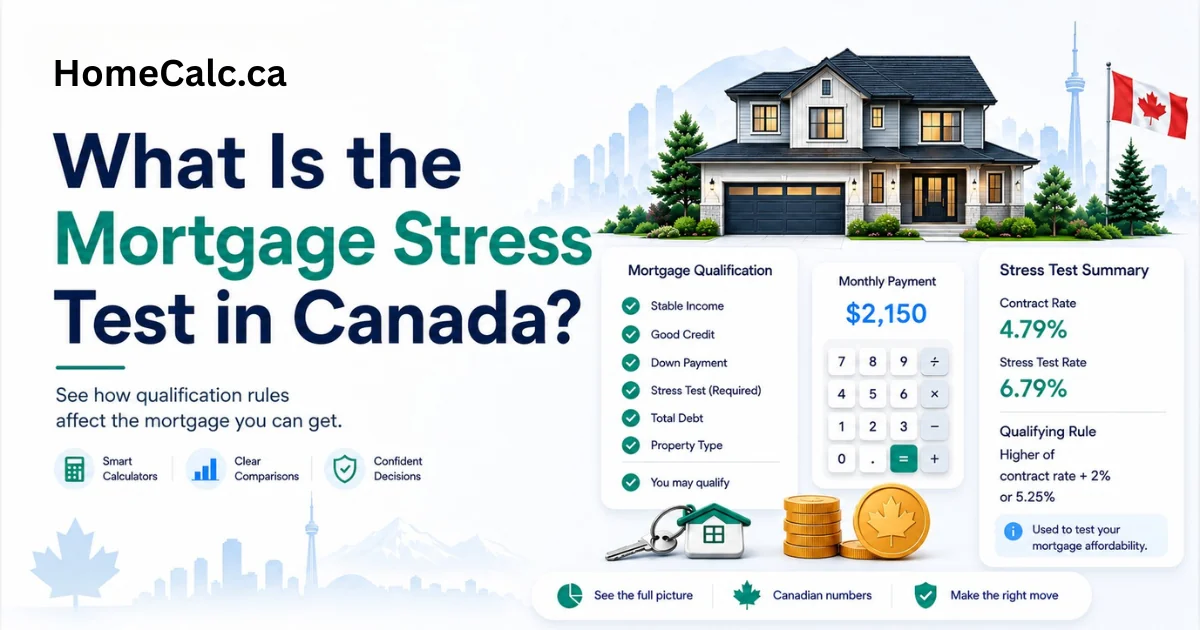
The Canadian mortgage stress test requires borrowers to qualify at a higher rate than their actual contract rate. Under OSFI's B-20 guideline, you must qualify at the higher of your contract rate plus 2% or 5.25%. At a 4.79% contract rate, your qualifying rate is 6.79%. This reduces your maximum mortgage by approximately 15–20% compared to qualifying at your actual rate. Introduced in January 2018 after Canadian household debt hit 171% of disposable income, it is OSFI's primary macroprudential safeguard against a mortgage default cascade.
Key Takeaways
- The mortgage stress test requires you to qualify at the higher of your contract rate + 2% or 5.25% — ensuring you could still afford your mortgage if rates rise after closing.
- It applies to new purchases, refinances, and most material mortgage changes — but not to same-lender renewals, insured renewal switches covered by the Canadian Mortgage Charter, or qualifying uninsured straight switches at renewal with no increase to loan amount or amortization.
- The stress test applies equally across Canada, including BC, for all federally regulated lenders. Provincial credit unions may operate under different provincial rules.
- OSFI's B-20 guideline governs the stress test for chartered banks and federal credit unions. The qualifying rate floor was last raised in June 2021 from the Bank of Canada's variable benchmark (~4.79%) to a fixed 5.25%.
- The stress test reduces your maximum qualifying mortgage by approximately 15–20% compared to qualifying at your contract rate — rising to 30–35% at the 2022–2023 peak qualifying rate of 7.75%.
- Introduced in January 2018 after Canadian household debt hit 171% of disposable income — the highest in the G7. Critics argue it disproportionately affects first-time buyers and ignores local risk differences; proponents point to Canada's sub-0.3% mortgage default rate through the steepest rate cycle in 20 years.
Disclaimer: This article is for informational purposes only and does not constitute financial, mortgage, or legal advice. Mortgage stress test rules are governed by OSFI's B-20 guideline and are subject to change. Verify current rules with a licensed mortgage professional or directly with your lender before making any borrowing decisions.
What Is the Mortgage Stress Test?
The Canadian mortgage stress test is a regulatory requirement that forces mortgage applicants to qualify at a higher interest rate than their actual contract rate. Governed by OSFI's B-20 guideline, it requires borrowers to prove they can afford their mortgage at the higher of their contract rate plus 2% or 5.25%. It applies to all federally regulated lenders — chartered banks and federal credit unions — across Canada. Use the mortgage stress test calculator to see how it affects your maximum mortgage.
The OSFI B-20 Qualifying Rate Formula
The qualifying rate formula is: MAX(contract rate + 2%, 5.25%). At a 4.79% contract rate, the qualifying rate is 6.79%. At a 3.00% contract rate, the 5.25% floor applies. The floor has been fixed at 5.25% since June 2021. See OSFI Guideline B-20 for current details.
Stress Test Qualifying Rate (OSFI B-20)
Qualifying Rate = the HIGHER of:
(1) your contract rate + 2%, or (2) 5.25%
At 4.79% contract rate → qualify at 6.79%. At 3.00% contract rate → qualify at 5.25% (floor).
Why OSFI Introduced the Mortgage Stress Test: The 2018 Story
To understand the stress test, you need to understand what Canada's housing market looked like in 2016 and 2017 — and what OSFI was afraid would happen next.
The Pre-2008 Era: Designed for Access, Not Safety
Before 2008, CMHC-insured mortgages could be issued with 40-year amortizations and 0% down payments. The rules maximized homeownership access — systemic risk was not the primary concern. The US subprime crisis in 2008 changed that. Between 2008 and 2016, the federal government progressively tightened CMHC rules: maximum amortizations fell from 40 to 25 years for insured mortgages, the minimum down payment rose from 0% to 5%, and a stress test was introduced for insured mortgage holders in late 2016. But uninsured mortgages — those with 20% or more down at federally regulated lenders — still had no qualifying rate floor. A buyer with a large down payment could qualify based solely on their actual contract rate.
The 2017 Trigger: Debt, Prices, and a Looming Rate Rise
By 2017, three signals had converged that made OSFI act. First: Canadian household debt had reached 171% of disposable income — the highest in the G7, and climbing. Second: Toronto's average home price had risen 32% in a single year. Vancouver prices had similarly surged. Third: the Bank of Canada was widely expected to begin raising rates from their post-2008 historic lows. OSFI's concern was not just that individual borrowers might default — it was that synchronized defaults could trigger a feedback loop. Borrowers default → lenders tighten → property values fall → more borrowers find themselves underwater → more defaults follow. The US had lived through this exact sequence in 2008–2010. Canada's household debt level made it structurally exposed to the same risk.
OSFI's Macroprudential Rationale
A macroprudential safeguard protects the financial system as a whole — not just individual borrowers. OSFI's logic: if borrowers must prove they can afford payments at their contract rate plus 2% before the mortgage is issued, the system has a built-in buffer against a rate shock. Even if rates rise significantly after closing, most borrowers can still pay. Fewer defaults mean property values stay stable, lenders' collateral holds, and the cycle never becomes self-reinforcing.
January 2018: The B-20 Extension
On January 1, 2018, OSFI's revised Guideline B-20 came into force for uninsured mortgages at federally regulated lenders. Uninsured borrowers (20%+ down) now had to qualify at the higher of their contract rate plus 2% or the Bank of Canada's 5-year conventional benchmark rate. In early 2018, a 3.1% contract rate meant a 5.10% qualifying rate (contract + 2% was higher than the roughly 4.99% benchmark). For households relying on an uninsured mortgage without any qualifying buffer, maximum purchasing power dropped by roughly 20% overnight.
June 2021: The Floor Becomes Fixed at 5.25%
From 2018 to 2021, the qualifying floor was pegged to the Bank of Canada's 5-year conventional posted rate — a variable benchmark. As contract rates fell to historic lows during COVID-era cuts, the BoC benchmark tracked lower with them, reaching 4.79%. OSFI concluded that a floor that followed rates down was undermining the buffer it was designed to provide. In June 2021, OSFI replaced the variable benchmark with a fixed floor of 5.25% — ensuring that even in ultra-low-rate environments, the qualifying standard maintained meaningful headroom. The OSFI minimum qualifying rate announcement explains this transition.
November 2024: The Lender-Switch Exemption
On November 21, 2024, OSFI amended B-20 to exempt uninsured mortgage holders from the stress test when switching lenders at renewal — provided the loan amount and amortization stay unchanged. This was a competition amendment: borrowers who were trapped at their existing lender's renewal rate (because switching triggered a new stress test that might disqualify them) now have real negotiating power. It did not lower the qualifying rate floor; it removed a friction that had inadvertently suppressed lender competition at renewal.
How the Mortgage Stress Test Works
When you apply for a mortgage, your lender uses the qualifying rate — not your actual contract rate — to calculate whether your GDS and TDS ratios meet their requirements. Your Gross Debt Service (GDS) ratio must stay at or below 39% and your Total Debt Service (TDS) ratio at or below 44%, both calculated at the qualifying rate. If your income passes both tests at this higher rate, you have cleared the debt-ratio portion of qualification; the lender still reviews credit, income documents, down payment source, the property, and any insurer requirements. Use the mortgage affordability calculator to see your GDS and TDS ratios at the qualifying rate.
What Lenders Check During the Stress Test
Lenders recalculate your monthly mortgage payment at the qualifying rate and check that (1) housing costs (mortgage + property tax + heating) ÷ gross monthly income ≤ 39% (GDS), and (2) all debt payments including housing ÷ gross monthly income ≤ 44% (TDS). The stress test reduces your maximum qualifying mortgage by approximately 15–20% versus qualifying at your actual contract rate — a consistent impact regardless of whether your contract rate is 4.5% or 6.0%.
When Is the Mortgage Stress Test Performed?
The stress test is performed at the time of mortgage pre-approval and again at full application. It also applies to refinances. Same-lender renewals are exempt. Insured mortgage holders are not required to requalify under the insured minimum qualifying rate when switching lenders at renewal under the Canadian Mortgage Charter. Qualifying uninsured straight switches are also exempt under OSFI's Nov. 21, 2024 update when the loan amount and amortization do not increase.
After confirming you pass the stress test, use our Canadian mortgage payment calculator to estimate your actual payment at contract rate.
Run the Stress Test on Your Numbers
Enter your income, debts, and contract rate to see your qualifying rate and maximum mortgage — in under a minute.
Mortgage Stress Test Rules — Who It Applies To
The stress test applies to federally regulated lenders in Canada for purchases, refinances, and material mortgage changes. It applies to both insured (under 20% down) and uninsured (20%+ down) new mortgages. The major renewal exemptions: (1) straight renewal with the same lender; (2) insured renewal switches covered by the Canadian Mortgage Charter; and (3) qualifying uninsured straight switches under OSFI's Nov. 21, 2024 update. For a full breakdown of qualification requirements, see our guide on how to qualify for a mortgage in Canada.
Insured vs. Uninsured Mortgages
| Mortgage Type | Stress Test Applies? | Regulator |
|---|---|---|
| Insured — purchase (under 20% down) | Yes | Federal insured-mortgage rules |
| Uninsured — purchase (20%+ down) | Yes | OSFI B-20 |
| Refinance | Yes | OSFI B-20 |
| Switch lenders at renewal (insured, same loan amount/amortization) | No insured MQR requalification | Canadian Mortgage Charter |
| Switch lenders at renewal (uninsured straight switch) | No prescribed MQR — OSFI Nov 21, 2024 | OSFI B-20 (exempted) |
| Renew with same lender | No | Exempted under B-20 |
| Private lender mortgage | No (not federally regulated) | Provincial rules vary |
Source: OSFI — Minimum Qualifying Rate for Uninsured Mortgages (Nov 21, 2024 amendment). Use the down payment calculator to determine whether your mortgage will be insured or uninsured.
The Renewal Exemption — Same Lender and Lender Switches
Stress Test Exemptions at Mortgage Renewal
Two exemptions apply at renewal:
(1) Same-lender renewal — no stress test required, as it has always been.
(2) Lender switch at renewal — insured mortgage holders are not required to requalify under the insured MQR under the Canadian Mortgage Charter. Qualifying uninsured straight switches are also exempt under OSFI's Nov. 21, 2024 update when the loan amount and amortization stay the same. See the OSFI announcement (Nov 21, 2024).
Refinances — where the loan amount or terms change — still require a full stress test. Use the mortgage renewal calculator to compare lender offers at renewal, or run the guided Homeowner Journey to see renewing, switching, refinancing, and a HELOC side by side on your own numbers.
See which Canadian cities face the biggest 2026 payment jump at renewal in HomeCalc's Renewal Shock Index 2026, part of our ongoing housing research.
How the Stress Test Has Shrunk Canadian Buying Power
The abstract formula understates the real-world impact. The three scenarios below follow the same household — $80,000 annual income, standard debt load, 5% down — across different market eras, using conservative GDS assumptions (39% maximum housing costs, $450/month for property tax and heating). For your current qualifying amount, use the mortgage stress test calculator.
Scenario 1 — January 2018: B-20 Lands on Uninsured Buyers
A household with $90,000 combined income is buying with 20% down in Hamilton. Before January 1, 2018, uninsured mortgages at federally regulated lenders had no qualifying rate requirement. At their actual contract rate of 3.1%, this household could borrow approximately $520,000 — enough for a $650,000 home with $130,000 down. On January 1, 2018, Guideline B-20 applied to their application. The qualifying rate became max(3.1% + 2%, roughly 4.99% BoC benchmark) = 5.10%. Their maximum mortgage dropped to approximately $415,000. Max purchase: $519,000. Same household, same income, same contract rate — $131,000 in purchasing power lost overnight. A Hamilton semi-detached listing at $600,000 that was within reach in December 2017 was now $81,000 above their qualifying ceiling.
Scenario 2 — June 2021: The Floor Rises as Rates Hit Historic Lows
Back to the $80,000 income household in spring 2021. Contract rates had fallen to 2.2% — the lowest in Canada's modern mortgage history. Before June 2021, the qualifying rate was max(4.2%, 4.79% BoC benchmark) = 4.79%. Maximum mortgage: approximately $376,000. Max purchase (5% down): ~$396,000.
On June 1, 2021, the fixed floor took effect at 5.25%. Same household, same contract rate 2.2%. Qualifying rate jumped from 4.79% to 5.25%. Maximum mortgage: approximately $358,000. Max purchase: ~$377,000. The floor change alone cost this buyer approximately $19,000 in purchasing power — modest in isolation, significant when stacked on top of the 2018 B-20 impact.
Scenario 3 — 2022–2026: When the Stress Test Met a Real Rate Shock
The stress test was built for a rising-rate scenario. In 2022–2023, Canada got one. The Bank of Canada raised its overnight rate from 0.25% to 5.0% in 18 months. Contract rates rose from the low 2s to nearly 6%. The $80,000 income household on 5% down experienced this arc:
- Early 2022: Contract rate 2.5%, qualifying at 5.25% (floor) → max purchase ~$377,000.
- Late 2023: Contract rate 5.75%, qualifying at 7.75% → max purchase ~$300,000. Lost $77,000 in buying power from early 2022 alone. From the pre-2018 baseline, this household's buying ceiling had fallen by more than 50%.
- Mid-2026: Contract rate ~4.5%, qualifying at 6.5% → max purchase ~$338,000. Rates recovering — but the stress test's +2% floor means buying power recovers more slowly than contract rates alone would suggest.
The Stress Test Amplifies Rate Cycles in Both Directions
When rates rise, the qualifying rate rises by the same amount — amplifying affordability compression. When rates fall, the +2% floor means the qualifying rate falls more slowly than the contract rate. A drop from 5.75% to 4.5% in contract rates improves buying power, but the qualifying rate only drops from 7.75% to 6.5%. This asymmetry is intentional: it prevents the stress test from becoming meaningless in low-rate environments.
Limitations and Criticisms of the Stress Test
The mortgage stress test has attracted sustained criticism from the real estate industry, first-time buyer advocates, and some economists — even from parties who generally support macroprudential mortgage regulation. The criticisms fall into three categories.
It Is Geography-Blind
The same qualifying rate formula applies to a buyer purchasing a $250,000 home in Winnipeg — where the price-to-rent ratio is approximately 12 and prices have historically been stable — and to a buyer purchasing a $1.4 million home in Vancouver, where the P/R ratio exceeds 35 and prices have seen double-digit annual swings. Both borrowers face the same 5.25% floor. The systemic risk profiles of these two markets are not comparable, but the regulatory bar is identical. CREA and TRREB have lobbied for a tiered system or a first-time buyer exemption. OSFI has consistently declined: macroprudential rules must be simple and uniform to be credible — exceptions create arbitrage and complexity that undermine the system.
It Falls Hardest on First-Time Buyers
Repeat buyers carry equity from their current property — equity that funds a larger down payment and reduces the required mortgage. First-time buyers start from zero equity. The stress test's effect on maximum mortgage size therefore falls hardest on the buyers who are already most constrained. The federal government has partially acknowledged this through the First Home Savings Account (FHSA, 2023) and the 30-year amortization extension for first-time buyers on new-build insured mortgages (2024) — both measures that work around the stress test rather than modifying it.
The Counterargument: It Worked
OSFI's defenders point to a single data point that is difficult to argue with: Canada's residential mortgage arrears rate (mortgages 90+ days past due) remained below 0.3% throughout the entire 2022–2023 rate cycle — the steepest in 20 years. In the US in 2008–2009, arrears rates hit 5–6% at peak. Canadian borrowers who qualified at 7.75% on a 2.2% contract rate were genuinely stress-tested — and the system held. Whether the stress test is the primary reason or one of several contributing factors (recourse mortgages in most provinces, CMHC default insurance, Canadian bankruptcy law) remains debated, but the outcome OSFI designed for — a rate shock without a default cascade — materialized.
Could the Stress Test Change? The Future Outlook
The stress test framework has been modified since 2018: the June 2021 fixed floor, insured renewal-switch relief through federal mortgage rules, and OSFI's November 2024 uninsured straight-switch exemption. Understanding what could drive the next change requires separating OSFI's uninsured B-20 rules from federal insured-mortgage policy.
OSFI's Independence — The Political Pressure Problem
OSFI operates at arm's length from the federal government. The Minister of Finance can issue directives to CMHC directly — which is how the 30-year amortization for first-time buyers was introduced in 2024. OSFI, as a regulatory body, is different: the government's influence runs through legislative frameworks, not day-to-day directives. Politicians facing affordability pressure from voters cannot simply order OSFI to lower the qualifying rate floor. This institutional independence is deliberate — it insulates stress test policy from electoral cycles.
What Would Need to Change for the Floor to Move
OSFI adjusts the floor based on the buffer it provides over actual market rates. When contract rates are at 2.2% and the floor is 5.25%, the buffer is 305 basis points — well above the nominal +200bp the rule implies. OSFI has shown willingness to maintain an over-buffered state when it perceives systemic risk. OSFI reviews the uninsured MQR at least annually and can change the floor or buffer when the risk evidence supports it. Any change would be published by OSFI, not inferred mechanically from a single Bank of Canada rate threshold.
What OSFI Is Watching Now
The insured renewal-switch exemption already exists under the Canadian Mortgage Charter. OSFI's active macroprudential overlay is now the loan-to-income (LTI) framework for uninsured mortgage portfolios. Those LTI limits apply at the portfolio level to federally regulated institutions; they constrain the share of high-LTI uninsured originations rather than creating a single borrower-level maximum mortgage.
Bottom Line on the Future Outlook
The 5.25% floor remains in force until OSFI changes the minimum qualifying rate. The federal government can influence affordability through insured-mortgage rules and direct programs, but the uninsured qualifying rate is OSFI's domain. Watch OSFI notices rather than a fixed Bank of Canada trigger.
Mortgage Stress Test in BC
British Columbia borrowers using federally regulated lenders — major chartered banks and federal credit unions — are subject to the same OSFI B-20 stress test rules as the rest of Canada. The qualifying rate formula is identical: the higher of contract rate plus 2% or 5.25%. There are no BC-specific modifications to the stress test for federally regulated lenders.
BC provincial credit unions are regulated by BC's Financial Institutions Act and supervised by the BC Financial Services Authority (BCFSA) rather than OSFI. Provincial credit unions may operate under different stress test requirements. The FCAC mortgage stress test guidance provides consumer-facing information applicable across all provinces.
Frequently Asked Questions
Disclaimer: This article is for informational purposes only and does not constitute financial, mortgage, or legal advice. Mortgage stress test rules are governed by OSFI's B-20 guideline and are subject to change. Verify current rules with a licensed mortgage professional or directly with your lender before making any borrowing decisions.
Ready to Find Out If You Pass?
Use our free Canadian mortgage stress test calculator — enter your income, debts, and contract rate to see your qualifying rate and maximum mortgage in seconds.