Rent to Own vs. Buying a Home in Canada (2026): Which Path Makes Sense?
By Hami Tahm · Last reviewed September 2026 · 8 min read
★ Quick Answer
Rent to own is not a replacement for buying — it's a bridge for people who can't yet qualify for a mortgage or don't have a sufficient down payment.
Buy directly if: you qualify for a mortgage, have your down payment saved, and can close within your target timeline. Buying is almost always cheaper than rent to own when you can qualify.
Rent to own if: you're 1–4 years away from mortgage-qualifying, need time to build credit or save a larger down payment, and want to lock in today's price in a rising market.
Read below for the full comparison — costs, risks, and Canadian programs.
Part of our complete rent vs. buy guide for Canada.
Rent to own is having a moment in Canada. With mortgage qualification barriers at historic highs, a growing number of Canadians — particularly first-time buyers — are exploring rent-to-own as a middle path between renting indefinitely and buying outright. Private companies like Requity Homes have gained traction, Royal LePage has partnered with rent-to-own providers, and even the Liberal Party of Canada included a rent-to-own program in its 2025 election platform.
But rent to own is not a silver bullet. It's a financial product with real costs, real risks, and a specific set of circumstances where it makes sense. This post gives you the full picture — how it works, what it costs, who it's right for, and when buying directly is the better choice.
Jump to:
How Rent to Own Works in Canada
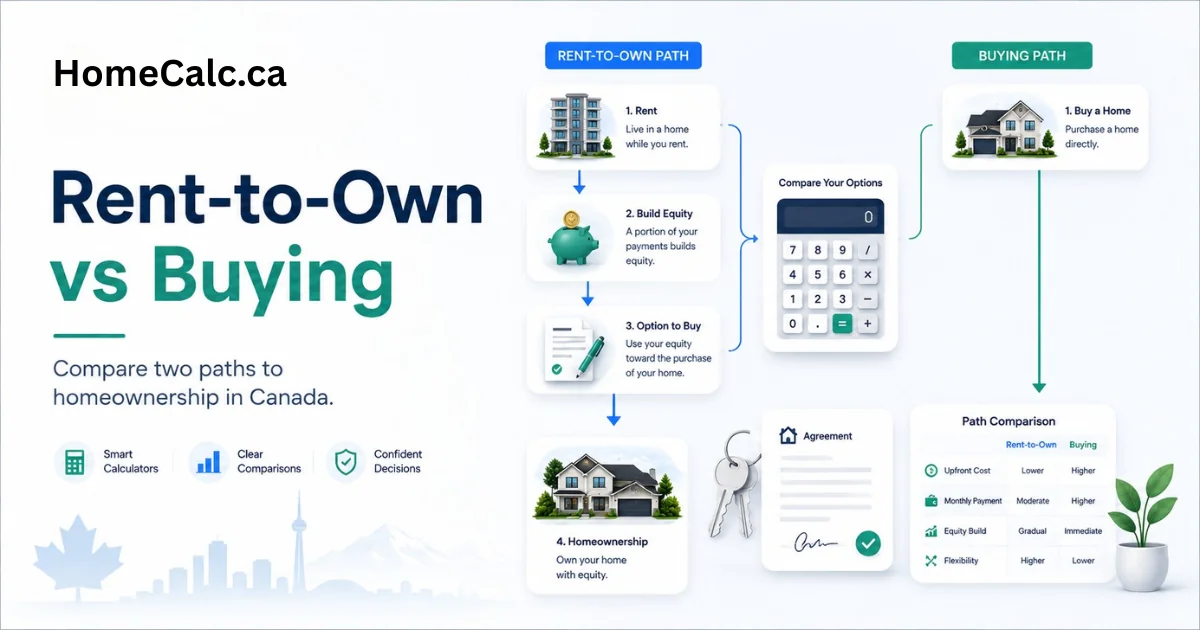
Rent to own is a housing arrangement where you rent a property with an option (or obligation) to buy it at a predetermined price at the end of the lease term — typically 1–5 years. Part of your monthly payment accumulates as "rent credits" toward your future down payment.
The two types of rent-to-own agreements
Option-to-purchase: You have the right, but not the obligation, to buy the home at the end of the term. If you choose not to buy, you walk away — though you typically forfeit the option deposit and may lose some rent credits. Most Canadian programs use this structure.
Lease-purchase: You are contractually obligated to buy the home at the end of the term. Failure to complete the purchase can result in significant penalty fees. This structure is riskier for the tenant-buyer and less common in Canada.
How the money works
- • Option deposit: Typically 2–5% of the agreed purchase price, paid upfront. This is applied to your down payment if you buy. It is usually forfeited if you walk away.
- • Monthly rent: Higher than market rent — the premium covers the rent credit that accumulates toward your down payment.
- • Rent credits: The portion of each monthly payment set aside as down payment savings. Varies by program — typically $200–$600/month.
- • Purchase price: Locked in at signing — this is both the key benefit (protection from price increases) and the key risk (if prices fall, you overpay).
★ Real Example: Requity Homes — Canada's largest rent-to-own provider (March 2026)
• Program: Requity buys the home you choose; you pay rent + savings toward down payment
• Home price range: $150,000 – $600,000
• Standard term: 3 years (you can buy back anytime)
• Purchase price: Locked in at program start
• Rent credits: Fixed savings amount added monthly toward down payment
• Requity pays: Legal fees, title insurance, land transfer tax at purchase
• Client pays: Home inspection + initial deposit (applied to down payment)
• Partner: CMHC-supported + Royal LePage partnership for home selection
• Cities served: Alberta (Calgary, Edmonton, Red Deer, Lethbridge and more), Ontario (Kingston, Windsor, Sault Ste. Marie, Thunder Bay and more), Saskatchewan
• Exit option: Walk away and keep savings per program rules
Source: Requity Homes (www.requityhomes.com), March 2026
Rent to Own vs. Buying Directly: The Full Cost Comparison
This is the most important section. Rent to own costs more than buying directly — that's the fundamental tradeoff. The question is whether the premium is worth what you get in return.
Example: $450,000 home in Calgary (within Requity's program range). Comparing rent-to-own over 3 years vs. buying directly with 5% down today:
| Cost Component | Buying Directly (5% down) | Rent to Own (3-yr program) |
|---|---|---|
| Upfront cost | $22,500 down + $8,000–$12,000 closing | $11,250 option deposit (2.5%) |
| Monthly housing payment | $2,200 (mortgage P+I at 3.94%) | $2,100–$2,400 (rent + premium) |
| CMHC insurance (5% down) | $13,500 added to mortgage | Not applicable during rent phase |
| Rent credits accumulated | N/A — paying own mortgage | ~$12,600 over 3 years ($350/mo) |
| Property tax | $375/month (0.64% of value) | Included in rent or paid separately |
| Maintenance responsibility | Owner pays all | Varies by program — often owner |
| Purchase price protection | Pay market price today | Price locked in — upside protection |
| Price risk | None — you own it | If market drops, you pay more |
| Mortgage qualification | Required now — stress test at 5.94% | Required at end of term only |
| Total cost over 3 years | ~$101,000 (mortgage + tax + CMHC) | ~$82,000–$94,000 (rent + deposit) |
| Equity/savings at end | Significant home equity built | Down payment saved (~$23,850 total) |
★ Key Insight: Why Rent to Own Costs More Long-Term
Over a full 25-year ownership period, someone who used rent to own for 3 years before buying will have paid approximately $30,000–$50,000 more in total housing costs than someone who bought directly with 5% down from the start.
The rent-to-own premium is the price you pay for:
• Time to qualify (build credit score, stabilize income, save more)
• Purchase price certainty in a rising market
• Living in the home before committing to the full purchase
Whether that premium is worth it depends entirely on your situation.
The Real Risks of Rent to Own — What to Watch For
Rent to own is not always the safe bridge it appears to be. Here are the risks you need to understand before signing anything:
Risk 1: Price lock works both ways
Your purchase price is fixed at signing — this protects you if prices rise, but it hurts you if prices fall. In a flat or declining market, you could be paying $450,000 for a home now worth $410,000 at the end of your 3-year term. You'd have to either overpay or walk away and lose your option deposit and rent credits.
Mitigation: Choose rent-to-own only in markets where you'd be comfortable buying at the locked price even if the market declines 5–10%.
Risk 2: You may still not qualify at term end
The purpose of rent to own is to give you time to qualify for a mortgage. But if your credit score, income, or debt situation doesn't improve enough during the rental period, you may be unable to secure a mortgage at term end — and forfeit your option deposit and accumulated rent credits. Some companies are more supportive than others in helping you reach qualification.
Mitigation: Before signing, get a pre-qualification assessment from a mortgage broker who can tell you realistically whether you'll qualify in your target timeframe.
Risk 3: Rent credits may not be what you expect
Read the contract carefully. Some programs apply rent credits toward the down payment; others reduce the purchase price. Some are forfeited entirely if you exit early. The terms vary significantly between providers.
Key question to ask: 'If I walk away in year 2, what do I keep?' Make sure the answer is in writing in the contract before you sign.
Risk 4: Unregulated market — quality varies significantly
There are no government rent-to-own programs in Canada (Source: TD Insurance / Canada.ca, 2026) — the market is entirely private. Program quality, contract terms, and exit protections vary enormously. Requity Homes is CMHC-supported and generally considered the most reputable option, but smaller or individual landlord programs may have far less favourable terms.
Mitigation: Always have a real estate lawyer review the contract before signing. Budget $500–$1,000 for legal review. It is money well spent.
Current Rent-to-Own Programs in Canada — March 2026
There are no federal government rent-to-own programs currently active in Canada, though the Liberal Party of Canada included one in its 2025 election platform. Available programs are all private:
| Program | Price Range | Province(s) | Notable Feature |
|---|---|---|---|
| Requity Homes | $150K – $600K | AB, ON, SK | CMHC-supported; Royal LePage partnership; 3-yr standard term; can buy anytime |
| Divvy Homes | $200K – $700K | Select cities | US-origin model; tenant chooses home; portion of payment builds equity |
| Private landlord programs | Varies | All provinces | Terms vary widely — must use a lawyer; less protection than institutional programs |
| Manitoba Housing (govt) | Existing Housing stock | Manitoba only | Rural Homeownership Program — income-qualified; forgivable loan component |
Source: Requity Homes (requityhomes.com), WOWA.ca, Loans Canada — March 2026.
Who Rent to Own Makes Sense For
Rent to own is a bridge product — it makes sense when direct buying is not yet available to you, but will be within 1–4 years. Specifically:
✓ Rent to own is the right path if:
• You cannot qualify for a mortgage today but realistically will in 1–4 years. Typical reasons: credit score needs to improve (target: 640+ for conventional, 680+ for best rates), self-employment income needs 2 years of tax history, or you need more time to build your down payment.
• You're in a rising market and want to lock in today's price. In Calgary or Edmonton where prices are expected to rise modestly in 2026, locking in a $450,000 price today vs. potentially $480,000 in 3 years is a meaningful financial benefit.
• You want to test the home and neighbourhood before committing. This is a legitimate non-financial reason: living somewhere before owning it reduces the risk of buyer's remorse on your largest financial decision.
• Your option deposit is manageable (2–5% of the purchase price). On a $400,000 home, a 2.5% option deposit is $10,000 — significant but not the $80,000 required for a 20% conventional down payment.
Who Should Buy Directly Instead
If you can qualify for a mortgage today, direct purchase is almost always the better financial decision. Here's why:
✗ Buy directly (not rent to own) if:
• You already qualify for a mortgage. The rent-to-own premium (higher monthly payment, option deposit at risk) is an unnecessary cost if you can already access a mortgage.
• You have enough for at least a 5% down payment. With 5% down and CMHC insurance, you can buy a $500,000 home with $25,000 + closing costs. There's no need to pay a rent-to-own premium for 3 years to save the same amount.
• You're buying in a flat or declining market. Rent to own's price-lock benefit disappears if prices stagnate or fall. In a soft market, direct purchase at a negotiated price is superior.
• You plan to stay in the area long-term. If your horizon is 7+ years, every month you spend in rent-to-own instead of building mortgage equity has a compounding cost.
• You're considering rent to own purely to delay the decision. Indecision is expensive. If your situation doesn't clearly require a bridge period, buying directly builds wealth faster.
use our free rent vs. buy calculator
► Related Reading
full rent vs. buy guide — The complete rent vs. buy guide for Canada 2026
use our free rent vs. buy calculator — Run your personal rent vs. buy numbers
first-time buyer guide — First-time buyer: should you rent or buy your first home?
Frequently Asked Questions
Disclaimer: This article is for informational and educational purposes only. It does not constitute financial, mortgage, or legal advice. Rent-to-own contract terms vary by program — always consult a real estate lawyer and licensed mortgage professional before entering any rent-to-own agreement or home purchase.
Sources: Requity Homes (requityhomes.com, March 2026) · TD Insurance (tdinsurance.com, 2026) · Loans Canada (loanscanada.ca, 2026) · WOWA.ca (March 2026) · Canada.ca / FCAC · Liberal Party of Canada (2025 Platform) · Royal LePage (December 2025) · CMHC (2026) · Bank of Canada (March 18, 2026)