By Hami Tahm · Published October 2026 · Rules and rates checked October 2026
HomeCalc Research · October 2026 edition
Canadian Cash-to-Close Index 2026: How Much Cash You Need to Buy a Home in 17 Canadian Cities
How much cash do you need to buy a home in Canada in 2026?
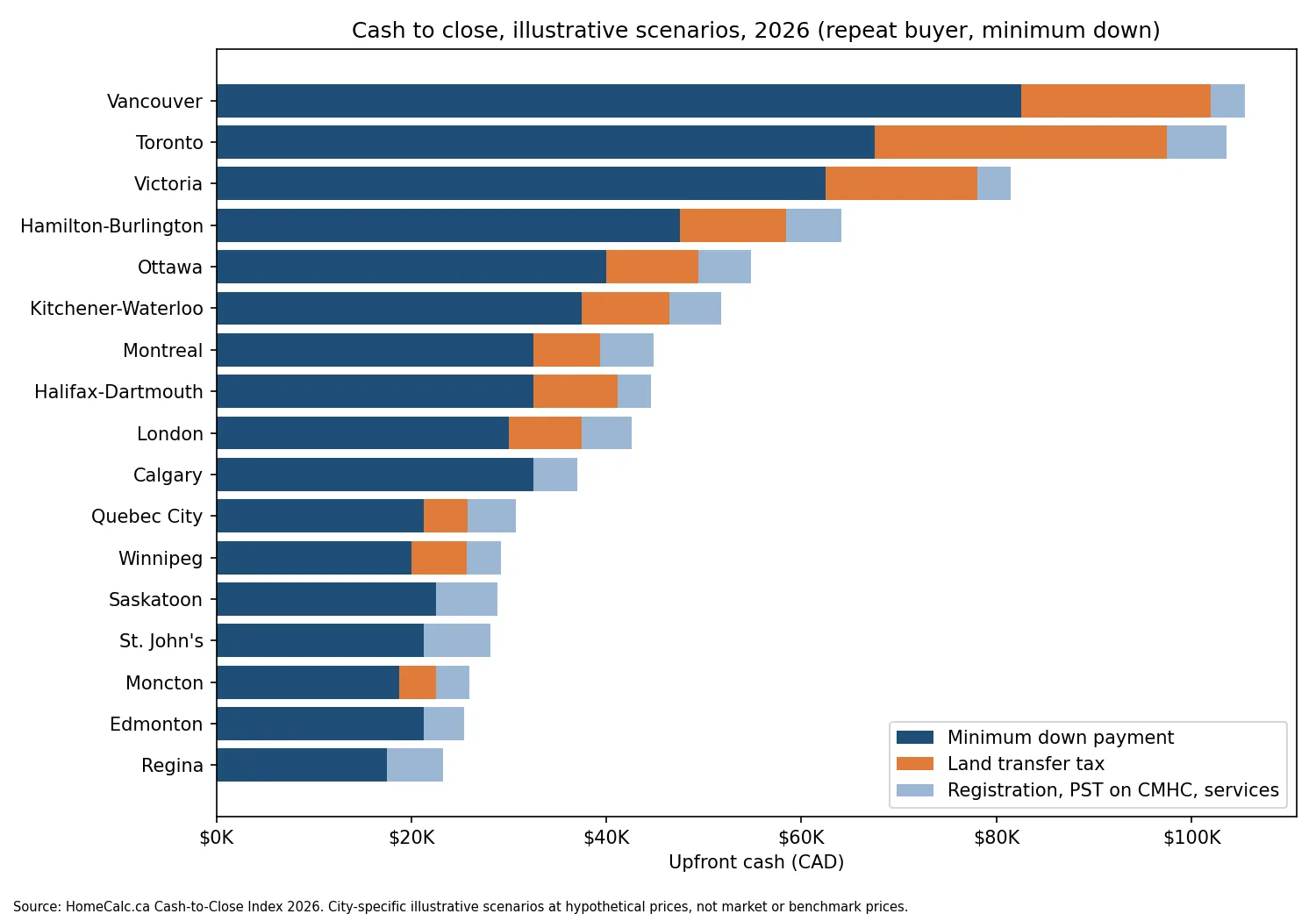
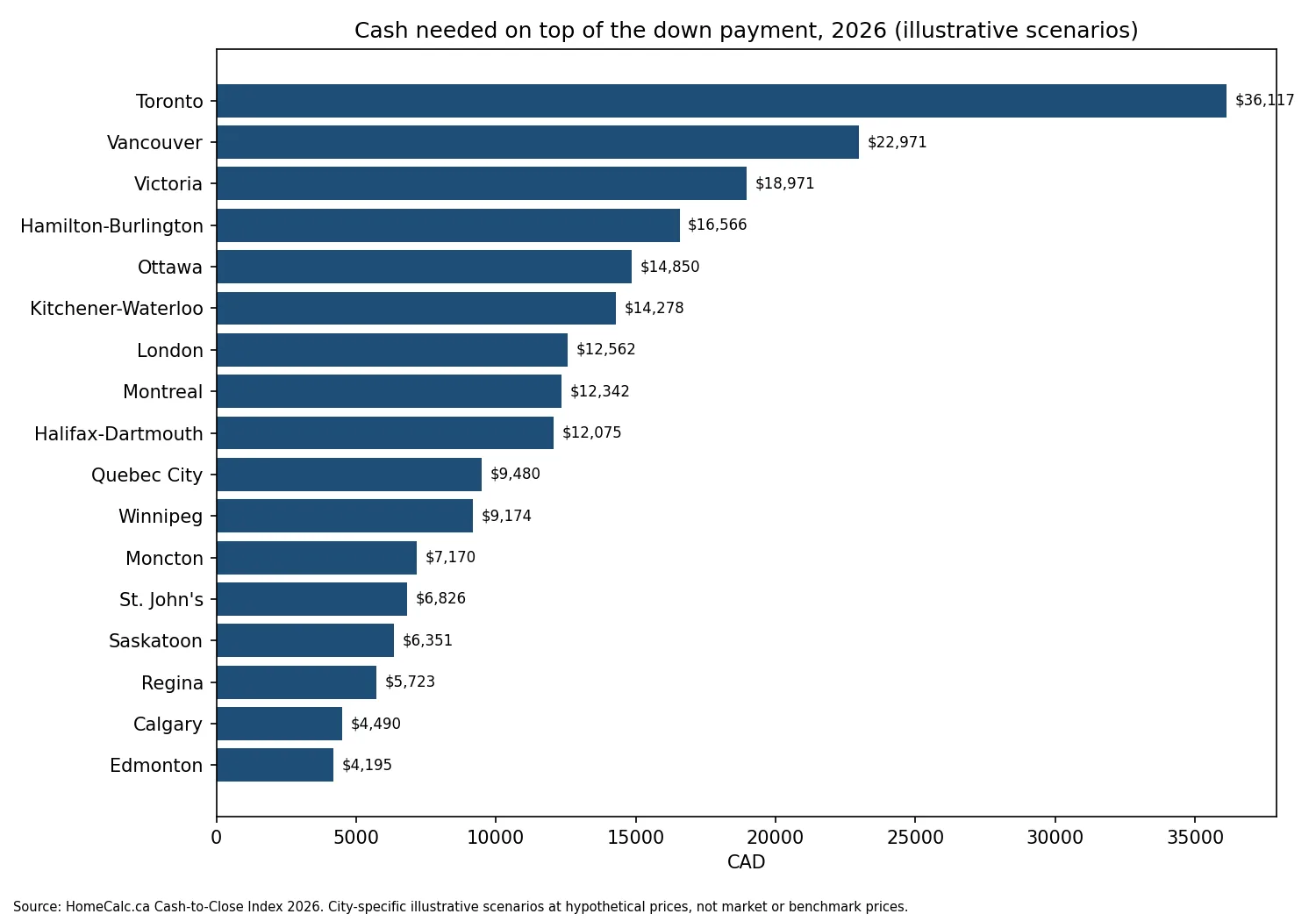
At the illustrative price levels used in this report, buying with the minimum down payment takes about $105,471 in cash in Vancouver and $103,617 in Toronto, but only $23,223 in Regina and $25,445 in Edmonton. The down payment is the biggest part everywhere. What separates the cities is the cash needed on top of the down payment, mostly land transfer tax: $36,117 in Toronto versus $4,195 in Edmonton, about 8.6 times less.
About the prices
Each city is a city-specific HomeCalc illustrative scenario at a round, hypothetical price (to the nearest $25,000). These are not market or benchmark prices and make no claim about actual home sale prices. The point of the index is the rules: the taxes, fees and insurance costs a buyer may face in this scenario at a given price. Plug in your own price with the Closing Cost Calculator.
Key findings
- Toronto has the highest closing costs among the 17 city scenarios in this index. It's the only city in Canada where buyers pay both a provincial land transfer tax and a municipal one. On a $925,000 Toronto home, the two together come to $29,950. That is more than the entire upfront cash, down payment included, needed to buy a $350,000 home in Regina ($23,223).
- The 8.6× gap. On top of the down payment, a Toronto repeat buyer needs $36,117. An Edmonton buyer needs $4,195 and a Calgary buyer $4,490. Alberta charges no land transfer tax, only land-titles registration fees ($1,240 on a $575,000 Calgary purchase, transfer plus mortgage).
- BC's first-time-buyer exemption doesn't reach the Vancouver and Victoria scenarios. BC exempts first-time buyers from property transfer tax only on homes up to $835,000. A partial exemption phases out completely at $860,000. The Vancouver ($1,075,000) and Victoria ($875,000) scenarios are above that ceiling, so a first-time buyer in either gets $0 in relief.
- Ontario's rebates cover part of the bill, not all of it. On a $925,000 Toronto home, the maximum first-time-buyer rebates ($4,000 provincial + $4,475 municipal) cut transfer tax from $29,950 to $21,475. That is still the highest of the 17 scenarios.
- The cash you can't finance. CMHC's mortgage insurance premium is added to the mortgage. But Ontario, Quebec and Saskatchewan charge provincial sales tax on that premium, and the tax must be paid in cash at closing. That's $2,744 on the Toronto home and $1,953 in Montreal.
- Income needed vs. income earned. To pass the federal stress test with the minimum down payment, a household needs roughly $222,000 a year in Vancouver and $202,400 in Toronto. That's about 2× the median family income in both cities. In Regina and Edmonton, the income needed is below the local median.
The 2026 Cash-to-Close Index: 17 cities ranked
Repeat buyer, minimum down payment, 25-year insured mortgage, resale home at the illustrative scenario price. The First-time buyer column assumes a 30-year amortization and all available transfer-tax rebates.
| # | City | Illustrative price | Min. down | Transfer tax | Registration fees | PST on CMHC premium | Cash beyond down | Cash to close | First-time buyer | Income needed | vs. median family income |
|---|---|---|---|---|---|---|---|---|---|---|---|
| 1 | Vancouver | $1,075,000 | $82,500 | $19,500 | $221 | $0 | $22,971 | $105,471 | $105,471 | $222,000 | 2.06× |
| 2 | Toronto | $925,000 | $67,500 | $29,950 | $173 | $2,744 | $36,117 | $103,617 | $95,279 | $202,400 | 1.97× |
| 3 | Victoria | $875,000 | $62,500 | $15,500 | $221 | $0 | $18,971 | $81,471 | $81,471 | $187,400 | 1.54× |
| 4 | Hamilton-Burlington | $725,000 | $47,500 | $10,975 | $173 | $2,168 | $16,566 | $64,066 | $60,174 | $175,100 | 1.52× |
| 5 | Ottawa | $650,000 | $40,000 | $9,475 | $173 | $1,952 | $14,850 | $54,850 | $50,948 | $153,000 | 1.14× |
| 6 | Kitchener-Waterloo | $625,000 | $37,500 | $8,975 | $173 | $1,880 | $14,278 | $51,778 | $47,872 | $149,700 | 1.37× |
| 7 | Montreal | $575,000 | $32,500 | $6,849 | $290 | $1,953 | $12,342 | $44,842 | $44,940 | $127,400 | 1.18× |
| 8 | Halifax-Dartmouth | $575,000 | $32,500 | $8,625 | $200 | $0 | $12,075 | $44,575 | $44,575 | $134,400 | 1.24× |
| 9 | London | $550,000 | $30,000 | $7,475 | $173 | $1,664 | $12,562 | $42,562 | $38,645 | $137,300 | 1.38× |
| 10 | Calgary | $575,000 | $32,500 | $0 | $1,240 | $0 | $4,490 | $36,990 | $36,995 | $127,500 | 1.09× |
| 11 | Quebec City | $425,000 | $21,250 | $4,486 | $290 | $1,454 | $9,480 | $30,730 | $30,802 | $96,500 | 0.82× |
| 12 | Winnipeg | $400,000 | $20,000 | $5,650 | $274 | $0 | $9,174 | $29,174 | $29,174 | $96,900 | 0.95× |
| 13 | Saskatoon | $450,000 | $22,500 | $0 | $2,075 | $1,026 | $6,351 | $28,851 | $28,902 | $105,500 | 0.95× |
| 14 | St. John's | $425,000 | $21,250 | $0 | $3,576 | $0 | $6,826 | $28,076 | $28,079 | $98,300 | 0.87× |
| 15 | Moncton | $375,000 | $18,750 | $3,750 | $170 | $0 | $7,170 | $25,920 | $25,920 | n/a | n/a |
| 16 | Edmonton | $425,000 | $21,250 | $0 | $945 | $0 | $4,195 | $25,445 | $25,450 | $99,700 | 0.87× |
| 17 | Regina | $350,000 | $17,500 | $0 | $1,675 | $798 | $5,723 | $23,223 | $23,263 | $84,800 | 0.75× |
- Every row includes an estimated $3,250 for services a buyer may pay in this scenario (not all are mandatory): legal $2,000, title insurance $400, inspection $500 and appraisal $350. These are the defaults in HomeCalc's Closing Cost Calculator.
- Registration fees cover registering both the transfer and the mortgage. In Saskatchewan and Newfoundland & Labrador these are value-based fees rather than a tax.
- In some provinces the first-time-buyer total is slightly higher than the repeat-buyer total. The 30-year amortization carries a 0.20-point higher CMHC premium, and Quebec and Saskatchewan charge sales tax on it.
- Moncton has no income figure because we had no verified 2026 residential tax rate for it.
Where the upfront cash goes
| City | Illustrative price | Cash beyond down |
|---|---|---|
| Toronto | $925,000 | $36,117 |
| Vancouver | $1,075,000 | $22,971 |
| Victoria | $875,000 | $18,971 |
| Hamilton-Burlington | $725,000 | $16,566 |
| Ottawa | $650,000 | $14,850 |
| Kitchener-Waterloo | $625,000 | $14,278 |
| London | $550,000 | $12,562 |
| Montreal | $575,000 | $12,342 |
| Halifax-Dartmouth | $575,000 | $12,075 |
| Quebec City | $425,000 | $9,480 |
| Winnipeg | $400,000 | $9,174 |
| Moncton | $375,000 | $7,170 |
| St. John's | $425,000 | $6,826 |
| Saskatoon | $450,000 | $6,351 |
| Regina | $350,000 | $5,723 |
| Calgary | $575,000 | $4,490 |
| Edmonton | $425,000 | $4,195 |
Five stories in the data
1. Toronto's double tax. Toronto buyers pay Ontario's land transfer tax and the City's municipal land transfer tax (MLTT), and the two use near-identical brackets. On a $925,000 home, the MLTT alone is $14,975. That is more than the total cash needed beyond the down payment in 13 of the other 16 cities in this index.
The MLTT has become part of Toronto's 2026 municipal debate, including the idea of exempting principal-residence buyers on the first $1.1 million of the price. Under that scenario, this buyer would need $21,142 beyond the down payment instead of $36,117. On the other side of the ledger, the tax brought the City about $805 million in 2025 (CP24), revenue that would have to be replaced. HomeCalc takes no position; these figures only show what's at stake for a buyer.
2. The Alberta advantage. At the same $575,000 price, a Calgary buyer needs $7,852 less cash beyond the down payment than a Montreal buyer. Alberta has no land transfer tax and no sales tax on mortgage insurance.
3. BC's relief stops below the BC scenarios. The first-time-buyer property transfer tax exemption is worth up to $8,000 on homes up to $835,000, and it is gone entirely above $860,000. In Vancouver and Victoria, a first-time buyer at the scenario price pays the full tax: $19,500 and $15,500.
4. Quebec's “welcome tax.” Quebec buyers pay municipal transfer duties (the taxe de bienvenue), and there's no general first-time-buyer exemption. On top of that, Quebec charges 9% sales tax on the CMHC premium, the highest such rate in the country. A Montreal first-time buyer needs $12,440 beyond the down payment. That's about $3,800 more than a London, Ontario first-time buyer at a similar price. Quebec welcome tax calculator.
5. Where the math still works. In six markets, the income needed to qualify is below the local median family income: Regina, Quebec City, Edmonton, St. John's, Winnipeg and Saskatoon. All six need less than $31,000 in total upfront cash.
Methodology
- Prices. Each city is a city-specific HomeCalc illustrative scenario at a round, hypothetical price (nearest $25,000). These are not market or benchmark prices and make no claim about actual home sale prices. Toronto uses a City of Toronto scenario, because the municipal land transfer tax applies only inside the city.
- Down payment. The federal minimum: 5% of the first $500,000 and 10% of the portion above (FCAC).
- Mortgage insurance. The CMHC premium is 4.00% at 95% loan-to-value, or 4.20% for a 30-year first-time-buyer amortization (CMHC). The premium itself is financed, so it isn't counted as cash. The provincial sales tax on it (8% in ON, 9% in QC, 6% in SK) is counted as cash.
- Transfer taxes. Each province's statutory brackets, as implemented in HomeCalc's Land Transfer Tax Calculator. This includes Toronto's MLTT, Quebec municipal duties (Montreal's own schedule; the provincial base schedule for Quebec City), Halifax's 1.5% deed transfer tax and New Brunswick's 1%. First-time-buyer rebates are Ontario $4,000, Toronto $4,475, and the BC exemption up to $835,000, phasing out to $860,000.
- Registration fees. Fees from each provincial land registry for both the transfer and the mortgage, as of October 2026.
- Income needed. Based on a gross debt service (GDS) ratio of 39%, using principal and interest at the federal stress-test rate, plus property tax and $100 a month for heating. The stress-test rate is 6.34%: the greater of the contract rate + 2 points and 5.25% (OSFI). The contract rate is 4.34%, HomeCalc's insured 5-year fixed guide rate as of October 12, 2026. Amortization is 25 years; property tax uses each city's 2026 residential rate. Medians are StatCan's median total income of all census families for 2023 (Table 11-10-0009), the latest available year. Because incomes have grown since then, the ratio runs a little high.
- Not included: property-tax and utility adjustments at closing, moving costs, GST/HST on new builds, and the federal Home Buyers' Amount (a tax credit of up to $1,500 claimed later at tax time). All four vary too much by buyer to show as a single city figure.
This is an illustrative estimate, not financial or legal advice. Exact amounts depend on the property, the lender and your lawyer.
Frequently Asked Questions
Cite this report
HomeCalc.ca, Canadian Cash-to-Close Index 2026, October 2026, homecalc.ca/reports/cash-to-close-index-2026. Media: hami@homecalc.ca
Rule sources
▶ Your purchase won't match these scenarios exactly — run your own numbers
- Closing cost calculatorEvery upfront cost for your price and province.
- Land transfer tax calculatorAll 13 provinces and territories, plus Toronto and Montreal.
- Down payment calculatorMinimum down payment and CMHC premium.
- Mortgage qualifierThe income you need to pass the stress test.
Last reviewed: October 2026 · Disclaimer