House Flipping in Canada: A Beginner's Complete Guide
By Hami Tahm · Published March 2026 · Updated September 2026 · 14 min read
What is house flipping in Canada?
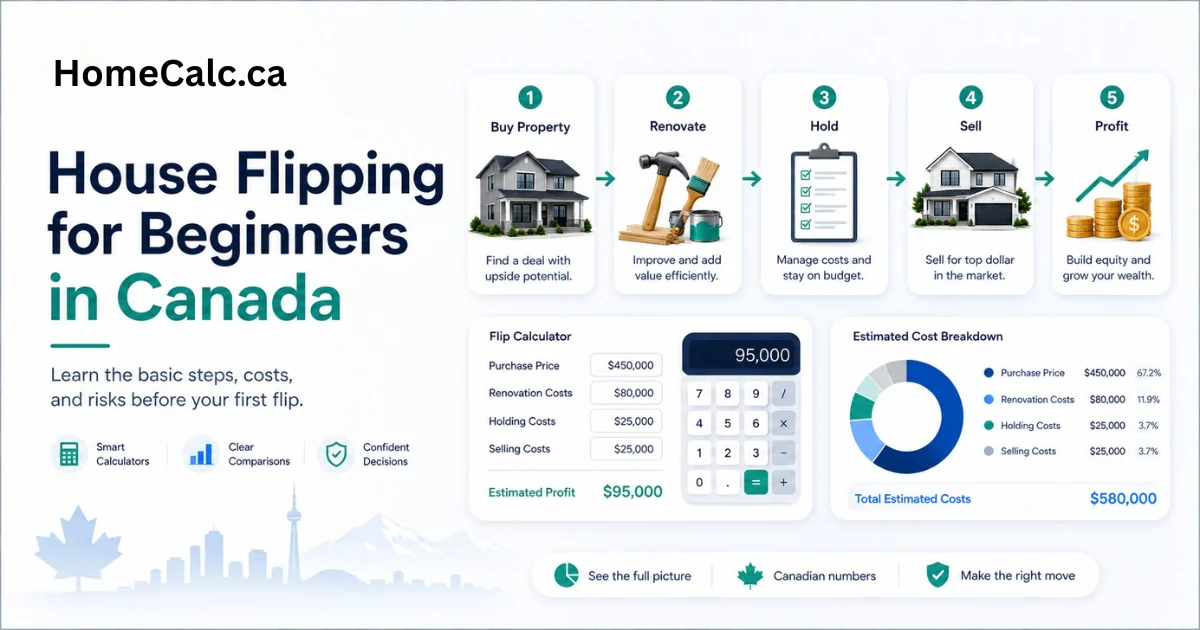
House flipping in Canada means buying a property below market value, renovating it, and reselling for profit — typically within 12 months. Canadian flippers averaged $50,000–$90,000 gross profit per deal in recent years, though margins vary sharply by city and market conditions. Key costs include purchase price, renovations, carrying costs, agent commissions (~5%), and tax — which may be treated as business income rather than capital gains. Ontario is Canada's most active flipping market.
Key Takeaways
- House flipping profits in Canada are usually taxed as business income — not capital gains — at your full marginal rate. For 365+ day holds that qualify as capital gains, the inclusion rate is 50% on all capital gains (the proposed 2/3 rate above $250,000 was cancelled March 21, 2025).
- The 70% rule caps your maximum purchase offer at 70% of ARV minus renovation costs — the single most important guardrail for protecting flip margins.
- Ontario is Canada's most active flipping market. Toronto adds a second layer of land transfer tax (Municipal LTT on top of provincial LTT) that can add $12,000–$20,000+ to acquisition costs.
- Budget flips under $50K renovation target cosmetic upgrades — kitchens, bathrooms, and curb appeal deliver the highest ROI. Target Hamilton, Windsor, and other mid-sized Ontario markets to reduce entry capital.
- BC's Home Flipping Tax adds an additional 20% surcharge on properties sold within 365 days of purchase, declining to 0% at 730 days — on top of federal income tax.
What Is House Flipping in Canada?
House flipping in Canada is the practice of purchasing a residential property, improving it through renovations, and selling it at a profit within a short period — usually under 12 months. Unlike long-term investing, flipping is treated by the CRA as active business income in most cases, making tax planning critical. Model your deal math first with the house flipping calculator and screen every deal with the 70% rule calculator before committing.
How House Flipping Differs from Long-Term Investing
Long-term real estate investing focuses on rental income and capital appreciation over years or decades. Flipping is an active business — your return comes from a single transaction, and your timeline is measured in months. Tax treatment differs sharply: rental income and long-term capital gains receive more favourable tax treatment than flip profits classified as business income. Flipping also requires active management of renovations and sales timelines, where delays directly reduce net profit through carrying costs.
Is House Flipping Legal in Canada?
Yes — house flipping is entirely legal in Canada. The CRA's rules govern how profits are taxed, not whether flipping is permitted. All required permits for renovation work must be obtained from the relevant municipality, and all income must be reported. The taxes on house flipping in Canada guide covers CRA classification in detail.
How to Flip a House in Canada: Step-by-Step
Flipping a house in Canada involves six core steps: setting a budget and target ROI, finding an undervalued property, securing financing, completing renovations on time and on budget, listing and selling strategically, and accounting for all taxes owed. Missing any step — especially tax planning — is the most common reason beginners lose money.
Step 1 — Set your budget and target return
Define your maximum purchase price, renovation budget, target ROI, and exit price before viewing any property. Use the house flipping calculator to model scenarios. Beginners should target a minimum 15–20% net profit margin to absorb cost overruns and holding period variance.
Step 2 — Find and evaluate a property using the 70% rule
Screen every deal with the formula: max offer = ARV × 70% − renovation costs. Source properties through MLS, estate sales, and power-of-sale listings. Use the 70% rule calculator to run numbers before making any offer.
Step 3 — Secure financing
Arrange financing before making an offer. Down payment requirements depend on the property and the lender, not a single national rule: CMHC's Income Property insurance caps a non-owner-occupied 2–4 unit rental at 80% LTV, so 20% equity, and only under that product's own conditions. A flip, a single-unit rental, a 5+ unit building or private financing can each require more. Confirm the actual requirement with your lender or broker, along with carrying cost assumptions and approval conditions, before bidding.
Step 4 — Complete renovations on time and on budget
Focus on high-ROI upgrades — kitchen, bathrooms, and curb appeal. Build a 15–20% contingency into your renovation budget. Use licensed contractors for all permitted work and make milestone-based payments rather than lump sums. Use the renovation ROI calculator to prioritize upgrades.
Step 5 — List and sell the property
Price based on comparable sold sales, not list prices. Factor agent commissions (~5%) into your selling cost model. Target a sale within 3–6 months of purchase to minimize carrying costs.
Step 6 — Calculate net profit and tax owing
Net profit = sale proceeds minus all costs. In most cases, CRA classifies flip profits as business income — fully taxable at your marginal rate. Use the house flip tax calculator to estimate tax. Consult a CPA before filing.
Step 1 — Set Your Budget and Target Return
Before looking at a single property, know three numbers: ARV (after-repair value — the estimated market value after renovation, based on comparable sold prices in the neighbourhood), your renovation cost estimate, and your maximum offer price from the 70% rule. A cosmetic flip in Ontario (kitchen, bathrooms, paint, flooring) typically runs $25,000–$50,000 in renovation costs. Always get contractor quotes before finalizing your budget.
Step 2 — Find and Evaluate a Property (Use the 70% Rule)
The 70% Rule at a Glance
For your first flip, prioritize cosmetic renovations — dated interiors with functional mechanicals, no structural or foundation issues. Estate sales, power-of-sale listings, and properties with 60+ days on market are common entry points. In Ontario, look outside Toronto for your first deal: Hamilton, London, Barrie, and Kitchener offer lower LTT, lower carrying costs, and more forgiving margins.
Step 3 — Finance the Flip
Assemble your financing team before making any offer: a mortgage broker who works with investment properties, a real estate lawyer familiar with investment transactions, and a general contractor who can provide pre-offer renovation estimates. Investment properties require minimum 20% down in Canada — rates are higher than owner-occupied. Know your approval amount and conditions before bidding.
Step 4 — Renovate Efficiently
Once possession closes, your renovation management determines profitability. Add 15–20% contingency to every contractor quote — budget overruns are standard, not exceptions. Use milestone-based payments (not lump-sum), visit the site weekly, and track actual costs vs. budget in real time. A cosmetic flip in Ontario should target 60–90 days. Every additional month in carrying costs reduces profit by $2,500–$5,000+.
Step 5 — List and Sell
Stage the property before listing — staging typically reduces days on market and can add perceived value exceeding its cost. Price at or slightly below market value based on comparable sold prices to generate competition. In a balanced market, strategic pricing below comparables outperforms high asking prices with later reductions.
Step 6 — Calculate Your Net Profit and Tax Owing
After closing, compare actual results to your original model. Where did costs overrun? Was your ARV accurate? File correctly — if you sold within 365 days, the CRA Schedule 3 capital gains reporting is where a capital gain gets reported, but the Residential Property Flipping Rule (effective January 1, 2023) is created by the Income Tax Act, not by the form: a property owned less than 365 consecutive days is deemed business income and reported on Form T2125 instead. A CPA who handles real estate investor returns typically costs $500–$1,500 and saves significantly more.
How Much Does It Cost to Flip a House in Canada?
The total cost to flip a house in Canada typically ranges from $350,000 to $700,000+, depending on the market. This includes the purchase price, renovation costs ($30,000–$150,000), carrying costs (mortgage interest, property tax, insurance), closing costs on both ends (~3–5% each), and agent commissions (~5%). In Ontario's major cities, renovation budgets alone often exceed $80,000. For a full cost breakdown by scenario, see the real cost to flip a house in Canada guide and how much it costs to flip a house in Ontario.
Renovation Cost Breakdown
| Renovation Category | Typical Cost Range (Canada) |
|---|---|
| Kitchen update (cosmetic) | $15,000–$40,000 |
| Bathroom update (cosmetic) | $8,000–$20,000 |
| Flooring (full house) | $8,000–$20,000 |
| Paint + trim (full house) | $4,000–$10,000 |
| Curb appeal + landscaping | $3,000–$12,000 |
Ranges are approximate for May 2026.
Carrying Costs and Holding Period
Carrying costs accumulate every month you hold the property: mortgage payments, property tax, insurance, and utilities. At a 6% rate on a $480,000 mortgage (80% of a $600K property), that's roughly $2,000/month in mortgage interest alone, plus ~$500–$800/month in tax and insurance. A 4-month hold adds $10,000–$11,000 in carrying costs before renovation is even considered. Every month of delay reduces net profit dollar-for-dollar.
Closing Costs on Purchase and Sale
Closing costs on purchase include land transfer tax (Ontario provincial: ~$8,475 on a $600K property; Toronto adds Municipal MLTT on top), legal fees ($1,500–$2,500), and home inspection ($500–$700). On the sale side: agent commission (~5% of sale price, plus HST on commission), legal fees ($1,000–$1,500), and staging ($3,000–$8,000). These costs are fixed and non-recoverable — they must be in your model before you make an offer.
→ Model your full cost stack in the house flipping calculator
House Flipping in Ontario: What You Need to Know
Ontario is Canada's busiest house flipping market, with the GTA accounting for a disproportionate share of flip transactions. Key Ontario-specific factors include the Municipal Land Transfer Tax in Toronto (on top of provincial LTT), higher purchase prices, strong renovation contractor demand, and CRA scrutiny of repeat flippers who may be classified as carrying on a business.
GTA vs. Mid-Sized Ontario Markets
| Market | Typical Purchase Price | Approx. LTT Cost | Notes |
|---|---|---|---|
| Toronto (GTA) | $800K–$1.2M+ | Provincial + Municipal MLTT | Highest entry cost; MLTT adds ~$12K–$20K+ |
| Hamilton | $500K–$750K | Provincial only | Active investor market; lower entry |
| Ottawa | $500K–$700K | Provincial only | Stable demand; no MLTT |
| Windsor / Sudbury | $300K–$500K | Provincial only | Budget flip targets; lower competition |
Purchase price ranges are approximate.
Land Transfer Tax Impact on Margins
Ontario's Land Transfer Tax adds thousands to every purchase — and it's non-refundable. On a $600,000 property, the provincial LTT is approximately $8,475. Buy in Toronto and add another ~$8,475 in Municipal MLTT — $16,950 total before renovation starts. Beginners who don't factor LTT into their offer price end up with compressed margins before a single wall is touched. Always model LTT before bidding: Ontario land transfer tax calculator | Toronto land transfer tax calculator | Manitoba land transfer tax calculator | BC property transfer tax calculator.
Ontario Renovation Permits and Timelines
Most cosmetic renovations (paint, flooring, cabinet replacement) do not require permits in Ontario. Structural work, electrical panel upgrades, plumbing changes, and additions require municipal building permits — and permit timelines vary significantly by municipality. Toronto publishes a service standard of 10 business days to review a complete house application, but an incomplete application has no committed timeframe, and the City's own data shows an average of roughly 61 business days from intake to issuance across all building permits (January 2022 to March 2026). Treat the 10-day standard as the review clock, not the elapsed time, and plan permits into your holding period model before committing to a sale date.
How to Flip a House on a Budget
Flipping a house on a budget in Canada means targeting lower-priced markets, limiting cosmetic renovations, doing non-licensed work yourself, and using the 70% rule strictly to avoid overpaying. Budget flips typically cap renovations at $30,000–$50,000 and focus on kitchens, bathrooms, and curb appeal for maximum ROI.
Target Markets for Budget Flips
Hamilton, Windsor, Sudbury, and smaller Ontario cities offer purchase prices in the $300K–$500K range — significantly lower entry capital and LTT than Toronto. Alberta markets (Calgary, Edmonton) have no provincial land transfer tax, further reducing acquisition costs. These markets also tend to have lower contractor demand, making renovation scheduling more predictable.
High-ROI Renovations Under $50,000
On a budget flip, every dollar of renovation should target the highest buyer-perceived value. Kitchen updates (cosmetic — new cabinet doors, countertops, hardware, appliances) consistently deliver the highest ROI. Bathroom refreshes (new vanity, fixtures, tile) follow. Full-house paint and flooring refresh the entire property for relatively low cost. Avoid structural work, additions, or full gut renovations on a budget flip — cost overrun risk is too high. Use the renovation ROI calculator to rank upgrades before committing.
The 70% Rule as a Budget Guardrail
The 70% Rule at a Glance
On a budget flip, the 70% rule is non-negotiable. If the asking price exceeds your maximum offer, walk away — there is no margin to absorb both a higher purchase price and a $50,000 renovation. The average profit from house flipping in Canada documented in the average profit guide shows how thin margins get when the 70% rule is violated.
Taxes on House Flipping in Canada
CRA Classification Warning
In Canada, house flipping profits are almost always taxed as business income — not capital gains — if you flip regularly or purchased with intent to resell. Business income is 100% taxable at your marginal rate. For properties held 365+ days that qualify as capital gains, individuals pay tax at a 50% inclusion rate on all capital gains (the proposed 2/3 rate above $250,000 was cancelled March 21, 2025). BC has an additional provincial Home Flipping Tax for sales within 730 days.
Business Income vs. Capital Gains — CRA Rules
The CRA applies a facts-and-circumstances test to determine whether a gain is business income or a capital gain. Factors include: frequency of similar transactions, length of ownership, improvements made, the taxpayer's occupation, and stated intent at time of purchase. Since January 1, 2023, the CRA Schedule 3 capital gains reporting is the form used when a disposition is a capital gain. Separately, the Income Tax Act deems any property owned less than 365 consecutive days to be business income regardless of intent, reported on Form T2125. Past that threshold the deeming rule stops applying, but CRA still treats income-versus-capital as a question of fact. See the house flipping tax guide for the full breakdown. Use the capital gains tax calculator to model your after-tax outcome for 365+ day scenarios.
BC Home Flipping Tax
BC Residents: Additional Flip Tax Applies
BC flippers face federal business income tax and the provincial Home Flipping Tax simultaneously on sub-365-day sales. BC's tax applies on top of — not instead of — federal income tax, significantly compressing margins on short-hold BC deals. Estimate both layers with the BC home flipping tax calculator.
How to Report House Flipping Income
Business income from house flips is reported on Schedule T2125 (Statement of Business or Professional Activities) of your T1 return. Capital gains are reported on Schedule 3. Deductible expenses against flip income include renovation costs, carrying costs (mortgage interest, property tax, insurance), acquisition closing costs, and selling costs. Keep all receipts — CRA audits of flippers are common. A CPA who handles real estate investor returns is strongly recommended for your first flip.
Is House Flipping Worth It in Canada in 2026?
The honest answer depends on the specific deal. Flipping is not a passive income strategy — it's an active, capital-intensive business that rewards thorough number analysis and realistic risk management.
Average Profit Margins by City
According to data in the average profit from house flipping in Canada analysis, national mid-scenario net profit is approximately $64,000 before tax, or ~$55,000 after capital gains tax for flips held over 12 months. In mid-range Ontario cities, that's achievable. In Toronto on a low-scenario cosmetic flip, margins can compress to under $10,000 before tax — which effectively means break-even after unexpected costs.
Risk Factors: Rising Rates, Permit Delays, Cost Overruns
The three most common ways beginners lose money on Canadian flips: (1) renovation cost overruns exceeding the contingency budget, especially on older properties where hidden damage is common; (2) permit delays extending the hold period and carrying costs; (3) a market softening between purchase and sale that reduces achievable ARV. Every one of these can turn a $50,000 projected profit into a loss. Budget conservatively on all three.
When Flipping Makes Sense vs. Long-Term Hold
Flipping makes sense when: your 70% rule math works at the current asking price, you have sufficient liquid capital beyond the down payment, and you can actively manage the renovation. A long-term hold makes more sense when: the property generates positive cash flow as a rental, purchase prices are elevated (making the 70% rule hard to satisfy), or your time and capital are better deployed elsewhere. If you're considering lot splits or multi-unit development, model those scenarios in the property development calculator.
House Flipping Calculators and Tools
Run every deal through these free calculators before making an offer. No calculator replaces a CPA or real estate professional — but these tools prevent the most common number errors.
- House Flipping Calculator — enter purchase price, reno budget, hold period, and target sale price to see projected net profit
- 70% Rule Calculator — calculate your maximum offer price from ARV and renovation costs
- House Flip Tax Calculator — compare business income vs. capital gains tax treatment on your flip profit
- Renovation ROI Calculator — prioritize renovations by estimated return before committing budget
Frequently Asked Questions
- Is house flipping profitable in Canada?
- House flipping can be profitable, with average gross profits of $50,000–$90,000 per deal. Net profitability depends on purchase price, renovation budget, hold period, and tax treatment. Margins have compressed in slower markets since 2022.
- Do you pay capital gains on house flipping in Canada?
- Usually no — CRA treats flip profits as business income at 100% of your marginal rate. If a flip qualifies as capital gains (365+ day hold), the inclusion rate is 50% on all capital gains (the proposed 2/3 rate above $250,000 was cancelled March 21, 2025).
- How much money do you need to flip a house in Canada?
- Typically $80,000–$150,000 in accessible capital covering down payment (20–25%), renovation costs, and carrying costs. At 20% down on a $350K property, capital requirements can reach $110K–$160K before renovation.
- Is flipping houses worth it in Ontario?
- Viable in mid-sized markets (Hamilton, Windsor) with lower entry costs. Toronto requires larger capital and higher land transfer tax at purchase (provincial LTT plus Municipal LTT). LTT is paid by the buyer on acquisition only, not again on sale.