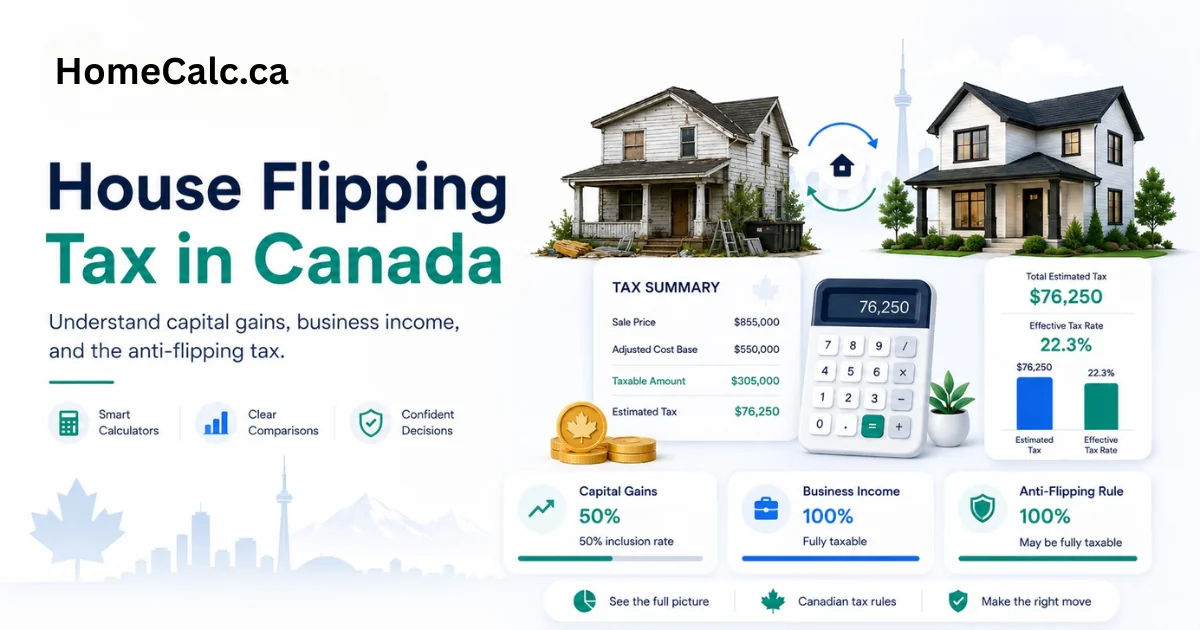
House Flipping Tax in Canada
By Hami Tahm · Published March 2026 · Updated September 2026 · 10 min read
House flipping in Canada triggers one of two very different tax outcomes: business income (100% taxable at your marginal rate) or capital gains (partially sheltered). Which applies depends primarily on how long you held the property — and since January 1, 2023, the CRA's Residential Property Flipping Rule has made that threshold automatic. Model your deal math first with the house flipping calculator, then stress-test the tax outcome with the house flip tax calculator. For general flip strategy, start with house flipping for beginners in Canada.
Key Takeaways
- Canada's federal Residential Property Flipping Rule (January 1, 2023) treats profits from properties sold within 365 days as fully taxable business income — the principal residence exemption cannot apply.
- Holding for 365 consecutive days or more stops the automatic deeming rule from applying. It does not by itself make the profit a capital gain — CRA treats that as a question of fact based on your intention when you bought. If the profit is a capital gain, the 50% inclusion rate applies (the proposed 2/3 rate above $250,000 was cancelled March 21, 2025), and the principal residence exemption may apply if you genuinely lived there.
- CRA life event exemptions — nine categories on the CRA flipping rule page, including death, household change, separation after 90+ days apart, safety threats, illness or disability, involuntary job loss, eligible relocation, insolvency, and destruction or expropriation — can override the rule on sub-365-day sales if documented.
- BC introduced a separate provincial Home Flipping Tax (effective January 1, 2025) on sales within 730 days — 20% for the first year, declining by formula to 0% at 2 years. Ontario and Alberta have no equivalent provincial tax.
- Maximizing deductible expenses (renovation costs, carrying costs, selling costs) reduces taxable profit regardless of how the gain is classified.
What Is the House Flipping Tax in Canada?
Canada's Residential Property Flipping Rule, effective January 1, 2023, automatically treats profits from selling a property within 365 days of purchase as business income — fully taxable at your marginal rate. The principal residence exemption does not apply to sub-365-day sales under this rule. It was introduced in the 2022 federal budget to address speculative flipping and applies to all residential properties in Canada regardless of province. Use the house flip tax calculator to estimate your tax owing under both scenarios. British Columbia layers its own BC Home Flipping Tax on top of this federal rule — if you're selling there, see the BC home flipping tax calculator.
CRA Residential Property Flipping Rule — Effective January 1, 2023
The 365-Day Rule — How It Works
The rule is mechanical: if you purchase and sell within 365 days, the CRA presumes the profit is business income. There is no intent test under this rule — unlike the older common-law test for frequent flippers, the 365-day rule triggers automatically. The only overrides are qualifying life event exemptions (see Strategy 2 below). If you hold for 365 consecutive days or more, the automatic rule does not apply and the normal business income vs. capital gains analysis takes over.
When Did the Anti-Flipping Tax Start?
The federal Residential Property Flipping Rule took effect January 1, 2023, introduced in Budget 2022. A separate provincial rule — BC's Home Flipping Tax — took effect January 1, 2025. Ontario and Alberta have not introduced equivalent provincial taxes as of September 2026.
How to Reduce House Flipping Tax in Canada
How do you avoid house flipping tax in Canada?
Holding for 365 consecutive days or more stops the automatic deeming rule from applying. It does not guarantee capital gains treatment: CRA states the character of the profit then remains a question of fact, judged on why you bought the property. Someone who buys intending to resell for profit can still be assessed as business income after 365 days. Where the profit is a capital gain, the 50% inclusion rate applies (the proposed 2/3 rate above $250,000 was cancelled March 21, 2025), and the principal residence exemption may apply if you genuinely lived there. If you must sell within 365 days, a qualifying CRA life event exemption is the alternative legal path.
There are five concrete strategies. The steps below mirror the HowTo schema served to Google — use them as a pre-sale checklist. For deal-level profit modeling, use the house flipping calculator before committing to a hold strategy.
Step 1 — Check your hold period against the 365-day threshold
Sub-365 days means automatic business income — 100% of profit is taxable at your marginal rate and the principal residence exemption cannot apply. 365 consecutive days or more means the automatic classification no longer applies; profits may qualify as capital gains (50% inclusion rate on all capital gains — the proposed 2/3 rate above $250,000 was cancelled March 21, 2025) or the principal residence exemption if you lived there.
Step 2 — Determine if a life event exemption applies
If selling within 365 days, check whether a CRA-listed life event applies: death; household change (birth, adoption, joining a related person's household); marriage or common-law breakdown after 90+ days living apart; threat to personal safety; serious disability or illness; involuntary job loss; eligible relocation; insolvency; or destruction or expropriation of the property. Document thoroughly — the CRA expects records linking the sale to the event.
Step 3 — Allocate your costs correctly for the classification
How a cost is treated depends on the classification. If the profit is business income, reasonable business expenses — renovation labour and materials, permits, carrying costs, commission and legal fees on sale — are claimed on Form T2125. If the profit is a capital gain, the treatment splits: acquisition costs and capital improvements are added to the adjusted cost base, selling outlays are deducted from proceeds, and current repairs and maintenance cannot simply be added to the ACB. Personal expenses are never deductible either way. Keep every receipt and have a CPA allocate them — the split is fact-specific.
Step 4 — Assess principal residence eligibility
Genuine occupancy as your primary residence for the full hold period is required, and the hold must exceed 365 days. The principal residence exemption is not automatic — it must be designated on your tax return. It cannot be claimed for sub-365-day sales under the 2023 CRA rule.
Step 5 — Consult a CPA before selling
House flipping tax rules are complex and highly fact-specific. A CPA with real estate experience can assess your exemption eligibility, determine the correct income vs. capital gains classification, and advise on timing and structuring options before the sale closes.
Strategy 1 — Hold Beyond 365 Days
Holding for at least 365 consecutive days removes the automatic business income designation. After that point, profits may be taxed as capital gains — at a 50% inclusion rate on all capital gains (the proposed 2/3 rate above $250,000 was cancelled March 21, 2025). See the capital gains tax in Canada guide for the full calculation methodology. On a $150,000 flip profit, the difference between business income and capital gains can exceed $20,000 in tax saved at an average marginal rate.
Strategy 2 — Qualify for a CRA Life Event Exemption
If you must sell within 365 days, CRA allows the automatic business income classification to be overridden when the disposition can reasonably be considered due to (or in anticipation of) a listed life event. Document the exemption thoroughly — the CRA expects contemporaneous records linking the sale to the qualifying event.
| Qualifying life event (CRA) | Notes |
|---|---|
| Death of the taxpayer or a related person | Executor or estate may sell within 365 days |
| Household change (related person joins your home or you join theirs) | e.g. birth, adoption, care of an elderly parent — per CRA list |
| Breakdown of marriage or common-law partnership | Must be living separate and apart ≥90 days before disposition (CRA wording) |
| Threat to personal safety | e.g. domestic violence — taxpayer or related person |
| Serious disability or illness | Taxpayer or related person; document with records |
| Involuntary termination of employment | Taxpayer or spouse/common-law partner — not the same as voluntary job change |
| Eligible relocation | Generally: enables business, employment, or full-time post-secondary (see CRA / tax guidance for tests) |
| Insolvency | e.g. accumulation of debts forcing disposition |
| Destruction or expropriation | Natural or man-made disaster, expropriation, etc. |
Source: CRA — Residential Property Flipping Rule (see “What is flipped property?” — list as amended on that page).
Strategy 3 — Maximize Deductible Expenses
Regardless of whether your flip is classified as business income or capital gains, deductible expenses reduce your taxable profit. Common deductibles include renovation costs (materials, labour, permits), acquisition closing costs (land transfer tax, legal fees, home inspection), carrying costs during the hold period (mortgage interest, property tax, insurance, utilities), and selling costs (realtor commission, legal fees, staging). Keep all receipts — CRA audits of flippers are common, and documentation is your first line of defence. Estimate your post-expense profit using the house flipping calculator and the average profit from house flipping in Canada.
Strategy 4 — Principal Residence Designation (365+ Days)
If you genuinely occupied the property as your primary residence for the entire hold period and you owned it for at least 365 consecutive days, you may be eligible for the principal residence exemption. The PRE can shelter the entire capital gain from tax. It is not automatic — it must be designated on Schedule 3 of your T1 return. It cannot be applied to sub-365-day sales under the 2023 rule, and CRA may challenge designations where the facts do not support genuine primary occupancy.
BC Flipping Tax — Rules and Exemptions
BC Flippers Face Two Taxes on Sub-365-Day Sales
British Columbia introduced a separate provincial Home Flipping Tax effective January 1, 2025. It applies to net profit from residential properties sold within 730 days of purchase — at a rate of 20% for sales within 365 days, declining by formula to 0% at 730 days. The BC tax applies in addition to federal income tax, meaning BC flippers within the first year face both the CRA business income rate and the 20% provincial tax on the same profit.
BC Home Flipping Tax Rate Schedule
| Hold Period (Days) | BC Home Flipping Tax Rate | Federal Tax Treatment |
|---|---|---|
| 0–365 days | 20% (flat) | Business income at marginal rate (CRA 365-day rule) |
| 365–730 days | Declining: 20% × [1 − (days − 365) / 365] | May be capital gains (50% inclusion on all gains — proposed 2/3 tier cancelled March 21, 2025) |
| 730+ days | 0% (no BC tax) | May be capital gains or principal residence exemption |
Sources: Government of BC — BC Home Flipping Tax; BC Home Flipping Tax Exemptions
BC Flipping Tax Exemptions
A primary residence is not exempt from the BC home flipping tax. This is the single most misunderstood part of the rule. What BC offers is a primary residence deduction of up to $20,000 off your net taxable income — not an exemption from the tax. To claim even that deduction you must have owned the property for at least 365 consecutive days and lived in it as your primary residence. Sell before 365 days and you get neither the exemption nor the deduction. The deduction is also unavailable when you assign a presale contract.
BC does list genuine exemptions — qualifying life events, certain property locations, and some presale contracts — on its exemptions page. Some apply automatically; others only after you file a return. BC categories are defined under provincial law and are not identical word-for-word to the CRA list, so confirm current BC guidance before relying on one. Use the capital gains tax calculator to model your after-tax BC proceeds.
House Flipping Tax in Ontario
Ontario does not have a separate provincial flipping tax — the federal CRA Residential Property Flipping Rule is the applicable tax for Ontario flippers. Properties in Ontario sold within 365 days of purchase are subject to the federal 365-day business income rule. Profits are fully taxable at the owner's marginal income tax rate unless a qualifying life event exemption applies.
Ontario's Top Marginal Rate on Business Income
For a deeper look at Ontario-specific flip economics, see how much it costs to flip a house in Ontario. Screen deals with the 70% rule calculator before factoring in tax — see how the 70% rule formula works for the full breakdown.
House Flipping Tax in Alberta
Alberta has no separate provincial flipping tax — the federal CRA Residential Property Flipping Rule applies to Alberta properties as it does across Canada. Properties sold within 365 days are treated as business income. Alberta does not have a provincial sales tax (PST/HST), and its provincial income tax rates are among the lowest in Canada, making Alberta's after-tax flip margins relatively more attractive than BC or Ontario for the same pre-tax profit. That pre-tax profit is net of selling costs, and Alberta's usual tiered commission structure is worth sizing with the Alberta commission calculator before you estimate the taxable gain.
Do You Pay Taxes on Flipping Houses in Canada?
Yes — in all cases. The question is how much, not whether. Sub-365 days: 100% of net profit is taxable as business income at your marginal rate. 365+ days: profit may qualify as capital gains — at a 50% inclusion rate on all capital gains (the proposed 2/3 rate above $250,000 was cancelled March 21, 2025) — or the principal residence exemption may shelter the gain entirely. In BC, the provincial 20% tax adds a second layer for sales within 730 days.
Use the capital gains tax calculator to model your after-tax outcome under both scenarios before deciding when to sell.
Frequently Asked Questions
- What is the house flipping tax in Canada?
- Canada's Residential Property Flipping Rule (effective January 1, 2023) treats profits from properties sold within 365 days of purchase as fully taxable business income. The principal residence exemption does not apply to sub-365-day sales.
- How do you avoid house flipping tax in Canada?
- Hold for 365+ days (federal rule) or 730+ days in BC. Beyond 365 days, profits may qualify as capital gains — 50% inclusion rate on all capital gains (the proposed 2/3 rate above $250,000 was cancelled March 21, 2025). If selling within 365 days, qualify for a CRA life event exemption. Past 365 days, CRA still treats income-versus-capital as a question of fact based on your original intention.
- What is the house flipping tax in BC?
- BC's Home Flipping Tax (effective January 1, 2025) applies to net profit from sales within 730 days — 20% for sales within 365 days, declining by formula to 0% at 730 days. Applies in addition to federal income tax. A primary residence is not exempt — BC allows a deduction of up to $20,000, and only with at least 365 consecutive days of ownership. Qualifying life events and certain other categories are genuine exemptions.
- Is there a house flipping tax in Ontario?
- No separate provincial tax — the federal CRA 365-day rule applies. Profits from sub-365-day flips are fully taxable as business income at the owner's marginal rate.
- Is there a house flipping tax in Alberta?
- No separate provincial flipping tax. The federal CRA 365-day rule applies across Canada including Alberta. Alberta's lower provincial income tax rates make after-tax margins relatively more attractive than BC or Ontario.
- When did the anti-flipping tax start in Canada?
- The federal CRA Residential Property Flipping Rule took effect January 1, 2023. BC's provincial Home Flipping Tax took effect January 1, 2025.
- Do you pay taxes on flipping houses in Canada?
- Yes. Sub-365 days: business income at marginal rate. 365+ days: capital gains (50% inclusion on all capital gains — 2/3 tier cancelled March 21, 2025) or principal residence exemption. BC adds provincial tax for sales within 730 days.