What Is the 70% Rule in House Flipping?
By Hami Tahm · Published March 2026 · Updated September 2026 · 10 min read
What is the 70% rule in house flipping?
The 70% rule in house flipping is a formula that sets the maximum price you should pay for a property: Maximum Offer = (After-Repair Value × 70%) − Estimated Renovation Costs. The rule reserves 30% of ARV as a buffer to cover purchase costs, carrying costs, agent commissions, and profit margin. It is a rule of thumb — not a guarantee — and many Canadian investors adjust it to 65% in slower markets.
The 70% rule is the fastest deal-screening tool in real estate investing — 30 seconds to apply, and it eliminates most deals that would break even or lose money. For Canadian flippers, the standard rule applies in most markets, but Toronto and Vancouver typically use 65% to account for land transfer tax and higher carrying costs. Run every deal through the 70% rule calculator before making any offer.
Key Takeaways
- The 70% rule formula: Max Offer = (ARV × 70%) − Renovation Costs. The 30% buffer covers costs and profit — but not taxes.
- ARV is the most critical variable — overestimating it by 10% on a $600K ARV property eliminates ~$60K of your buffer and can wipe your entire profit margin.
- In slower Canadian markets, experienced investors apply a 65% rule for additional safety margin (e.g., smaller Ontario cities post-2022).
- The rule does NOT account for CRA business income tax — add your estimated tax bill as a separate line before deciding whether a deal works.
- Use the 70% rule calculator to run scenarios before committing to a purchase.
The 70% Rule Formula
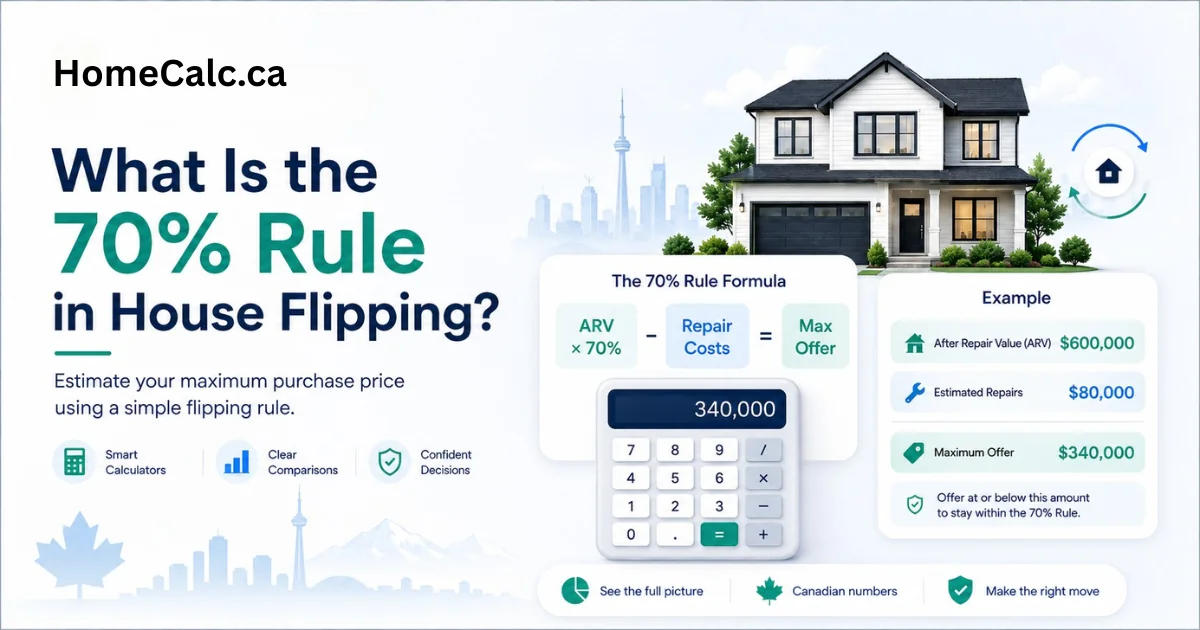
The house flipping formula is: Maximum Purchase Price = (ARV × 0.70) − Renovation Costs. ARV is the property's estimated value after all renovations are complete. The 30% buffer accounts for transaction costs, carrying costs (mortgage, taxes, insurance), real estate commissions on sale (~5%), and your target profit. Skipping this buffer is the most common reason first-time flippers lose money.
The Formula at a Glance
How to Apply the 70% Rule in House Flipping
Follow these five steps — the text below matches the structured HowTo data (JSON-LD) on this page. Verify your numbers with the 70% rule calculator before you bid.
Step 1 — Estimate the After-Repair Value (ARV)
Pull comparable sales of renovated properties in the same neighbourhood sold within the past 90 days. Use the median of 3–5 comps, not the highest sale. Overestimating ARV by $50,000 on a $600K property reduces your profit buffer by the same amount.
Step 2 — Estimate total renovation costs
Get contractor quotes for all planned work. Add a 15% contingency buffer to whichever quote you use. Beginners consistently underestimate renovation costs by 20–30% — a $60,000 renovation without contingency that runs $75,000 erases a significant portion of projected profit.
Step 3 — Multiply ARV by 0.70
Multiply your ARV estimate by 0.70 (or 0.65 in Toronto and Vancouver). Example: $600,000 × 0.70 = $420,000. This is the maximum amount available to cover renovation costs, all other purchase and selling costs, and your profit margin.
Step 4 — Subtract renovation costs
Subtract your total renovation cost estimate (including contingency) from the Step 3 result. Example: $420,000 − $80,000 = $340,000. This is your maximum purchase price.
Step 5 — Compare result to asking price
If the asking price is at or below your maximum purchase price, the deal passes the 70% rule. If the asking price is above your maximum, the deal fails — every dollar above the ceiling comes directly out of your profit margin.
Breaking Down Each Variable
ARV (After-Repair Value) is the estimated market value of the property after your renovations are complete — based on what comparable renovated homes have actually sold for nearby, not the current listing price. To find ARV, use comparable sold prices (comps) of similar properties within 500 metres, similar bed and bath count, sold in the last 90 days. Sold prices only — list prices are irrelevant.
Renovation Costs mean the full cost of all planned work: contractor labour, materials, permits, project management, and a 15% contingency buffer. Beginners consistently underestimate renovation costs by 20–30%. An $80,000 renovation that runs $96,000 changes your maximum purchase price — and your deal profitability — by the same $16,000.
What the 30% Buffer Covers
The 30% of ARV left after your maximum offer is reserved to cover: land transfer tax (Ontario provincial LTT ~$8,475 on a $600K purchase; Toronto adds Municipal MLTT on top), legal fees on both purchase and sale, carrying costs during the hold period (mortgage interest, property tax, insurance, utilities), agent commissions on sale (~5% of sale price), staging costs, and your target profit margin. In mid-sized Canadian markets, 30% is sufficient. In Toronto and Vancouver, LTT and carrying costs on high-priced properties consume enough of that buffer to justify dropping to 65%.
70% Rule Example: How to Calculate It
Example: A property has an ARV of $600,000 and needs $80,000 in renovations. Maximum offer = ($600,000 × 0.70) − $80,000 = $420,000 − $80,000 = $340,000. If the property is listed at $380,000, the deal fails the 70% rule and should be passed unless your renovation estimate is conservative enough to absorb the gap.
Example 1 — Deal That Passes the Rule
ARV: $600,000. Renovation cost (with 15% contingency): $80,000. Max offer = ($600,000 × 0.70) − $80,000 = $340,000. Asking price: $310,000. The deal passes with $30,000 of buffer below the ceiling — enough margin to absorb minor cost overruns or a slightly softer sale price.
Example 2 — Deal That Fails the Rule
Same ARV ($600,000) and renovation cost ($80,000) — max offer remains $340,000. Asking price: $380,000. The deal fails by $40,000. Paying $380,000 means you've already consumed $40,000 of your 30% buffer before renovation starts. In a flat or declining market you may not recover costs.
| Scenario | ARV | Reno Cost | Max Offer (70%) | Ask Price | Verdict |
|---|---|---|---|---|---|
| Strong deal | $600,000 | $80,000 | $340,000 | $310,000 | PASS — $30K buffer |
| Borderline deal | $600,000 | $80,000 | $340,000 | $340,000 | PASS — no margin |
| Failed deal | $600,000 | $80,000 | $340,000 | $380,000 | FAIL — $40K over limit |
Formula: Max Offer = (ARV × 0.70) − Renovation Costs. Adjust to 0.65 for Toronto/Vancouver.
What to Do When a Deal Doesn't Pass
Walk away or renegotiate. If the seller's asking price is $20,000–$30,000 above your maximum offer, a negotiated price reduction or a revised renovation scope (if the estimate was conservative) may bring the deal inside the threshold. If the gap is larger — $50,000+ — the deal almost certainly doesn't work unless your ARV estimate was deliberately conservative. Use the 70% rule calculator to model the impact of different asking prices, ARV estimates, and renovation budgets on your maximum offer.
What Is ARV (After-Repair Value)?
ARV — After-Repair Value — is the estimated market price of a property after all planned renovations are complete. It is calculated using comparable sales (comps) of similar renovated properties in the same neighbourhood within the past 90 days. ARV is the most important variable in the 70% rule formula; overestimating it is the leading cause of unprofitable flips.
How to Estimate ARV Accurately
Pull 3–5 comparable sold properties: within 500 metres of the target, similar square footage, same bed and bath count, sold within the last 90 days, and in renovated condition (not distressed sales). Use the median, not the highest comp. Your real estate agent can pull these comps from MLS data. In smaller markets with thin comparable data, widen the search radius or time window — and apply a lower threshold (65%) to compensate for higher ARV uncertainty.
Common ARV Mistakes
The most common ARV mistakes: (1) using list prices instead of sold prices — list prices reflect seller expectations, sold prices reflect market reality; (2) using the highest comp instead of the median — the highest sale is an outlier, not the baseline; (3) comparing unrenovated properties to your post-renovation ARV — comps must be in renovated condition; (4) ignoring neighbourhood variance — a sold price 600 metres away in a different school zone or across a major road may not be a valid comp. A $50,000 ARV overestimate on a $600K property effectively funds a $35,000 reduction in your maximum offer that you didn't plan for.
When to Adjust the 70% Rule
The 70% rule is a starting point, not a fixed law. Experienced flippers adjust the threshold based on market conditions: 65% in slower or higher-risk markets, 75% in hot markets with low days-on-market and strong comparable sales. The rule also needs adjustment for higher carrying costs, expensive renovations, or thin comparable data.
When to Use 65% Instead of 70%
Use 65% when: purchase prices are high (Toronto, Vancouver) and land transfer tax consumes a larger share of the 30% buffer; the market has softened and days-on-market have extended (adding carrying costs); renovation cost certainty is low (older property, limited pre-offer contractor access); or comparable sales data is thin (rural or unique properties). In smaller Ontario cities post-2022 correction, the 65% threshold gives a meaningful additional safety margin against market softness.
When Experienced Flippers Stretch Above 70%
Stretching to 72–75% may be justified when: the market is highly competitive with low days-on-market and multiple offers (your ARV estimate is conservative and well-supported); the renovation scope is highly predictable (cosmetic-only, recent contractor quotes, no structural unknowns); or the property has a unique characteristic that meaningfully increases ARV beyond the comp set. Edmonton is a common example — lower purchase prices plus no provincial LTT mean the 30% buffer goes further at the same absolute dollar amount.
Adjusting for Canadian Market Conditions
| Threshold | When to Apply | Example Market Condition |
|---|---|---|
| 65% | Slower markets, high carry cost, uncertain comps | Smaller Ontario cities post-2022 correction |
| 70% | Standard balanced market | Most Canadian mid-size cities |
| 75% | Hot market, low DOM, strong comps | Competitive bidding environments |
| Custom | Unusual renovation scope or thin comp data | Rural properties, unique assets |
Sources: Ontario land transfer tax calculation rules; Government of BC — BC Home Flipping Tax
Limitations of the 70% Rule in Canada
The 70% rule is a fast screen, not a guarantee. Four material limitations apply to Canadian flippers specifically.
The 70% Rule Doesn't Include Tax
It Doesn't Account for Taxes (Business Income vs. Capital Gains)
The 30% buffer is designed to cover transaction costs and profit — it is not sized to absorb CRA business income tax. For most flippers, flip profits are taxed as business income at 100% of the marginal rate — in Ontario the top combined marginal rate reaches 53.53% once the provincial surtax is included, though only the portion of income that falls in the top bracket is taxed at that rate. A deal showing $80,000 gross profit under the 70% rule can therefore yield substantially less after tax, depending on your other income. Model your after-tax return before committing to any deal. See taxes on house flipping in Canada for the full breakdown, and use the house flip tax calculator to estimate your CRA obligation.
It Ignores Land Transfer Tax on Purchase
Ontario's Land Transfer Tax is paid at purchase and is non-refundable — it comes directly out of your capital before renovation starts. On a $340,000 purchase, Ontario LTT is $3,575. In Toronto, Municipal MLTT adds a nearly identical amount. These costs reduce your effective profit before a single dollar of renovation is spent, and the 70% rule's 30% buffer must absorb them. In high-cost markets where LTT is proportionally larger, this is one of the primary reasons to use 65% instead of 70%.
ARV Accuracy Depends on Local Comparable Data Quality
The 70% rule is only as accurate as the ARV you feed it. In data-rich markets (Toronto, Ottawa), 3–5 strong comps are usually available within 90 days. In smaller cities, rural areas, or for unique property types, comparable data may be sparse — forcing wider search windows that introduce more market variance into the ARV estimate. When comp data quality is low, reduce your threshold to 65% or lower to compensate for the additional uncertainty. For a full cost model beyond the screen, use the house flipping calculator and see how much it costs to flip a house in Ontario.
70% Rule vs. Other House Flipping Formulas
Three tools do the same job at different levels of precision. Use the 70% or 65% rule to decide which deals are worth investigating further. Use the MAO formula or a full deal model to set your final bid price on deals that pass the initial screen.
Maximum Allowable Offer (MAO) — Same Formula, Different Name
The MAO (Maximum Allowable Offer) formula is more precise: MAO = ARV − Renovation Costs − Profit Target − Holding Costs − Closing Costs. The 70% rule bundles holding costs, closing costs, and profit into the 30% buffer. MAO separates every line item individually — more accurate but requires more data and time. Use MAO when you need an exact bid number on a deal that has already passed the 70% rule screen. For a full deal model, use the house flipping calculator.
The 65% Rule for Conservative Flippers
The 65% rule is identical in structure to the 70% rule — Max Offer = (ARV × 0.65) − Renovation Costs — with the percentage reduced to 35% buffer instead of 30%. The extra 5% is specifically sized to absorb higher land transfer tax in Toronto and Vancouver, longer holding periods in slower markets, and greater renovation cost uncertainty on larger properties. Investors may choose to test a lower threshold such as 65% where carrying costs, renovation uncertainty or transaction costs run higher — treat it as a sensitivity check on your own numbers rather than an established market standard.
When to Use Cap Rate Instead
Cap rate applies to income-producing properties held for rental — not flips. If you are evaluating whether a property is worth buying as a rental (rather than flipping), use the cap rate calculator and the methodology in how to calculate cap rate. If you are flipping and considering converting to a rental as a fallback exit strategy, model both scenarios — the 70% rule for the flip exit, cap rate for the rental fallback.
Frequently Asked Questions
- What is the 70% rule in house flipping?
- The 70% rule states that a house flipper should pay no more than 70% of a property's After-Repair Value (ARV) minus the estimated renovation costs. This reserves 30% of ARV to cover transaction costs, carrying costs, commissions, and profit.
- How do you calculate the 70% rule?
- Maximum Purchase Price = (ARV × 0.70) − Renovation Costs. Example: ARV $600,000, renovations $80,000 → max offer = ($600,000 × 0.70) − $80,000 = $340,000.
- Is the 70% rule accurate for Canadian real estate?
- The 70% rule is a useful starting point in Canada but often needs adjustment. In slower markets or where carrying costs are high, many investors use 65%. In competitive markets with strong comparable sales, some stretch to 75%. It also does not account for Canada's land transfer taxes or CRA business income treatment of flipping profits.
- What does ARV mean in house flipping?
- ARV stands for After-Repair Value — the estimated market price of a property after all planned renovations are complete. It is calculated using comparable sales of similar renovated properties sold nearby within the past 90 days.