Is Renting Really Throwing Money Away? (The Math)
By Hami Tahm · Last reviewed September 2026 · 7 min read
★ The Short Answer
No — and also: not entirely.
Renting is not throwing money away. But the phrase contains a grain of truth that proponents of renting often ignore.
The full answer requires running actual numbers — which is what this post does.
Part of our complete rent vs. buy guide for Canada.
"Renting is throwing money away." You've heard it from your parents, your coworkers, probably your bank. It's one of the most repeated pieces of financial advice in Canada — and one of the most misleading.
But here's the honest truth: the people who say renting is fine also sometimes oversimplify. The real answer is more nuanced than either side admits — and it depends entirely on the math, your city, and what you actually do with the money you're not spending on a down payment and mortgage.
This post runs the actual numbers. We'll look at what renters and homeowners really spend, what they really gain, and what the research actually says about who builds more wealth over 20 years.
Jump to:
What "Throwing Money Away" Actually Means
The argument goes like this: every dollar you pay in rent is gone. It builds no equity, gives you no asset, and disappears forever into your landlord's bank account. A mortgage, by contrast, builds equity — every payment converts into partial ownership of an appreciating asset.
This argument is correct, as far as it goes. Rent payments do not build equity. That part is indisputably true.
But the argument has a fundamental flaw: it compares rent (a pure housing cost) to a mortgage payment (which it treats as a pure investment) — and ignores the massive costs that come with homeownership that are just as 'thrown away' as rent.
The Hidden Costs Homeowners Also 'Throw Away'
Here's what the 'renting is wasting money' crowd never puts in their calculation. On a $660,000 home in Canada (close to the national average in 2026), here is what a homeowner pays that builds zero equity and will never be recovered:
| True "Sunk" Cost | Annual cost | Over 20 years |
|---|---|---|
| Mortgage interest (year 1 at 3.94%) | $18,864 | $162,000+ total (decreasing over time) |
| Property tax (1.0% of value) | $6,600/yr | $132,000+ (as home value grows) |
| Home insurance | $2,000/yr | $40,000 |
| Maintenance (1% rule) | $6,600/yr | $132,000 (some years $0, some $20K+) |
| Land Transfer Tax (Toronto, 1x) | $20,000 | $20,000 (paid once, never recovered) |
| Realtor commission when selling (4.5%) | $29,700 | $29,700+ (paid once when you sell) |
| TOTAL unrecoverable costs (owner, 20 yrs) | — | ~$515,000+ on a $660K Toronto home |
The Globe and Mail's Ben Felix has calculated "when you add up all those costs — property taxes, maintenance, and the cost of capital [the down payment] — the total unrecoverable costs of owning are about the same as rent." (Source: The Globe and Mail Stress Test, 2025)
In other words: homeowners also "throw away" money — just in different buckets than rent. The true unrecoverable cost of renting and the true unrecoverable cost of owning are closer than most people think.
The Real Math: Renter vs. Owner Wealth Over 20 Years
Let's do the actual comparison. Two people, same income, same starting point in March 2026:
- • Person A buys a $660,000 home in Toronto with 20% down ($132,000) at 3.94%, 25-year amortization.
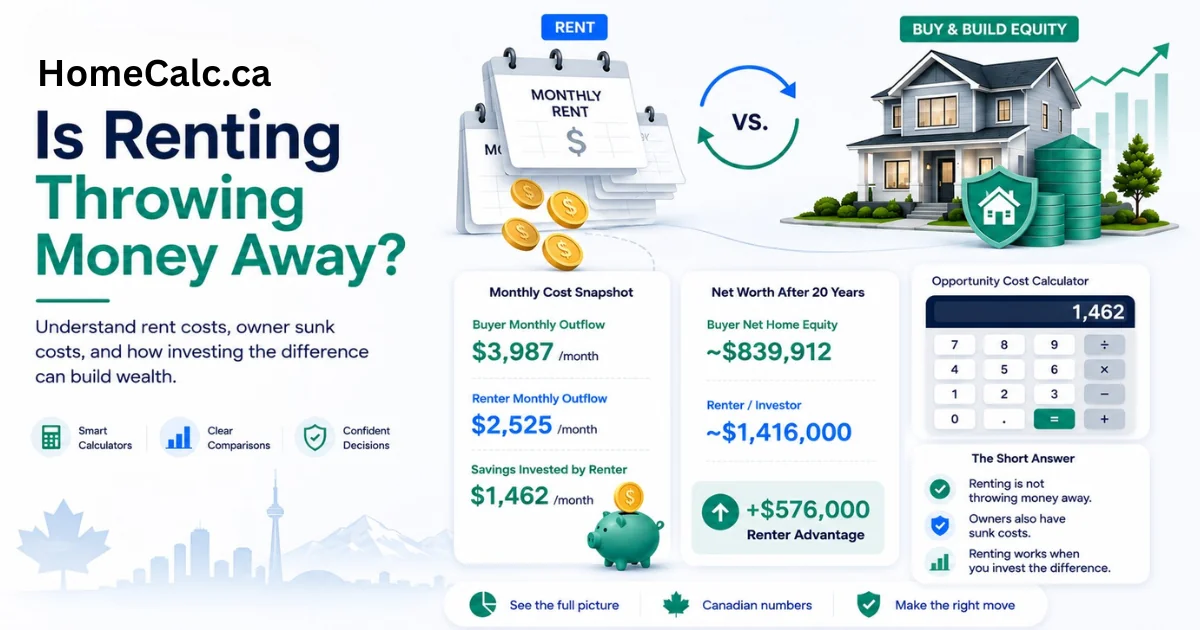
- • Person B rents a comparable unit for $2,500/month and invests the $132,000 down payment plus the monthly cash flow savings from renting ($3,987 − $2,525 = $1,462/month saved) in a diversified index fund at 7% annually.
| Person A — Buyer | Person B — Renter/Investor | |
|---|---|---|
| Starting capital | $132,000 (locked in down payment) | $132,000 (invested at 7%/yr) |
| Monthly cash outflow | $3,987 (mortgage + tax + ins. + maint.) | $2,525 (rent + renters insurance) |
| Monthly savings invested | $0 | $1,462/month (cash flow advantage) |
| Home value after 20 yrs | $1,193,625 (3%/yr appreciation) | N/A |
| Mortgage balance after 20 yrs | ~$300,000 remaining | N/A |
| Home equity after 20 yrs | ~$893,625 | N/A |
| Net of selling costs (4.5%) | −$53,713 | N/A |
| Net home equity (after selling) | ~$839,912 | N/A |
| Investment portfolio — DP growth | N/A | $132,000 → $511,116 at 7%/yr |
| Investment portfolio — monthly savings | N/A | $1,462/mo for 20 yrs → $905,000+ |
| Total net worth after 20 years | ~$839,912 | ~$1,416,000 |
Assumptions: Toronto market. Home appreciation 3%/yr. Index fund return 7%/yr (long-term S&P/TSX average). Rent increases 2.5%/yr. No CMHC insurance (20% down). Selling costs 4.5%.
★ What This Model Shows
In Toronto, the renter-investor wins significantly — by approximately $576,000 in net worth after 20 years — because the massive monthly cash flow advantage of renting ($1,462/month) compounds dramatically when invested consistently.
BUT: this assumes Person B actually invests the full $1,462/month every month for 20 years. This is where the model breaks down in practice.
The Ben Felix Analysis: What the Data Actually Shows
Ben Felix, portfolio manager at PWL Capital and co-host of The Rational Reminder podcast, published a landmark 2025 analysis of renting vs. buying using historical data for Canadian cities from 2005–2024. Here are the findings:
★ PWL Capital / Ben Felix — Renting vs. Buying Canada 2005–2024
• Toronto: A renter-investor ended with 37% MORE wealth than a homeowner over the 20-year period. (Source: PWL Capital / Physician Finance Canada, March 2026)
• Vancouver: A renter-investor ended with 12% LESS wealth than a homeowner. Why? Home appreciation in Vancouver was so extreme it outpaced market returns.
• Outside major cities: Results are mixed — in most markets, renting and investing is competitive with homeownership when consistently practised.
The key word: "when consistently practised."
Ben Felix to The Globe and Mail: "There is some academic research showing that owners are saving more than renters, even if you hold all else equal... renters do tend to have a little bit less wealth. And the theoretical reason is... there's a forced savings with homeownership that you don't have with renting." (Source: The Globe and Mail Stress Test, February 2025)
The gap between Toronto and Vancouver on one side and Calgary, Halifax, and Edmonton on the other isn't random — it tracks each city's price-to-rent ratio. See best cities to buy vs. rent in Canada for the full city-by-city breakdown.
What Renters Must Do to Build Comparable Wealth
The math favours renting and investing — but only if you actually invest. Here's the discipline required:
1. Automate investing from day one
Ben Felix's prescription: "I think a big thing is automation. You have to automate it. You have to pay yourself first." Set up automatic transfers to a TFSA or RRSP the day your rent comes out. Treat it like a mortgage payment — non-negotiable, automatic, every month.
2. Invest the full down payment immediately
The renter-investor math only works if the $132,000 down payment that Person B didn't lock up in a home goes directly into a diversified index fund the day they choose to rent instead of buy. Not a savings account. Not cash. Invested. The difference between 7% (invested) and 3% (high-interest savings) on $132,000 over 20 years is $383,000.
3. Never spend the monthly savings
The $1,462/month cash flow advantage of renting (in our Toronto example) is only valuable if it goes into investments — not lifestyle upgrades, not a nicer car, not more dining out. This is the single most common failure mode for would-be renter-investors. As BDO Debt Solutions notes: 'renters still need more discipline than homeowners do when it comes to taking those extra steps to ensure they're saving and building wealth outside of their homes.'
4. Use registered accounts aggressively
Renters in Canada have access to the same registered accounts as homeowners: TFSA ($7,000/year contribution room in 2026), RRSP (18% of previous year's income), and First Home Savings Account ($8,000/year, up to $40,000 lifetime) if you plan to buy eventually. A renter who maxes these accounts every year has significant tax-advantaged compounding working in their favour. The 5-Year Rule: Renting vs Buying
5. Have a plan for housing costs as you age
One real risk of lifelong renting in Canada: you're not protected from rent increases and potential displacement. The renter-investor strategy works best when paired with a long-term plan — whether that's eventually buying, moving to a lower-cost city, or accumulating enough investment wealth that housing costs become a smaller percentage of your portfolio income.
The Verdict: Is Renting Throwing Money Away?
✓ Renting is NOT throwing money away if:
• You invest the down payment and monthly savings consistently
• You're in Toronto or Vancouver where price-to-rent ratios exceed 35
• You plan to stay under 5 years (transaction costs destroy buying's advantage)
• Your income is variable or your financial situation is not yet stable
• You're using the flexibility to build career capital, explore cities, or save for a better down payment in a more affordable market
In these cases, renting is not a financial failure. It's often the smarter move.
✗ Renting IS effectively throwing money away if:
• You rent for years without investing the savings or down payment
• You could comfortably buy in a market with P/R ratio under 20 (Calgary, Edmonton, Halifax, Regina) and plan to stay 7+ years — but you don't
• You're spending the monthly cash flow savings on consumption instead of investing them
• You're renting indefinitely out of inertia or fear — not out of strategy
In these cases, the grain of truth in "renting is throwing money away" applies.
Not because renting is inherently bad — but because the alternative wealth-building path isn't being followed.
Bottom line: Whether renting is 'throwing money away' depends almost entirely on what you do with the money you're not locking into a home. Renting with a strategy is financially defensible — often superior. Renting without a strategy is the closest thing to the cliché that it's wasted money.
use our free rent vs. buy calculator
► Related Reading
full rent vs. buy guide — The complete rent vs. buy guide for Canada 2026
the 5-year rule explained — The 5-year rule: when buying finally beats renting
The 5-Year Rule: Renting vs Buying — How renters can build wealth: the complete guide
use our free rent vs. buy calculator — Run your personal rent vs. buy numbers
Should I buy a house in Canada right now? — Where the 2026 market stands before you decide
Canada Housing Benefit Guide — Provincial rental assistance still running (the one-time federal top-up closed in 2023)
Frequently Asked Questions
Disclaimer: This article is for informational and educational purposes only. It does not constitute financial, mortgage, or investment advice. All calculations use March 2026 market data and stated assumptions. Individual results will vary. Always consult a licensed financial advisor before making real estate or investment decisions.
Sources: PWL Capital / Ben Felix (2025) · The Globe and Mail Stress Test (February 2025) · Physician Finance Canada (March 2026) · BDO Debt Solutions · Tangerine (2025) · CMHC (2026) · Statistics Canada · Bank of Canada (March 18, 2026) · CREA (January 2026)