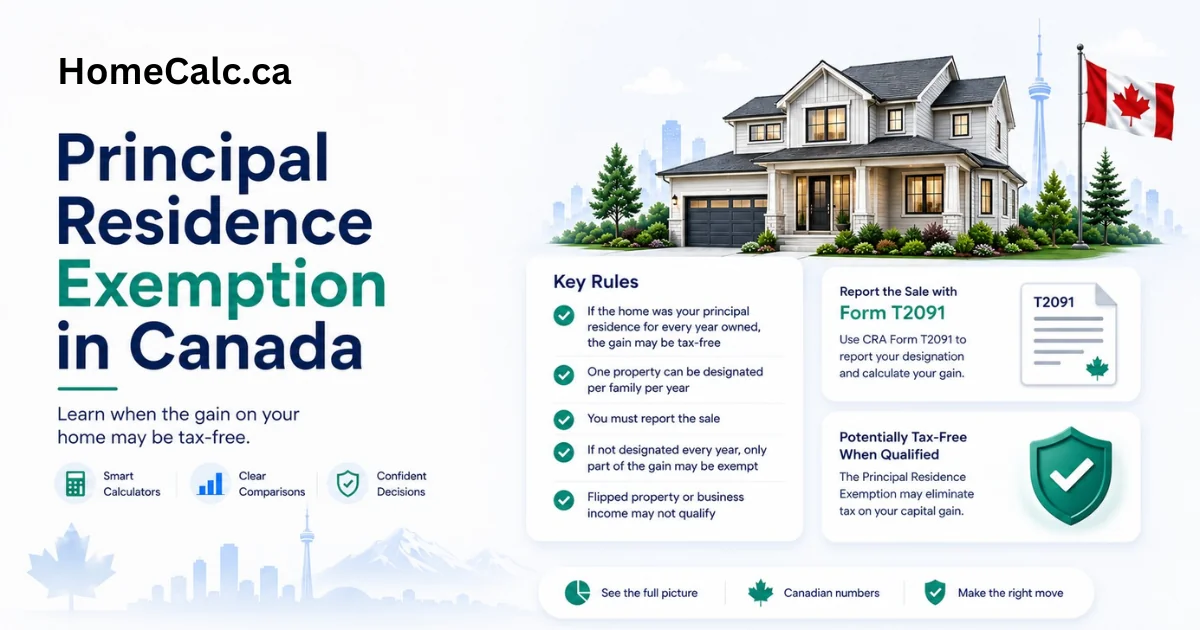
Does Selling Your Home Trigger Capital Gains Tax in Canada?
By Hami Tahm · Published April 2026 · Updated September 2026 · 8 min read
Does selling your home trigger capital gains tax in Canada?
Canada's principal residence exemption can shelter the entire capital gain when your home qualified as your principal residence for every year you owned it. Since the 2016 tax year, you must report every sale on Schedule 3 (with Form T2091 where required), even when the gain is fully exempt — failure to report can cause CRA to deny the exemption. If the property was only partly a principal residence, a partial exemption applies and tax is owing on the rest.
⚠️ Tax rules change — verify before you file
The principal residence exemption rules described here reflect CRA guidance as of April 2026. Exemption eligibility, reporting requirements, and change-in-use rules can be affected by your specific circumstances. This article is for informational purposes only and does not constitute tax advice. Consult a qualified Canadian tax professional before filing.
Key Takeaways
- Canada's principal residence exemption has no dollar cap — a $2 million gain on a qualifying home is fully tax-free, while a $50,000 gain on a rental property is fully taxable.
- The '+1' bonus year in the exemption formula prevents a double-taxation gap when Canadians sell one home and buy another in the same calendar year.
- Only one property per family unit can be designated as a principal residence per year — 'family unit' includes spouses, common-law partners, and unmarried children under 18.
- As of the 2016 tax year, all home sales must be reported on Schedule 3 even when the full gain is sheltered — an unreported sale can result in CRA denying the exemption.
- If you did not live in the property for every year you owned it, the partial exemption formula applies: exempt fraction = (designation years + 1) ÷ total ownership years.
What Is the Principal Residence Exemption?
The principal residence exemption (PRE) is a Canadian tax rule that lets homeowners shelter capital gains from income tax when they sell their home. Under the Income Tax Act, the exempt portion equals the gain multiplied by a fraction: the number of years the property was designated as your principal residence, plus one, divided by the total number of years you owned it. The "+1" bonus year is a CRA rule that allows overlap when switching between two properties.
Canada's principal residence exemption has no dollar cap — a $2 million gain on a qualifying home is fully tax-free, while a $50,000 gain on a rental property is fully taxable.
The exemption applies to capital gains only — it does not shelter rental income earned while you owned the property. The gain sheltered is the appreciation in value (sale price minus adjusted cost base minus selling costs), and when the property qualifies as your principal residence for every year you owned it, the entire gain is excluded from income. See CRA principal residence exemption rules.
The One-Plus Rule: Why You Can Own It for 9 Years and Claim 10
The '+1' bonus year in the exemption formula exists to prevent a double-taxation gap when Canadians sell one home and buy another in the same calendar year.
+1 Bonus Year — Plain Language
The formula adds 1 to your designation years because CRA recognizes you cannot physically live in two homes at once. If you sell your old home and buy a new one in the same calendar year, both properties would normally lose one year of designation. The "+1" ensures one of them keeps that year — preventing a taxable gap on every standard home purchase. You get the bonus regardless of whether you actually owned two properties simultaneously.
In practice this means that if you owned a property for exactly 9 years and designated it as your principal residence for all 9, the formula produces (9 + 1) ÷ 9 = 111%, which CRA caps at 100% — the full gain is exempt. The "+1" can never create a taxable gain.
What Counts as a "Residence"?
A principal residence can be any housing unit — a house, condominium, cottage, mobile home, or houseboat. It does not need to be your permanent or only home. CRA requires that the property be "ordinarily inhabited" by you, your spouse or common-law partner, or your child during the year. Courts have interpreted "ordinarily inhabited" broadly — seasonal use of a cottage generally qualifies, provided the property is actually occupied, not merely owned.
Who Qualifies for the Exemption?
To qualify for Canada's principal residence exemption, the property must be a housing unit — a house, condo, cottage, mobile home, or houseboat — ordinarily inhabited by you, your spouse, or your child during the year. Only one property per family unit can be designated as a principal residence per calendar year. A family unit includes you, your spouse or common-law partner, and your unmarried children under 18.
Reporting change since 2016
Before 2016, homeowners did not need to report the sale of a principal residence to CRA if the full gain was exempt. As of the 2016 tax year, you must report all home sales on Schedule 3 using Form T2091 (Designation of a Property as a Principal Residence), even if no tax is owed. Failure to report can result in CRA denying the exemption.
As of the 2016 tax year, the CRA requires all home sales to be reported on Schedule 3, even when the full capital gain is sheltered by the principal residence exemption — an unreported sale can result in the exemption being denied.
Eligibility Requirements
Four conditions must all be met for a year to count as a designation year: (1) you were a Canadian resident in that year; (2) you or a qualifying family member ordinarily inhabited the property; (3) you owned the property (sole or jointly); and (4) you have not designated another property for that same year. If any condition is not met for a given year, that year cannot be a designation year and the partial exemption formula reduces the exempt amount accordingly.
One Property Per Family Unit Per Year
Only one property per family unit can be designated as a principal residence per year — 'family unit' includes spouses, common-law partners, and unmarried children under 18.
This rule has practical consequences for families who own multiple properties. A couple who owns a city house and a cottage can only designate one of them as their principal residence for any given year. The gains on each accrue independently, but only the designated property earns exempt status for that year. Planning the designation strategy — which property to shelter first — can significantly affect the total tax owing when both properties are eventually sold.
How the Partial Exemption Formula Works
If you did not live in the property for every year you owned it, only part of the capital gain is exempt. The formula is: exempt fraction = (number of years designated as principal residence + 1) ÷ total years owned. Multiply your total capital gain by this fraction to get the exempt amount. The remaining gain is taxable and must be reported on Schedule 3. The "+1" in the numerator is a CRA rule that softens the transition between properties.
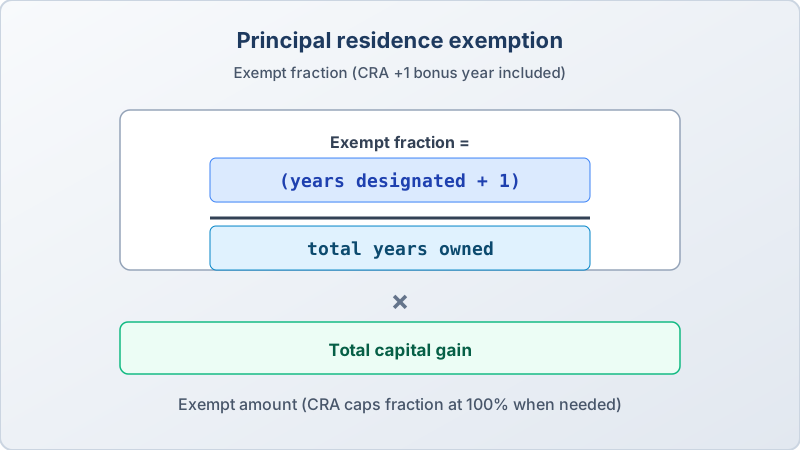
The Formula: (Years Designated + 1) ÷ Total Years Owned
Written out: Exempt fraction = (designation years + 1) ÷ ownership years. When the result exceeds 1 (i.e., 100%), CRA caps it at 100% — the gain is fully exempt. This cap applies whenever you designated the property for all or nearly all of your ownership years.
Worked Example: You Owned 10 Years, Lived There 6
4-Step Calculation
Step 1 — Calculate your total capital gain
Your total capital gain equals your proceeds of disposition minus your adjusted cost base (ACB) minus eligible selling costs. Proceeds of disposition is the sale price. ACB includes what you originally paid plus acquisition costs and capital improvements. Selling costs include real estate commissions and legal fees at sale. Example: sold for $900,000, ACB of $400,000, selling costs of $30,000 — total capital gain = $900,000 − $400,000 − $30,000 = $470,000.
Step 2 — Count your designation years
Count the number of calendar years you designated the property as your principal residence. A designation year is any year the property was your principal residence and you or a family member ordinarily inhabited it for part of the year. Using the example: you owned the property from January 2014 to December 2023 — 10 ownership years. You lived there from 2014 to 2019 — 6 designation years.
Step 3 — Apply the exemption fraction
Apply the partial exemption formula: exempt fraction = (designation years + 1) ÷ total ownership years. The '+1' is a CRA bonus year that prevents double-taxation when you buy and sell homes in the same calendar year. Example: (6 + 1) ÷ 10 = 0.70 — 70% of the gain is exempt. Exempt amount = $470,000 × 0.70 = $329,000. Taxable capital gain = $470,000 − $329,000 = $141,000.
Step 4 — Report the taxable remainder on Schedule 3
Report the taxable capital gain on Schedule 3 of your T1 return. You must also file Form T2091 (Designation of a Property as a Principal Residence). Apply the 50% capital gains inclusion rate: $141,000 × 50% = $70,500 is added to your income for the year. Use the HomeCalc capital gains tax calculator to estimate your province-specific tax owing on this amount.
For the taxable portion, the 50% capital gains inclusion rate applies — see how the inclusion rate applies to the taxable portion.
| Scenario | Ownership Years | Designation Years | Exempt Fraction | Taxable Portion of Gain |
|---|---|---|---|---|
| Full exemption — lived there entire ownership | 8 | 8 | (8+1)÷8 = 112.5% → capped at 100% | $0 — fully exempt |
| Partial — owned 10 yrs, lived there 6 | 10 | 6 | (6+1)÷10 = 70% | 30% of gain taxable |
| Zero — investment property, never inhabited | 10 | 0 | 0÷10 = 0% | 100% of gain taxable |
When the exempt fraction exceeds 1, CRA caps it at 100% — the full gain is exempt. "Taxable portion" is the capital gain before applying the 50% inclusion rate.
Cottages, Vacation Properties, and the Exemption
A cottage or vacation property can qualify as a principal residence in Canada — but only one property per family unit per year can be designated. If you designate your cottage for certain years, your city home loses the exemption for those same years. The decision only matters if both properties have significant unrealized gains. CRA requires you to weigh which property has the larger accrued gain before deciding which to designate for each year of dual ownership.
Can a Cottage Be a Principal Residence?
A cottage qualifies for the principal residence exemption only if it was ordinarily inhabited — CRA's position is that seasonal use meets the 'ordinarily inhabited' test, but the property must actually be used, not merely owned.
A cottage used only for storage, or a vacation property that sits vacant year-round without personal use, does not meet the "ordinarily inhabited" test. There is no minimum number of days CRA specifies — courts have found that even a few weeks of personal use per year can qualify, provided the use is genuine personal habitation.
Designating the Cottage vs. the City Home
When you own both a city home and a cottage, the optimal designation strategy depends on which property has the higher accrued gain per year. If the cottage has appreciated significantly while the city home has appreciated more modestly, you may benefit from designating the cottage for some years. A qualified tax professional can model both scenarios. Once both properties are eventually sold, the designation choices made over the years are locked in — you cannot retroactively change them.
Common Situations and Edge Cases
Renting out part of your home does not automatically disqualify the principal residence exemption, but it may limit it. CRA applies a "change in use" rule: if you convert part of your home to a rental, only the portion you inhabit qualifies for the exemption. Moving out before you sell triggers a deemed disposition at fair market value on the date you stop using the property as your principal residence — not on the date of sale.
Renting Out Part of Your Home
Renting out a basement suite or single room generally does not disqualify the exemption if the predominant use of the property remains personal. CRA looks at whether the rental changes the character of the property. Key test: is the home primarily a residence with incidental rental income, or has it been converted into an income-earning property? See CRA — Change in Use rules .
⚠️ CCA Claim Warning — Triggers Change in Use
If you claim capital cost allowance (CCA) on the rental portion of your home, CRA treats this as a change in use — and the change-in-use rules apply to the entire property, not just the rental room. Once CCA is claimed, you cannot use the Section 45(2) election to defer the deemed disposition. Consult a tax professional before claiming CCA on any portion of your principal residence.
Moving Out Before You Sell
The Section 45(2) election allows a homeowner who moves out to continue treating the property as a principal residence for up to four additional years — but only if no other property is designated and no CCA is claimed.
Without a Section 45(2) election, moving out triggers a deemed disposition at the fair market value on the date you vacate. The gain from the date of acquisition to the date of move-out is sheltered by the principal residence exemption for the years you designated; the gain from move-out to eventual sale is fully taxable. See ITA Section 45(2) election.
Inherited Property and Deemed Disposition
When a homeowner dies, CRA deems a disposition of all capital property at fair market value immediately before death. The principal residence exemption can be claimed on the deceased's final T1 return for the years the property was their principal residence. Inheriting a property does not automatically allow the heir to use the deceased's designation years — the heir begins a new ownership period from the date of inheritance at the stepped-up ACB (the fair market value at the time of inheritance). House flips, by contrast, do not qualify for the principal residence exemption when reclassified as business income under the CRA anti-flipping rule.
▶ Estimate your capital gains tax on a partial exemption
- Open Capital Gains Tax CalculatorEnter your sale price, ACB, designation years, and province. The calculator applies the confirmed 50% inclusion rate to your taxable portion.
Frequently Asked Questions
Sources
- 1. Canada Revenue Agency — CRA principal residence exemption rules (Accessed April 2026)
- 2. Canada Revenue Agency — Form T2091 — Designation of a Property as a Principal Residence (Accessed April 2026)
- 3. Canada Revenue Agency — Change in Use rules (Accessed April 2026)
- 4. Government of Canada, Department of Justice — ITA Section 45(2) election (Accessed April 2026)