Canada's Capital Gains Inclusion Rate: 50% or 66.67%?
By Hami Tahm · Last reviewed July 2026 · 9 min read
What is the capital gains inclusion rate in Canada?
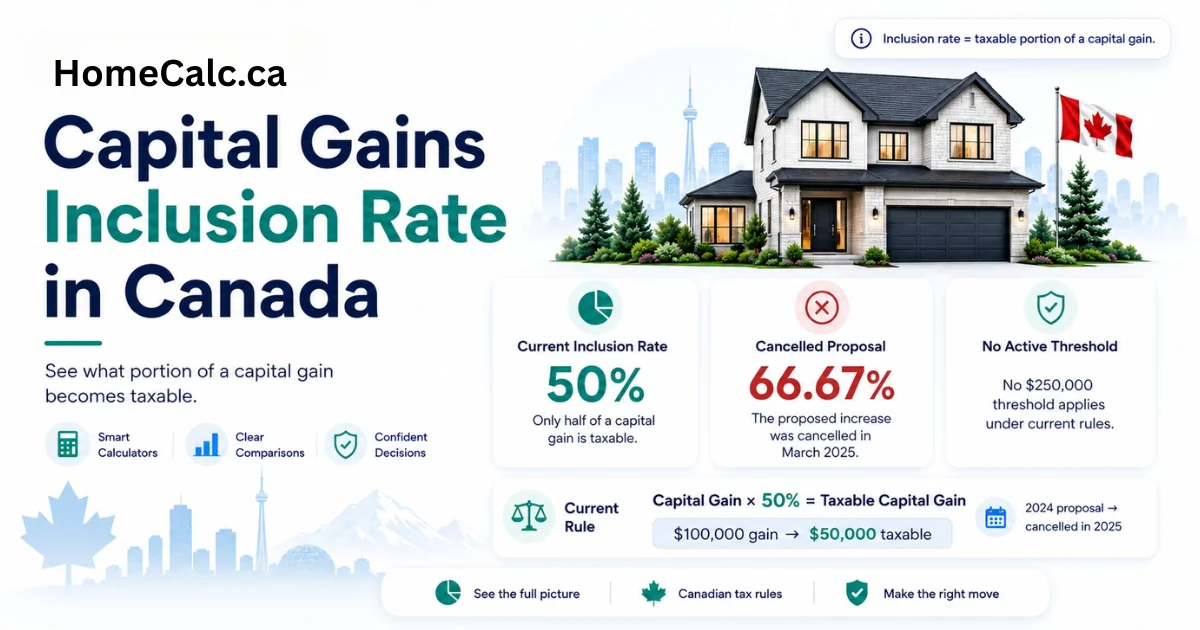
Canada's capital gains inclusion rate is the fraction of a capital gain that gets added to your taxable income. Since 1990, that fraction has been 50%: if you sell a property for a $100,000 gain, only $50,000 is taxable. Your marginal income tax rate is then applied to that $50,000. The rate itself does not equal your tax bill — your bracket does.
⚠️ Tax rules change — verify before you file
The 2024 federal budget proposed raising Canada's capital gains inclusion rate from 50% to 66.67% on individual gains above $250,000. The Government of Canada cancelled this proposal on March 21, 2025 — the 50% rate remains in effect. Always confirm the current rate at canada.ca or with a qualified tax professional before calculating your tax liability. This article reflects rules as of July 2026.
Key Takeaways
- Canada's capital gains inclusion rate is 50% — only half of any capital gain is added to taxable income; the other half is tax-free.
- Canada's inclusion rate has been 50% since February 1994, when it was lowered from 75% under Finance Minister Paul Martin.
- The 2024 federal budget proposed raising the rate to 66.67% on individual gains above $250,000 — but the Government of Canada cancelled this proposal on March 21, 2025. The 50% rate remains in effect.
- Ontario's top marginal rate of 53.53% applied to a 50% inclusion produces an effective capital gains tax rate of approximately 26.77% — not 53.53%.
- The principal residence exemption eliminates capital gains tax entirely on a qualifying home sale — regardless of the inclusion rate.
What Is the Capital Gains Inclusion Rate?
The capital gains inclusion rate determines how much of a capital gain is counted as income for tax purposes. Canada's rate has been 50% since 1990. A 50% inclusion rate means half your gain is taxable; the other half is tax-free. The rate applies to all capital property — stocks, investment real estate, and cryptocurrency — unless a specific exemption applies, such as the principal residence exemption.
The 50% Rule Explained
Canada's capital gains inclusion rate has been 50% since February 1994, when Finance Minister Paul Martin lowered it from 75%.
The mechanics are straightforward. When you sell a capital asset — an investment property, stocks, a cottage — for more than you paid, the difference is your capital gain. The inclusion rate determines what fraction of that gain enters your taxable income. At 50%, only half the gain is taxable; the other half is permanently excluded. There is no deduction to claim and no form to file for the excluded half — it simply does not count as income.
For a detailed step-by-step walkthrough of the full calculation — including ACB and selling costs — see our step-by-step capital gains tax calculation guide.
Inclusion Rate vs. Capital Gains Tax Rate — Not the Same Thing
The inclusion rate is not your tax rate. Canada has no separate flat capital gains tax rate. The inclusion rate controls how much of your gain enters taxable income; your combined federal and provincial marginal rate then taxes that included amount. The two figures multiply together to produce your effective rate on the total gain.
Example: Ontario's top combined marginal rate is 53.53%. But that rate applies only to the included 50%, producing an effective capital gains rate of 53.53% × 50% = 26.77% on the full gain — not 53.53%. This is one of the most widely misunderstood aspects of Canadian capital gains tax. Use our capital gains tax calculator to see your effective rate by province.
What Did the 2024 Federal Budget Propose?
Canada's 2024 federal budget proposed raising the capital gains inclusion rate from 50% to 66.67% (two-thirds) on gains above $250,000 per year for individuals, effective June 25, 2024. For corporations and trusts, the 2/3 rate would apply to all capital gains with no threshold. The proposal also included a $250,000 annual threshold for individuals below which the 50% rate would still apply.
The 66.67% Proposal Above $250K for Individuals
Under the 2024 federal budget proposal, individuals with capital gains above $250,000 in a single year would have paid tax on 66.67 cents of every dollar gained — up from 50 cents — but the Government of Canada cancelled this proposal on March 21, 2025.
The proposed threshold was per-year, not per-property. An individual with two properties generating $200,000 in gains each in the same calendar year would have had $150,000 of the combined $400,000 gain subject to the 66.67% rate in the original proposal ($400,000 − $250,000 = $150,000 above threshold). All of this is now moot — the proposal was cancelled.
Source: 2024 federal budget announcement .
Corporations and Trusts: 2/3 Rate With No Threshold
Corporations and trusts have no $250,000 threshold; the proposed 2/3 inclusion rate would have applied to their first dollar of capital gain, but the proposal was cancelled before becoming law.
The proposed corporate rate change had significant implications for holding companies and real estate corporations. Under current law, corporations remain at the 50% inclusion rate. See CRA capital gains inclusion rate guide for the full legislative record. For information on the Lifetime Capital Gains Exemption applicable to certain qualifying property, see CRA lifetime capital gains exemption rules.
What Is the Inclusion Rate Status in 2025–2026?
Canada's capital gains inclusion rate is 50% for all individuals for the 2025 tax year and 2026. The Liberal government that tabled the 2024 budget fell before the Ways and Means Motion received Royal Assent. On March 21, 2025, the Government of Canada officially cancelled the proposed inclusion rate change. The 50% inclusion rate applies to all capital gains for individuals, with no threshold.
✓ Legislative status confirmed — March 21, 2025
The Liberal government that tabled Budget 2024 fell before the Ways and Means Motion received Royal Assent. On March 21, 2025, the Government of Canada officially cancelled the proposed capital gains inclusion rate change. The 50% inclusion rate applies to all capital gains for individuals for the 2025 tax year and beyond, with no $250,000 threshold. Source: Government of Canada — Department of Finance, March 21, 2025.
Government Fell — The Bill Did Not Become Law
The 2024 federal budget proposed the inclusion rate change to take effect for dispositions occurring on or after June 25, 2024. However, because the Ways and Means Motion — the required legislative mechanism — never received Royal Assent before the government fell, the change never became law. No retroactive filing is required; individuals who disposed of capital property in the second half of 2024 report gains at the 50% inclusion rate for the full year.
What Taxpayers Should Assume Right Now
For the 2024, 2025, and 2026 tax years: apply the 50% inclusion rate to all capital gains, regardless of amount. There is no $250,000 threshold in effect, no tiered rate, and no transitional rules for pre- vs. post-June 2024 dispositions. Do not use 66.67% in any capital gains calculation for individuals. If CRA guidance changes, this page will be updated.
How Tax Brackets Interact With Capital Gains
Capital gains are not taxed at a flat rate in Canada. Instead, the included portion of your gain is stacked on top of your other income and taxed at your marginal rate. If your regular income puts you in Ontario's 53.53% top bracket, you pay 53.53% on the included capital gain — not on the full gain. A 50% inclusion rate in that bracket produces an effective capital gains tax rate of approximately 26.77%.
Your Marginal Rate Is Applied to the Included Amount
The stacking effect is important to understand. Your employment income, rental income, and other sources are calculated first. Your taxable capital gain — the 50% included amount — is then added on top. If that pushes you across a bracket threshold partway through the gain, part of the taxable capital gain is taxed at a lower rate and part at a higher rate. The full capital gains calculation must be done in the context of your total income for the year.
Worked example: $80,000 employment income + $185,000 capital gain. Apply 50% inclusion: $92,500 taxable capital gain. Total income = $172,500. In Ontario at approximately 46.41% combined marginal rate at that income level, estimated capital gains tax ≈ $92,500 × 46.41% ≈ $42,929. Use our capital gains tax calculator to run these numbers for your province and income.
Effective Capital Gains Tax Rates by Province
Ontario's combined federal-provincial top marginal rate of 53.53% means a 50% inclusion rate produces an effective capital gains rate of approximately 26.77% on gains above the top bracket threshold.
Had the 66.67% inclusion rate been enacted, that same Ontario top-bracket taxpayer would have faced an effective capital gains rate of approximately 35.69% on the included portion above $250,000.
| Province | Top Marginal Rate | Effective Rate at 50% | Effective Rate at 66.67% (proposed — cancelled) |
|---|---|---|---|
| Ontario | 53.53% | ~26.77% | ~35.69% |
| British Columbia | 53.96% | ~26.98% | ~35.97% |
| Alberta | 48.00% | ~24.00% | ~32.00% |
| Quebec | 53.31% | ~26.66% | ~35.54% |
| Nova Scotia | 54.00% | ~27.00% | ~36.00% |
Source: Canada Revenue Agency. Rates are indicative; actual rates depend on total income and applicable credits.
Impact on Real Estate and Investment Property
The capital gains inclusion rate applies when you sell investment real estate at a profit — rental properties, cottages, vacant land, and house flips. Your principal residence is fully exempt from capital gains tax regardless of the inclusion rate. For non-exempt property, the inclusion rate determines how much of the profit enters your taxable income; your province and federal marginal rate then determines the actual tax owed.
Principal Residence — When Capital Gains Are Exempt
The principal residence exemption operates before the inclusion rate is applied — a qualifying home sale produces a $0 taxable gain regardless of whether the rate is 50% or 66.67%. For full eligibility rules and the partial exemption formula, see how the principal residence exemption is unaffected by inclusion rate changes (sheltering applies first).
PRE Is Not Affected by Inclusion Rate Changes
The principal residence exemption eliminates capital gains tax on your home entirely — regardless of the inclusion rate. The exemption is applied before the inclusion rate, zeroing out the taxable gain. Whether the rate is 50% or any other figure, a home that qualifies as your principal residence for every year of ownership produces $0 in capital gains tax. You must still report the sale to CRA on Schedule 3 since 2016.
If you rented the property for part of your ownership period, only the years it was designated your principal residence are fully exempt. The exemption is prorated and the non-exempt gain is subject to the inclusion rate. See CRA Line 12700 taxable capital gains.
Rental Properties, Cottages, and Flips
Rental properties, cottages, and vacant land are fully subject to the 50% inclusion rate with no principal residence exemption. Capital cost allowance (CCA) recapture — if you claimed depreciation on a rental property — is taxed as regular income at 100% inclusion in addition to the capital gain, which is taxed at 50%.
House flips sold within 12 months of purchase are reclassified as business income under the CRA anti-flipping rule — the full profit is taxable at 100% inclusion (your marginal rate), with no 50% exclusion and no principal residence exemption. For the full tax treatment of a flip, see house flipping tax rules in Canada, or use the house flip tax calculator.
▶ Calculate your capital gains tax by province
- Open Capital Gains Tax CalculatorEnter your sale price, ACB, and province. The calculator applies the confirmed 50% inclusion rate and 2026 combined marginal rates — no 66.67% anywhere.
Frequently Asked Questions
Sources
- 1. Canada Revenue Agency — Line 12700 — Taxable capital gains (Accessed April 2026)
- 2. Government of Canada, Department of Finance — Budget 2024 federal announcement (Accessed April 2026)
- 3. Canada Revenue Agency — CRA capital gains inclusion rate guide (Accessed April 2026)
- 4. Canada Revenue Agency — CRA lifetime capital gains exemption rules (Accessed April 2026)